Introduction
Thank you for reading this post, don’t forget to subscribe!American poetry is not merely an artistic tradition—it is a mirror of the nation’s conscience, struggles, dreams, and transformations. From the transcendental musings of the 19th century to the raw confessions and civil rights voices of the 20th century, American poets have chronicled history while shaping it.
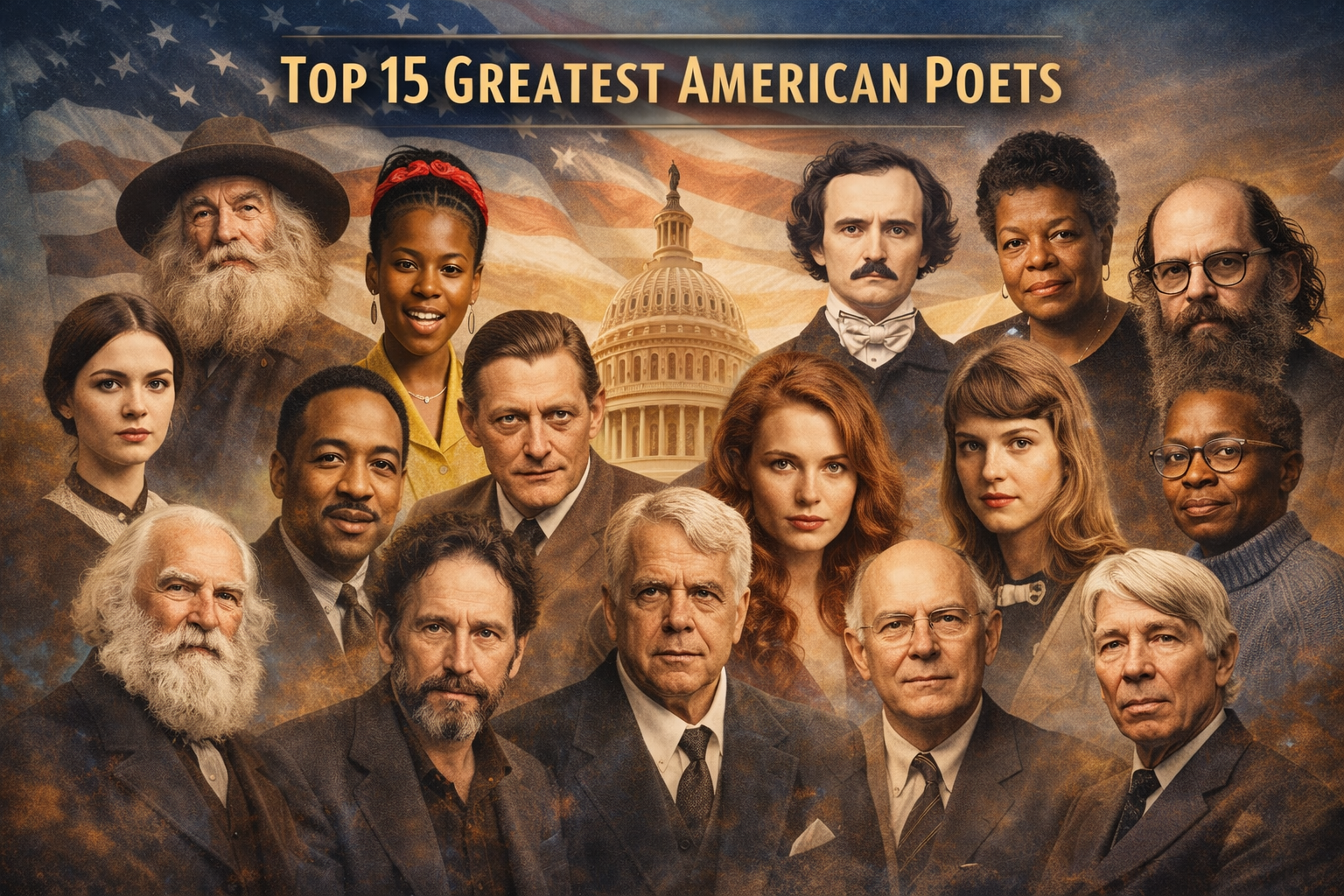
This blog presents the Top 15 Poets of the United States of America of all time, selected for their literary excellence, cultural influence, originality, and lasting impact on American and world literature. Alongside their famous works, we explore their themes, messages, and role in the evolution of American poetry.
The Evolution of American Poetry (Brief Overview)
American poetry evolved through several phases:
- Early National & Transcendentalist Era (19th century)
- Romanticism & Realism
- Modernism (early 20th century)
- Confessional & Beat Movements
- Civil Rights & Contemporary Voices
Unlike European poetry, American poetry emphasized individualism, democracy, nature, social justice, and personal freedom, reflecting the nation’s evolving identity.
1. Walt Whitman (1819–1892)
Father of American Free Verse
Famous Works:
- Leaves of Grass (1855)
- Song of Myself
- O Captain! My Captain!
Themes & Message:
Whitman celebrated democracy, the human body, sexuality, nature, and the common man. He broke away from traditional poetic forms, inventing free verse that revolutionized poetry.
Contribution:
He gave American poetry its distinct voice, independent of European traditions.
2. Emily Dickinson (1830–1886)
The Poet of Inner Life
Famous Works:
- Because I could not stop for Death
- Hope is the thing with feathers
- I’m Nobody! Who are you?
Themes & Message:
Death, immortality, nature, love, and isolation. Her poems are compact yet philosophically profound.
Contribution:
Dickinson reshaped poetic expression through unconventional punctuation, slant rhyme, and psychological depth.
3. Edgar Allan Poe (1809–1849)
Master of the Macabre and Musical Verse
Famous Works:
- The Raven (1845)
- Annabel Lee
- To Helen
Themes & Message:
Death, madness, loss, beauty, and the supernatural.
Contribution:
Poe influenced Symbolism and modern psychological poetry while pioneering gothic aesthetics.
4. Robert Frost (1874–1963)
Poet of Rural America
Famous Works:
- The Road Not Taken
- Stopping by Woods on a Snowy Evening
- Mending Wall
Themes & Message:
Nature, choices, human relationships, and moral dilemmas.
Contribution:
Frost combined traditional form with philosophical depth, making poetry accessible yet profound.
5. Langston Hughes (1901–1967)
Voice of the Harlem Renaissance
Famous Works:
- The Negro Speaks of Rivers
- I, Too
- Let America Be America Again
Themes & Message:
Racial identity, African-American life, equality, and hope.
Contribution:
He brought Black voices and jazz rhythms into mainstream American poetry.
6. T.S. Eliot (1888–1965)
Architect of Modernist Poetry
Famous Works:
- The Waste Land
- The Love Song of J. Alfred Prufrock
- Four Quartets
Themes & Message:
Spiritual crisis, alienation, modern disillusionment.
Contribution:
Though British-American, Eliot transformed modern poetry with fragmented, intellectual verse.
7. Sylvia Plath (1932–1963)
Confessional Poetry Icon
Famous Works:
- Ariel
- Daddy
- Lady Lazarus
Themes & Message:
Mental illness, identity, feminism, death.
Contribution:
Plath brought emotional honesty and psychological intensity into poetry.
8. Allen Ginsberg (1926–1997)
Beat Generation Revolutionary
Famous Works:
- Howl
- America
- Kaddish
Themes & Message:
Anti-establishment views, spirituality, sexuality, political protest.
Contribution:
He challenged censorship and reshaped poetic performance and expression.
9. Maya Angelou (1928–2014)
Poet of Resilience and Empowerment
Famous Works:
- Still I Rise
- Phenomenal Woman
- And Still I Rise
Themes & Message:
Dignity, racial pride, womanhood, survival.
Contribution:
Angelou merged poetry with activism and global humanism.
10. Henry Wadsworth Longfellow (1807–1882)
America’s First Popular Poet
Famous Works:
- Paul Revere’s Ride
- The Song of Hiawatha
Themes & Message:
Patriotism, history, morality.
Contribution:
He popularized poetry among common readers in 19th-century America.
11. Ezra Pound (1885–1972)
Champion of Imagism
Famous Works:
- In a Station of the Metro
- The Cantos
Themes & Message:
Precision, imagery, cultural critique.
Contribution:
He mentored modernist poets and redefined poetic economy.
12. Carl Sandburg (1878–1967)
Poet of the American People
Famous Works:
- Chicago
- Fog
Themes & Message:
Urban life, labor, democracy.
Contribution:
He captured the voice of working-class America.
13. Wallace Stevens (1879–1955)
Philosopher-Poet
Famous Works:
- Sunday Morning
- The Idea of Order at Key West
Themes & Message:
Imagination, reality, perception.
Contribution:
He expanded poetry into philosophical inquiry.
14. Gwendolyn Brooks (1917–2000)
First Black Pulitzer Winner
Famous Works:
- We Real Cool
- Annie Allen
Themes & Message:
Urban Black life, youth, social justice.
Contribution:
She elevated everyday Black experiences into high poetry.
15. Amanda Gorman (1998– )
The Contemporary Voice of Hope
Famous Works:
- The Hill We Climb (2021)
- Call Us What We Carry
Themes & Message:
Unity, democracy, youth activism.
Contribution:
She represents the future of American poetry in the digital age.
Conclusion
American poetry is a living tradition—constantly evolving yet rooted in truth, resistance, and imagination. These 15 poets did not merely write poems; they shaped the moral, cultural, and emotional landscape of the United States.
Their voices continue to inspire readers across generations, proving that poetry remains one of humanity’s most powerful tools for understanding itself.
Leave a Reply