Introduction
Thank you for reading this post, don’t forget to subscribe!Since the dawn of civilization, humans have observed the Sun’s movement to measure time, plan agriculture, and understand nature. Two of the most important astronomical events in this journey are the Winter Solstice and the Summer Solstice. These events mark the shortest and longest days of the year, shaping seasons, weather patterns, cultural traditions, and even spiritual beliefs across the world—from India to Europe, the Americas, and East Asia.
What Is the Winter Solstice?
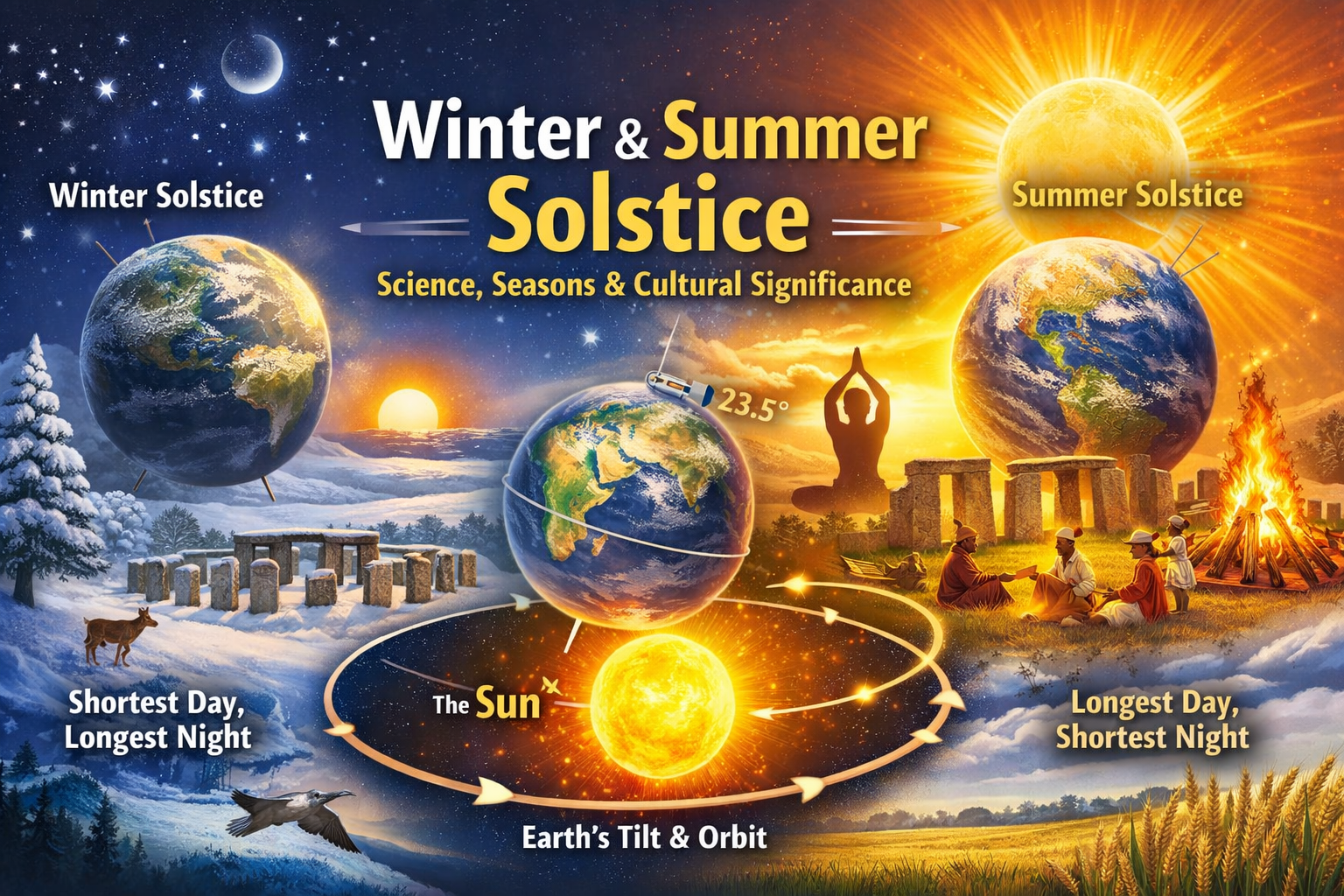
The Winter Solstice is the day when the Sun reaches its lowest position in the sky, resulting in the shortest day and longest night of the year in a given hemisphere.
When Does the Winter Solstice Occur?
- Northern Hemisphere:
21 or 22 December every year - Southern Hemisphere:
20 or 21 June
In India and most of the Northern Hemisphere, the Winter Solstice usually occurs on 21 December.
What Is the Summer Solstice?
The Summer Solstice is the day when the Sun reaches its highest position in the sky, producing the longest day and shortest night of the year.
When Does the Summer Solstice Occur?
- Northern Hemisphere:
20 or 21 June every year - Southern Hemisphere:
21 or 22 December
In India, the Summer Solstice typically falls on 21 June.
The Science Behind Solstices
The occurrence of solstices is purely astronomical and is explained by two fundamental facts:
1. Earth’s Axial Tilt
- Earth’s axis is tilted at approximately 23.5 degrees.
- This tilt causes different parts of Earth to receive varying amounts of sunlight throughout the year.
2. Earth’s Revolution Around the Sun
- As Earth orbits the Sun, the tilted axis causes the Sun’s rays to strike different hemispheres more directly at different times.
What Happens During Solstices?
- Summer Solstice: The hemisphere is tilted towards the Sun, receiving maximum daylight.
- Winter Solstice: The hemisphere is tilted away from the Sun, receiving minimum daylight.
Do Solstices Influence Weather, Climate, or Atmospheric Phenomena?
Weather
Solstices do not directly cause daily weather, but they:
- Set the boundary points of seasons
- Influence solar heating patterns
- Affect long-term temperature trends
Climate
Solstices play a crucial role in:
- Seasonal climate cycles
- Agricultural calendars
- Monsoon preparation phases (especially relevant in India)
Atmospheric Phenomena
Indirect effects include:
- Changes in jet stream patterns
- Altered pressure systems
- Seasonal fog, frost, heatwaves, and prolonged daylight effects in higher latitudes
Significance of Solstices
Astronomical Significance
- Mark the extreme points of Earth–Sun geometry
- Used historically to develop calendars and timekeeping systems
Agricultural Significance
- Help farmers plan sowing and harvesting cycles
- In ancient India, solstice knowledge guided Vedic agricultural practices
Ecological Significance
- Influence animal migration, hibernation, and plant life cycles
Cultural and Social Impact Across the World
In India
- Winter Solstice: Associated with Uttarayan (Sun’s northward journey)
- Celebrated through festivals like:
- Makar Sankranti
- Pongal
- Lohri
- Summer Solstice:
- International Yoga Day (21 June) highlights solar energy and wellness
- Ancient Indian yogic tradition considers it a powerful spiritual transition
Across the World
- Stonehenge (UK): Built to align with solstice sunrise
- Yule (Northern Europe): Winter Solstice festival symbolizing rebirth
- Inti Raymi (Inca Civilization): Celebrated the Sun God
- Dongzhi Festival (China): Marks winter solstice with family rituals
Why Solstices Still Matter Today
Even in the age of satellites and atomic clocks, solstices:
- Anchor modern calendars
- Influence tourism and cultural identity
- Shape global environmental awareness
- Connect humanity with cosmic rhythms
Conclusion
The Winter and Summer Solstices are more than astronomical milestones—they are deeply woven into human history, science, culture, and climate systems. They remind us that Earth is not isolated but part of a larger cosmic dance where even a slight tilt can shape civilizations, seasons, and survival.
Leave a Reply