Introduction
Thank you for reading this post, don’t forget to subscribe!Every year in December, when winter deepens in the Northern Hemisphere, the night sky offers a subtle yet fascinating celestial display known as the Ursid Meteor Shower. Though less dramatic than the Perseids or Geminids, the Ursids are scientifically important and occasionally surprise skywatchers with sudden outbursts.
This blog explains what the Ursid meteor shower is, why it is in the news, what meteors are, and how they differ from asteroids, planets, satellites, and other celestial bodies, while also uncovering the science behind meteor showers.
What Is the Ursid Meteor Shower?
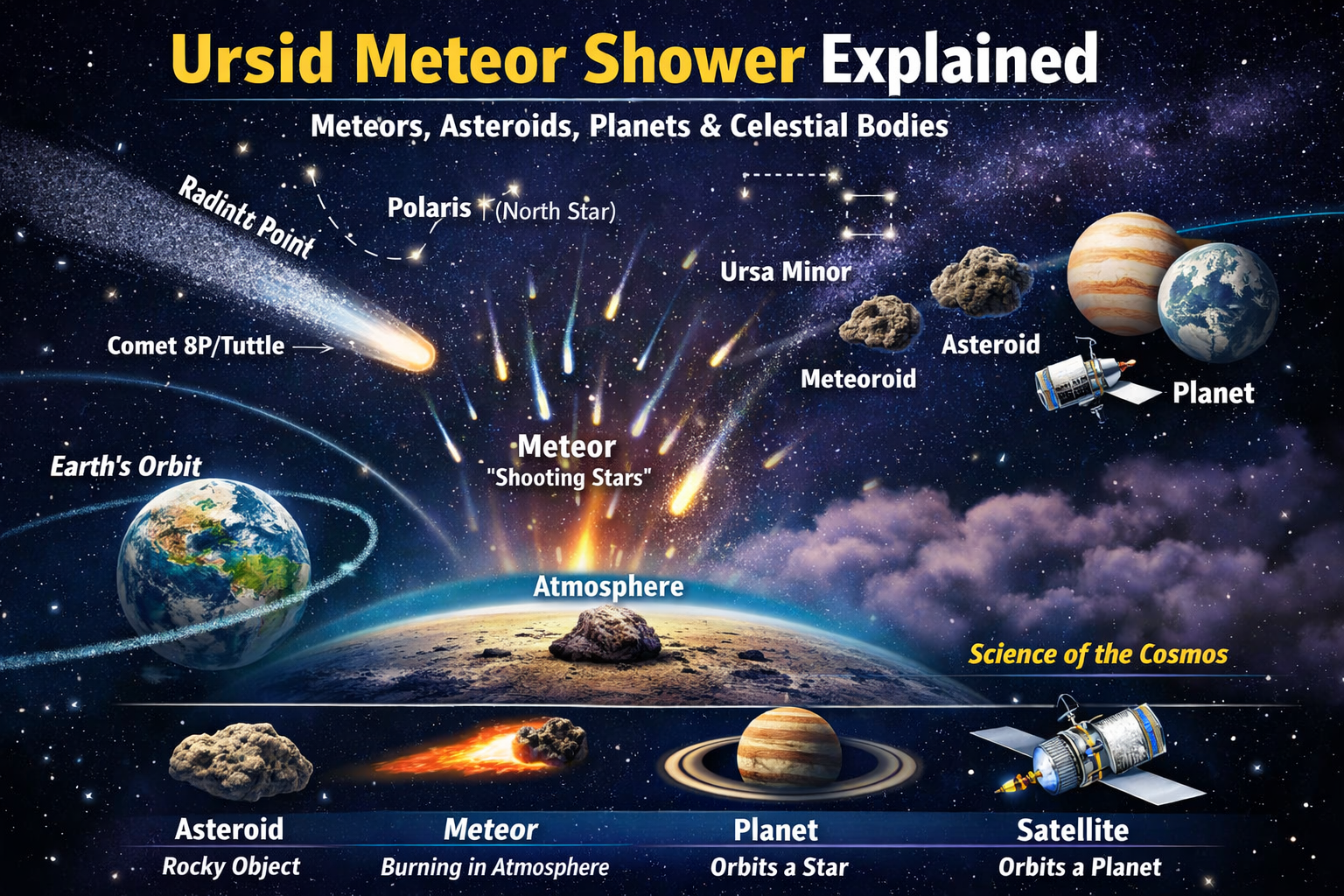
The Ursid meteor shower is an annual meteor shower that appears to radiate from the constellation Ursa Minor (the Little Bear), near the North Star (Polaris).
Key Facts
- Active period: 17–26 December
- Peak: Around 21–22 December
- Average rate: 5–10 meteors per hour
- Parent body: Comet 8P/Tuttle
- Visibility: Best from the Northern Hemisphere
The name Ursid comes from Ursa Minor, indicating the point in the sky from which these meteors appear to originate.
Why Is the Ursid Meteor Shower in the News?
The Ursids often make news because:
- Winter Solstice Timing – The peak occurs close to the winter solstice, making it astronomically significant.
- Unexpected Outbursts – Unlike predictable showers, Ursids sometimes produce sudden spikes of 50–100 meteors per hour.
- Scientific Observation – Astronomers study Ursids to understand comet debris behaviour and gravitational influences of Jupiter.
- Climate & Light Pollution Context – Clear winter skies and minimal moonlight make certain years ideal for observation.
What Is a Meteor?
A meteor is the visible streak of light produced when a small space object enters Earth’s atmosphere at high speed and burns due to friction.
Three Related Terms Explained
- Meteoroid: A small rocky or metallic object in space
- Meteor: The glowing streak seen in the sky
- Meteorite: The fragment that survives and reaches Earth’s surface
Popularly called a “shooting star”, though it has nothing to do with stars.
What Causes Meteor Showers?
Meteor showers occur when Earth passes through a stream of debris left behind by a comet.
Step-by-Step Process
- A comet travels around the Sun and sheds dust and ice.
- These particles form a debris trail.
- Earth intersects this trail during its orbit.
- Particles enter Earth’s atmosphere at high speed.
- Friction causes them to burn, creating meteors.
In the case of the Ursids, the debris comes from Comet 8P/Tuttle.
Why Do Meteors Appear in Showers, Not Randomly?
Meteor showers happen at the same time each year because:
- Earth follows a fixed orbital path.
- Comet debris remains concentrated along that path.
- The radiant point stays constant due to perspective.
Difference Between Asteroid, Meteor, Planet, Satellite, and Celestial Body
1. Celestial Body
A broad term for any natural object in space, including stars, planets, moons, asteroids, and comets.
2. Asteroid
- Rocky bodies orbiting the Sun
- Mostly found between Mars and Jupiter
- Larger than meteoroids
- Do not burn in the atmosphere
3. Meteoroid / Meteor
- Meteoroid: Small space debris
- Meteor: Burning streak in Earth’s atmosphere
- Meteorite: Reaches Earth’s surface
4. Planet
- Large body orbiting a star
- Clears its orbital path
- Has sufficient gravity for a spherical shape
Examples: Earth, Mars, Jupiter
5. Satellite
- Object that orbits a planet
- Can be natural (Moon) or artificial (communication satellites)
Quick Comparison Table
| Object | Orbits | Size | Key Feature |
| Planet | Star | Very large | Clears orbit |
| Satellite | Planet | Medium | Orbital companion |
| Asteroid | Sun | Medium-small | Rocky |
| Meteoroid | Sun | Very small | Debris |
| Meteor | Atmosphere | Light | Burns |
| Meteorite | Earth | Fragment | Impacts ground |
Scientific Importance of Meteor Showers
Meteor showers help scientists:
- Study solar system formation
- Understand comet composition
- Track near-Earth space debris
- Improve planetary defence systems
Cultural and Educational Significance
- Meteor showers have inspired myths, calendars, and navigation systems
- In modern times, they promote astronomy education and public engagement
- Events like Ursids highlight the dynamic nature of space
Conclusion
The Ursid Meteor Shower may be modest in appearance, but it holds immense scientific value. It reminds us that Earth is constantly interacting with cosmic material and that even the quietest celestial events have powerful stories to tell.
Understanding meteors and their relationship with comets, asteroids, and planets deepens our appreciation of the universe—and our place within it.
Leave a Reply