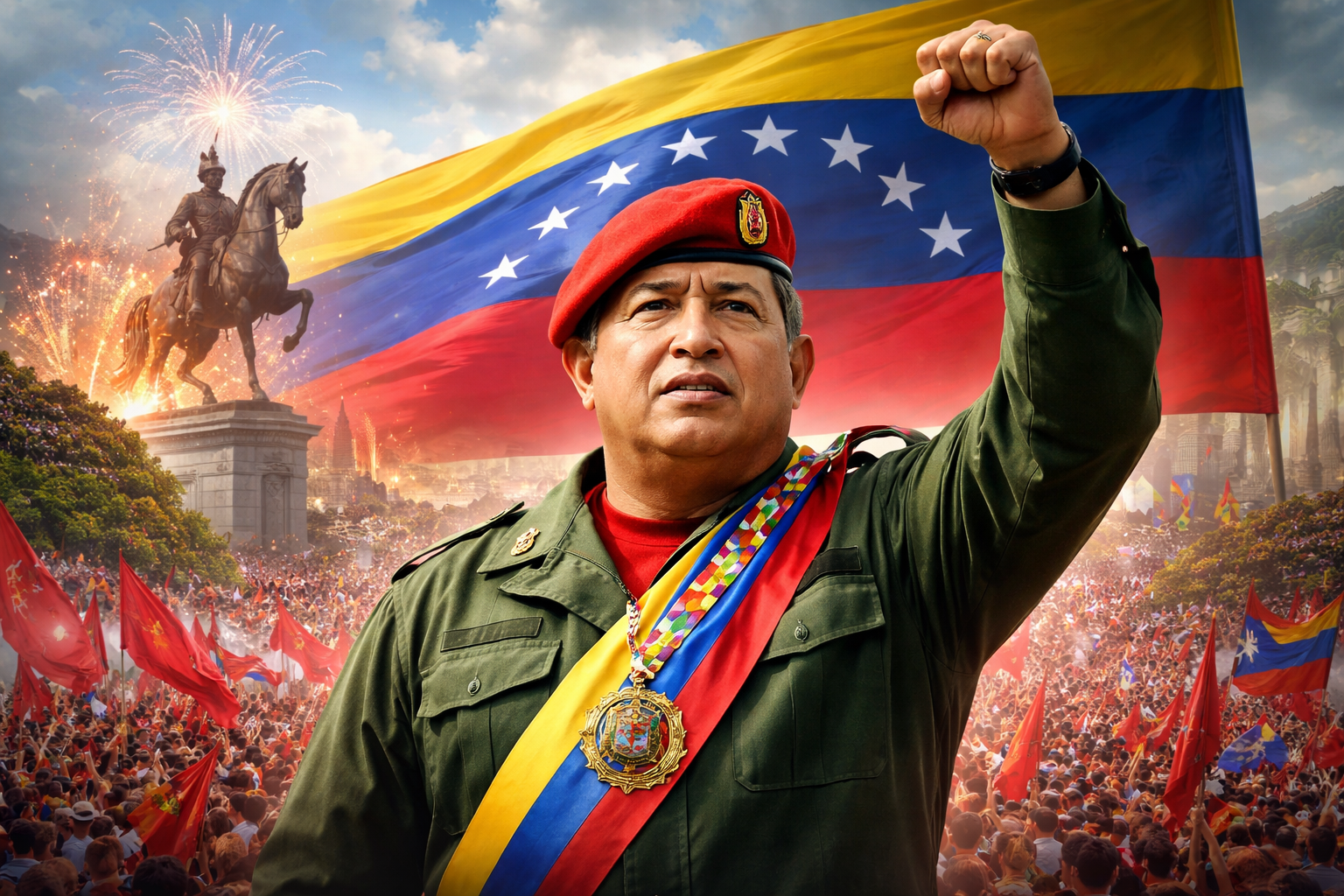
Hugo Rafael Chávez Frías (July 28, 1954 – March 5, 2013) was one of the most polarizing and transformative political figures in modern Latin American history. Rising from rural poverty to become President of Venezuela, his charismatic leadership and revolutionary agenda forever altered Venezuela’s political landscape and influenced leftist movements throughout the Americas.
Thank you for reading this post, don’t forget to subscribe!Early Life and Education: From Llanos to Military Academy
Born in Sabaneta, a modest rural town in the Venezuelan state of Barinas, Chávez was the son of schoolteachers. His early upbringing in a poor, provincial environment shaped his empathy for the marginalized and ignited an interest in politics and social justice.
At age 17, Chávez entered the Venezuelan Academy of Military Sciences in Caracas, initially attracted by baseball opportunities but ultimately discovering his political purpose within the armed forces. He graduated in 1975, beginning a military career that would eventually become the foundation of his political ascent.
During his formative years, Chávez immersed himself in the ideas of Simón Bolívar, the legendary South American liberator, and Marxist thinkers — the blend that later formed the core of his own political philosophy.
Political Ideology: Bolivarianism Meets Socialism
Chávez’s political ideology was a distinctive fusion of Bolivarian nationalism and 21st-century socialism, widely known as Chavismo. This approach emphasized sovereignty, social justice, wealth redistribution, and resistance to foreign domination — especially that of the United States.
The term Bolivarian Revolution — Chávez’s signature political project — drew on the legacy of Simón Bolívar, aiming to unify Latin America politically and economically, reduce inequalities, and create a “participatory democracy” that actively involved ordinary citizens.
Rise to Power and the Birth of a Movement
In 1982, while still in the military, Chávez co-founded the Revolutionary Bolivarian Movement-200 (MBR-200), dedicated to promoting radical reform.
Chávez’s first national spotlight came in 1992, when he led a failed coup against Venezuela’s President Carlos Andrés Pérez. Though the attempt did not succeed, Chávez’s televised surrender speech — capped with “por ahora” (“for now”) — captured public imagination and painted him as a leader of integrity and conviction.
After serving nearly two years in prison, Chávez was pardoned and turned his movement into a political force. In 1998, he won the presidency with a promise to end corruption, redistribute oil wealth, revamp the constitution, and empower the poor.
Presidency (1999–2013): Revolution and Controversy
Constitution and State Reforms
Upon taking power in 1999, Chávez initiated a new constitution that expanded executive powers, restructured key institutions, and renamed the nation the Bolivarian Republic of Venezuela — honouring Bolívar’s legacy.
Social Programs and “Missions”
Leveraging Venezuela’s oil wealth, Chávez launched extensive social programs known as Bolivarian Missions — focusing on literacy, healthcare, food security, and housing. These initiatives helped reduce illiteracy and expanded access to fundamental services nationwide.
Economic and Political Turmoil
Chávez’s radical reforms and authoritarian drift generated sharp domestic divisions. A 2002 coup briefly ousted him, but intense public support and loyal military factions restored him within days.
Large strikes, especially within the state oil company PDVSA, erupted as opposition forces attempted to challenge his rule. Chávez responded by firing striking workers and consolidating control.
His government increasingly exerted influence over Venezuela’s institutions, often sidelining independent media and opposition voices. Critics accused him of weakening democratic checks and balances and fostering political polarization.
International Relations and Anti-Imperialism
On the international stage, Chávez positioned Venezuela as a leading critic of U.S. foreign policy and a champion of anti-imperialist solidarity. He promoted regional alliances like ALBA (Bolivarian Alliance for the Peoples of Our America) and strengthened ties with countries such as Cuba, Bolivia, and Iran.
Political Style: Charismatic, Populist, and Polarizing
Chávez was known for his fiery oratory, charismatic leadership, and populist rhetoric. He cultivated a deep bond with Venezuela’s poor, using dramatic speeches and public appearances to communicate directly with supporters.
His political style combined military symbolism, theatrical flair (such as his trademark red beret), and a persistent narrative of struggle against historical elites and external foes. These elements fostered a devoted following — Chavistas — who saw him as a defender of the oppressed.
At the same time, his critics denounced his approach as divisive and authoritarian, pointing to economic mismanagement, institutional overreach, and erosion of democratic norms under his rule.
Health Struggles and Final Years
Chávez’s later years were overshadowed by illness. He underwent multiple surgeries for cancer starting in 2011 and spent considerable time receiving treatment abroad, particularly in Cuba.
His health struggles weakened his public presence and created political uncertainty within Venezuela. Despite this, he won re-election in 2012, but his condition continued to deteriorate.
Death and Legacy
On March 5, 2013, Hugo Chávez died at the age of 58 after a long battle with cancer in Caracas. His passing marked the end of an era and intensified debates over his legacy.
Chávez left behind a deeply divided nation — revered by supporters as a transformative champion of social justice and condemned by opponents as a leader whose policies contributed to economic crisis and political authoritarianism.
His successor, Nicolás Maduro, continued Chávez’s socialist project amidst mounting economic, political, and social challenges — underscoring the enduring influence of Chávez’s rule.
Conclusion: A Complex Legacy
Hugo Chávez remains one of the most consequential figures in 21st-century Latin American politics. His story — from rural beginnings to revolutionary leader — reflects the aspirations and contradictions of Venezuela itself. Whether celebrated as a voice for the marginalized or criticized for his authoritarian methods, Chávez’s impact on Venezuelan society and global political discourse will be studied for generations.
Leave a Reply