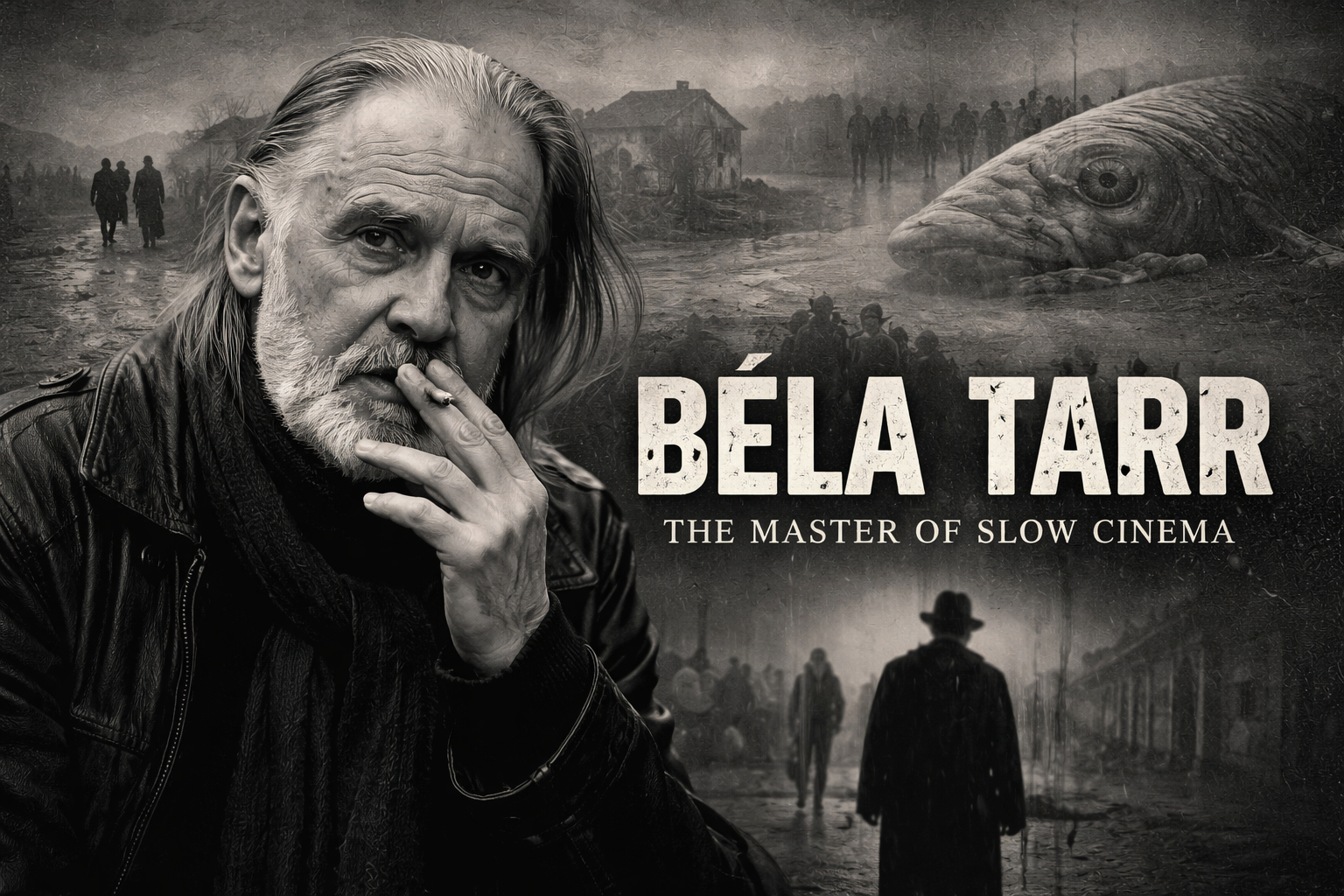
Introduction: The Enigma of Béla Tarr
Thank you for reading this post, don’t forget to subscribe!Béla Tarr (21 July 1955 – 6 January 2026) stood apart in world cinema as one of the most uncompromising and profound voices of the late 20th and early 21st centuries. His films felt less like stories and more like elemental experiences — meditations on time, despair, beauty, and the human condition. Tarr’s death at the age of 70 marks the passing of a master whose work forever altered how the moving image can feel and think.
Early Life & Beginnings
Béla Tarr was born in Pécs, Hungary, to artistic parents — his father a scene painter and his mother a stage prompter. From an early age, Tarr was immersed in visual art, eventually receiving a camera from his father at around 16 years old and beginning to make films on his own.
Before formal training, Tarr’s formative years were spent experimenting with short documentaries and explorations of quotidian life. His early, youthful engagement with cinema laid the foundation for the rigor and intensity that would define his later work.
Education & Early Struggles
Tarr later joined the Béla Balázs Studio — a crucible for Hungary’s avant-garde and experimental filmmakers — where he sharpened his craft. His early feature, Family Nest (1979), depicted the struggles of a young couple in Communist Hungary and won the Grand Prize at the Mannheim-Heidelberg International Film Festival.
Though initially linked with social-realist cinema and political nuance, Tarr’s work gradually pushed beyond straightforward critique into existential terrain.
Professional Career: Films That Redefined Cinema
Tarr directed nine feature films over four decades. His trajectory reflects a shift from social realism to an immersive, metaphysical cinematic language.
Key Films & Style
- Family Nest (1979) – A bold debut that earned international notice and set Tarr’s lifelong commitment to serious cinema.
- The Prefab People (1982) – A critically praised portrayal of marriage and domestic tension that hinted at Tarr’s stark realism.
- Damnation (1988) – A key turning point: co-written with László Krasznahorkai, it introduced long takes, bleak imagery, and philosophical focus.
- Sátántangó (1994) – Tarr’s magnum opus: nearly seven and a half hours of continuous black-and-white tracking shots, weaving a hypnotic tale of small-town despair.
- Werckmeister Harmonies (2000) – A masterpiece of mood and existential dread, based on a Krasznahorkai novel.
- The Man from London (2007) – A noir-infused adaptation that garnered international acclaim and featured Tilda Swinton.
- The Turin Horse (2011) – A stark, elemental meditation on existence — Tarr’s final feature, awarded the Silver Bear Jury Grand Prize at Berlinale.
Across these films, Tarr’s signature emerged: long, unbroken takes, monochrome cinematography, sparse dialogue, and a rhythm that allowed audiences to feel each scene’s duration.
Collaborators & Influences
A defining partnership was with writer László Krasznahorkai, whose literary density fused seamlessly with Tarr’s cinematic syntax. Their shared vision resulted in cinema that was philosophically rigorous, formally daring, and unforgettable.
Editor-turned-co-director Ágnes Hranitzky became integral to his aesthetic, shaping the pacing and visual flow that became Tarr’s hallmark.
Awards, Honors, & Later Life
Despite the esoteric nature of his films, Tarr received major festival recognition and honorary professorships abroad, especially in China, reflecting his impact on global cinema. His work was celebrated at major institutions, retrospectives, and film festivals worldwide.
In later years, he became an educator and mentor, co-founding the film.factory school in Sarajevo and supporting emerging talents — extending his philosophy of cinema beyond his own films.
Wealth & Public Persona
Unlike mainstream directors, Tarr didn’t pursue commercial success or blockbuster visibility. His filmmaking was rooted in artistic integrity rather than box-office wealth. Publicly, he was known for his candid views, including sharp criticism of nationalist politics in Hungary — advocating for cultural freedom and artistic support.
While data on his personal wealth is not a focus in cinematic historiography, his influence and esteem far outweigh material measures; his value lies in artistic legacy rather than financial empire.
Lessons from a Cinematic Philosopher
Béla Tarr taught the world many lessons:
- Cinema as Time, Not Story: Films can unfold like lived experience — slowly, painfully, beautifully.
- Form as Meaning: Long takes and minimal cuts communicate depth and presence in ways conventional editing cannot.
- Human Resilience: Even in bleak landscapes, Tarr’s films find dignity in struggle.
- Art Over Commerce: A commitment to artistic vision above market trends.
Legacy: How Will Béla Tarr Be Remembered?
Tarr will be remembered as one of the architects of “slow cinema”, a filmmaker whose works endure not because they entertain, but because they transform audiences. He expanded cinema’s emotional and intellectual terrain, influencing generations of filmmakers such as Gus Van Sant, Jim Jarmusch, and others exploring poetic film language.
His films are studied in film schools, restored for new audiences, and continue to inspire debates about time, meaning, and the cinematic experience. He didn’t just make movies — he challenged how cinema feels.
Conclusion: The Quiet After the Storm
Béla Tarr’s passing in 2026 marks the end of an era, but his films remain eternal — expansive, demanding, and profound. In a world obsessed with speed, Tarr’s cinema reminded us to slow down, to see the texture of a moment, and to feel deeply the poetry of existence. His legacy is not measured in dollars, but in depth: a rare artist who used film to make us think, feel, and endure.
Leave a Reply