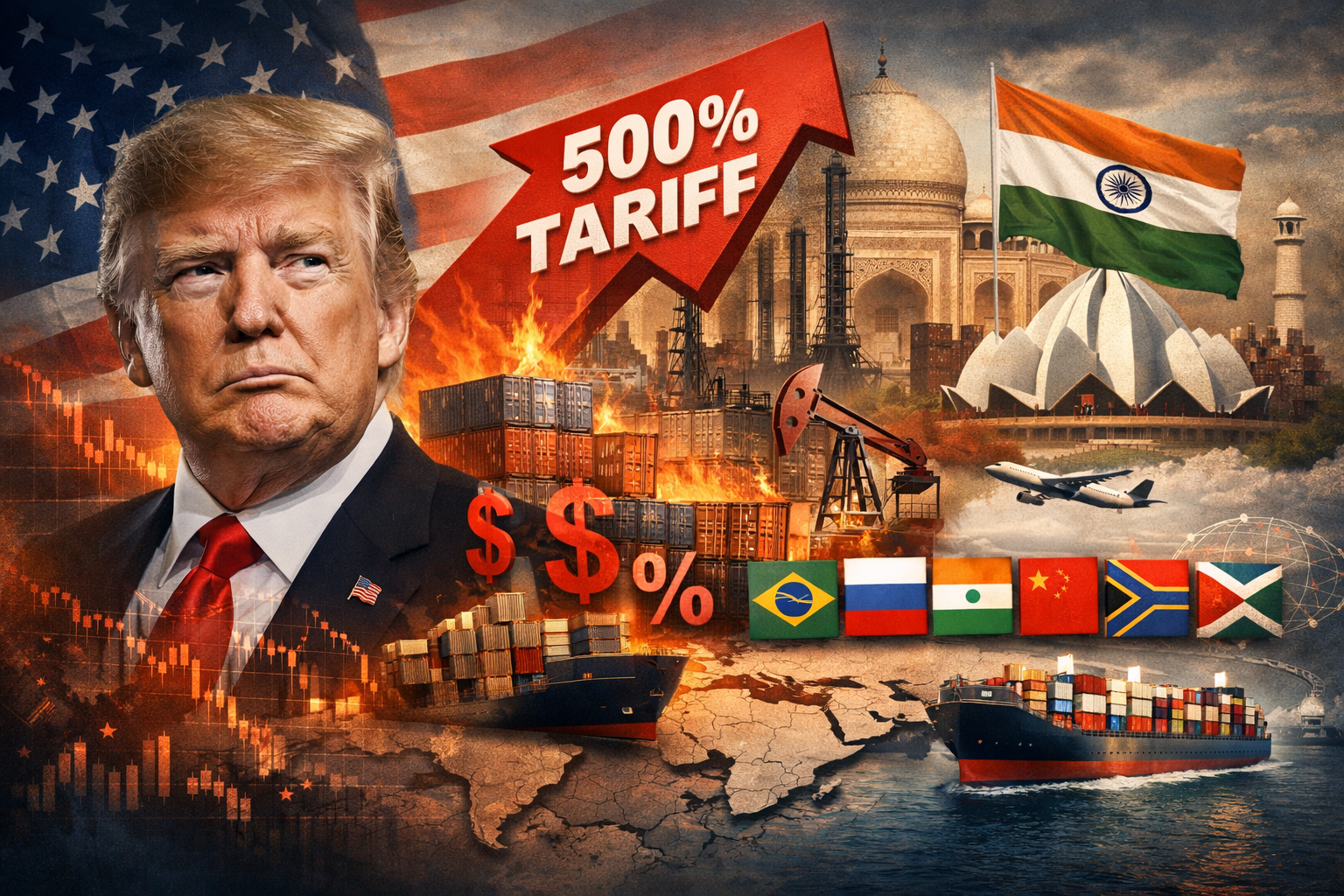
Introduction: What Is the Trump 500% Tariff Bill?
Thank you for reading this post, don’t forget to subscribe!In early January 2026, the U.S. government under President Donald Trump approved legislation known informally as the “Sanctioning Russia Act of 2025.” This bill empowers the U.S. to impose tariffs as high as 500 percent on imports from countries that knowingly trade in Russian-origin energy and strategic goods such as petroleum and uranium — effectively creating secondary trade sanctions on Russia’s partners.
The tariffs are not limited to Russia itself; nations purchasing significant volumes of Russian oil are subject to the penalty as well — a key reason India, China, and other BRICS members are in focus.
Why This Bill Came About: Background & Objectives
- Sanctions Against Russia:
The primary aim of the legislation is to hit Russia economically by cutting off its revenue streams — especially from oil exports — which fund its military actions. - Secondary Sanctions:
By threatening extreme tariffs (up to 500 percent) on countries that continue to import Russian energy, the U.S. seeks to deter allies and strategic partners from undermining Western sanctions. - Pressure on Global Trade Partners:
Beyond Russia, this framework is intended to exert economic pressure on India and China — two of Russia’s largest energy customers — to reduce their energy imports from Moscow. - Domestic Political Strategy:
The tariffs align with Trump’s broader trade agenda to protect U.S. industries and reduce trade deficits, reflecting an extension of his “America First” trade policy.
Impact on India
1. Trade Access to the U.S. Market
India has already faced tariff hikes — U.S. tariffs on Indian imports were raised to around 50 percent over Russia oil purchases in 2025.
If 500 percent tariffs activate:
- Indian exports to the U.S. could become prohibitively expensive, reducing demand for Indian goods like textiles, apparel, gems, and engineering products.
- India’s strategy of expanding market share in pharmaceuticals and IT services might face indirect headwinds as broader trade tensions rise.
2. Energy Security and Economic Costs
India relies heavily on imported crude, with Russian oil historically accounting for a significant share due to lower prices and stable supply.
If forced to reduce or halt these imports:
- Fuel prices domestically could rise, affecting inflation and production costs.
- Higher energy costs ripple through industrial and transport sectors, weakening economic growth momentum.
3. Diplomatic Strains
The tariff threats risk straining India–U.S. relations. Despite articulating positive diplomatic language, U.S. tariff pressure could push India toward closer ties with Russia and potentially China in the geopolitical arena.
Impact on Other BRICS Countries
China
China is Russia’s largest buyer of energy exports.
A 500 percent tariff on Chinese exports to the U.S. would:
- Increase costs of Chinese goods in the U.S. market; considerably disrupt supply chains.
- Potentially lead Beijing to retaliate via reciprocal tariffs or strategic economic partnerships outside U.S. influence.
Brazil, South Africa & Russia
- Brazil: Already facing past U.S. tariff disputes, this could reignite tariff escalation with its exports.
- South Africa: As a smaller export economy, punitive tariffs could affect sectors reliant on U.S. demand.
- Russia: Directly hit with the intention of starving its energy funds — but at the risk of deeper geopolitical confrontation.
Global Trade Implications
1. Supply Chain Disruptions
Tariffs of such magnitude will:
- Distort global supply chains by making certain trade routes economically unviable.
- Spur companies to restructure sourcing and production locations — potentially away from the U.S. or high-tariff destinations.
2. Inflation and Consumer Prices
Extremely high tariffs typically translate into higher prices for consumers in importing countries, especially the U.S., because costs are passed along.
3. Retaliation and Trade Wars
Affected countries may:
- Take disputes to the World Trade Organization (WTO).
- Impose reciprocal tariffs, culminating in an escalated trade war with broader global downturn risks.
4. Investment and Growth Slowdown
Analyses show that heightened tariffs globally can:
- Reduce GDP growth, lower exports, and reduce employment.
- Harm industries dependent on global trade. Global models forecast significant job losses if trade tensions escalate further.
Geopolitical Concerns
Erosion of Multilateral Trade Norms
Unilateral high tariffs undermine confidence in:
- The WTO dispute resolution system
- Collective trade rule-making
This may push major economies to seek new trade blocs or alliances.
BRICS & Global Pivot
BRICS countries may accelerate economic cooperation independent of U.S. influence, including:
- Alternative payment systems
- Energy cooperation mechanisms
- Regional supply chains
Such shifts could challenge U.S. influence in setting global economic rules.
Strategic Alignments
Countries targeted by tariffs could:
- Deepen relations with each other — e.g., India–Russia, China–Russia ties.
- Foster non-Western economic frameworks (e.g., greater South–South cooperation).
Conclusion: Why This Matters
The 500 percent tariff proposal is far more than an economic tool; it is a strategic lever with implications for:
- Global trade dynamics
- Energy policy
- Geopolitical balances
- India’s and BRICS economic priorities
Even the threat of such tariffs reshapes diplomacy and investment strategies worldwide.
Leave a Reply