Introduction
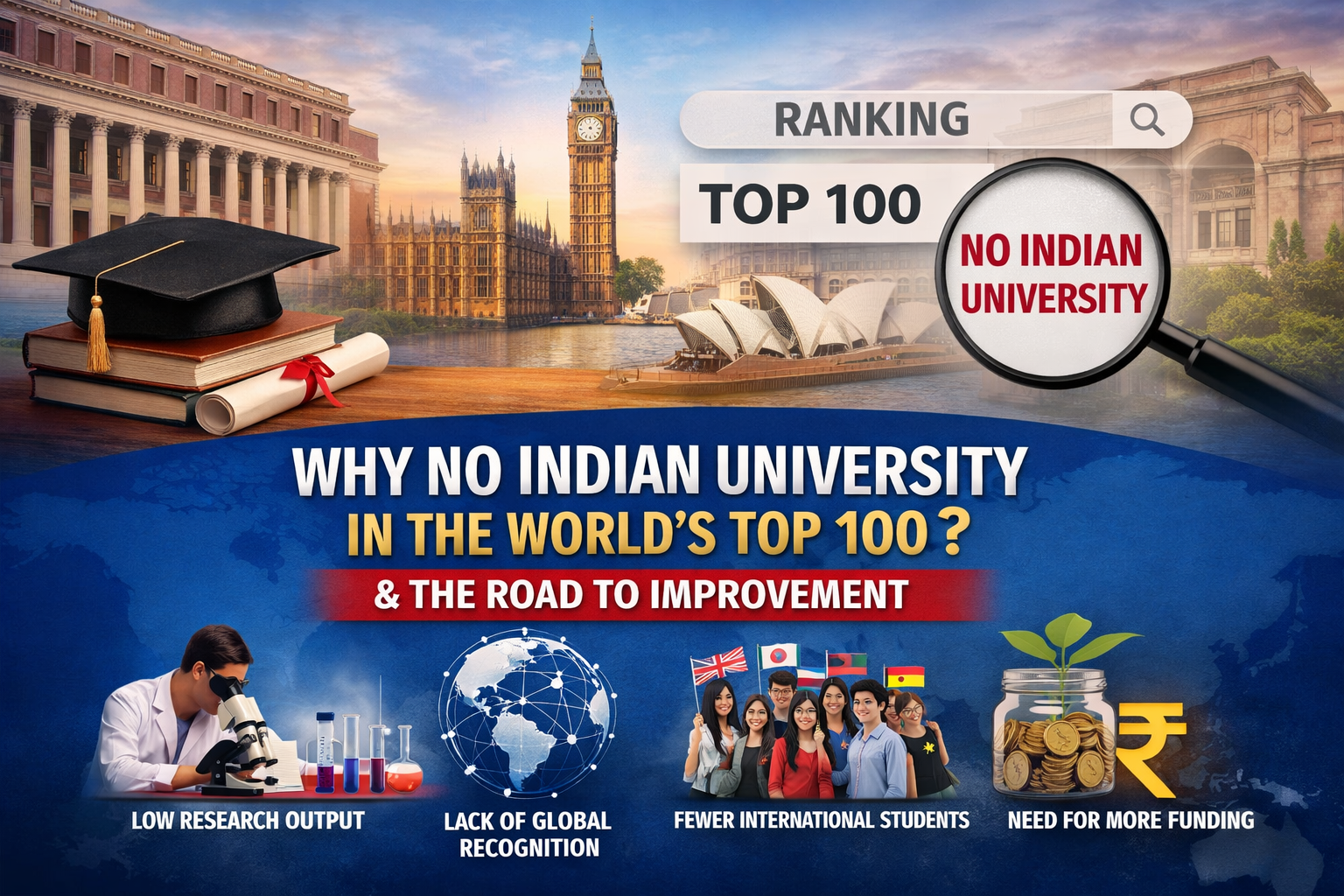
Thank you for reading this post, don’t forget to subscribe!Every year, global university ranking bodies release their latest lists measuring academic excellence, research impact, global reputation, and other critical indicators. The QS World University Rankings 2026 — one of the most authoritative global lists — was recently published, yet not a single Indian university made it into the top 100. In this article, we explore the full top 100 list, the criteria that drive rankings, the reasons India is absent from the elite group, and what needs to change if India’s universities are to break into the global top 100.
Top 100 Universities in the World (QS World University Rankings 2026)
Below is a sample of the Top 100 global universities from the QS Rankings — arguably the most influential ranking system globally (list truncated for brevity).
| Rank | University | Country |
| 1 | Massachusetts Institute of Technology (MIT) | United States |
| 2 | Imperial College London | United Kingdom |
| 3 | Stanford University | United States |
| 4 | University of Oxford | United Kingdom |
| 5 | Harvard University | United States |
| 6 | University of Cambridge | United Kingdom |
| 7 | ETH Zurich | Switzerland |
| 8 | National University of Singapore | Singapore |
| 9 | UCL, London | United Kingdom |
| 10 | California Institute of Technology (Caltech) | United States |
| 11 | The University of Hong Kong | Hong Kong |
| 12 | Nanyang Technological University | Singapore |
| 13 | University of Chicago | United States |
| 14 | Peking University | China |
| 15 | University of Pennsylvania | United States |
| 16 | Cornell University | United States |
| =17 | Tsinghua University | China |
| =17 | University of California, Berkeley (UCB) | United States |
| 19 | University of Melbourne | Australia |
| 20 | UNSW Sydney | Australia |
| … | … | … |
| 100 | (See full QS listing) | … |
Note: This snapshot is based on QS World University Rankings 2026, which ranks over 1,500 institutions worldwide.
For the full Top 100 list, official QS sources publish the complete dataset on their website.
What is QS (Quacquarelli Symonds)?
Quacquarelli Symonds (QS) is a UK-based global higher-education analytics and consulting organization, founded in 1990. It is best known worldwide for publishing the QS World University Rankings, one of the most influential and widely referenced global university ranking systems.
Methodology: How Universities Are Scored
Understanding how rankings work is critical to interpreting why certain universities excel while others lag. The QS World University Rankings methodology uses the following weightage:
| Indicator | Weightage |
| Academic Reputation | 40% |
| Employer Reputation | 10% |
| Faculty/Student Ratio | 20% |
| Citations per Faculty | 20% |
| International Faculty Ratio | 5% |
| International Student Ratio | 5% |
Key Implications of These Metrics:
- Academic Reputation is by far the most influential indicator, based on global surveys of academics and employers.
- Research output and citations are central — universities must produce high-impact global research.
- Internationalization rewards global diversity among students and faculty.
- Teaching capacity is measured through faculty/student balance.
Rankings like Times Higher Education (THE) and Academic Ranking of World Universities (ARWU) also weigh research volume, citations, international outlook, industry income, and teaching environment differently, but all emphasize research and global impact heavily.
Why No Indian University Is in the Top 100
Despite having a large higher education ecosystem and globally revered institutions like IITs and IISc, no Indian institution appears in the elite global top 100 list of the 2026 QS Rankings.
Here’s why:
1. Lower Research Citations per Faculty
Indian universities generate fewer high-impact research papers compared to top global counterparts. Citations per faculty significantly influence QS and THE rankings.
2. Global Reputation Still Weak
Reputation surveys heavily favour long-established Western institutions with a global footprint. Many Indian universities lack strong brand recognition internationally.
3. Less International Diversity
Indian universities have fewer international faculty and students, which weighs negatively in the internationalization metric.
4. Scale and Focus of Academic Mission
Several Indian institutions are highly specialized (e.g., engineering, technology) while QS and THE rankings reward broad-based excellence across arts, sciences, health, and research.
5. Autonomy and Governance Constraints
Operational and curriculum autonomy can affect research agility. Globally competitive universities typically enjoy broader academic freedom and governance flexibility.
Major Lacunae in India’s Higher Education System
Insufficient R&D Investment
India spends only ~0.7% of GDP on R&D — much lower than the ~2% seen in global science powerhouses. This limits research funding, labs, grants, and high-impact output.
Limited Research Ecosystem
Concerted research culture with incentives for high-quality publications, patents, and international collaboration is still evolving in most Indian universities.
Low Global Visibility
Even when Indian research is strong domestically, it often isn’t promoted or cited sufficiently internationally.
Curriculum Modernization Lag
Top global institutions constantly renew curricula in response to emerging fields (AI, biotech, climate science), while many Indian programs remain lagged.
Where India Must Improve to Break Into the Top 100
Here’s what India needs to focus on to elevate its world ranking:
Increase Quality Research Output
Prioritize world-class research facilities, cross-disciplinary labs, and grants targeting global publications and citations.
Boost International Engagement
Attract global faculty and students through scholarships, exchange programs, and collaborative research projects.
Enhance Reputation via Partnerships
Tie-ups with top global universities, co-authored research, and executive education programs help improve reputation scores.
Improve Teaching-Research Ecosystem
Balance teaching loads with research incentives. Faculty research output must align with high-impact global standards.
Strengthen Autonomy & Governance
Encourage academic freedom, flexible curricula, and decentralised decision-making to foster innovation.
Conclusion: A Roadmap for India’s Academic Future
The absence of Indian universities in the global Top 100 QS World University Rankings 2026 isn’t an indictment of India’s educational quality — it is a call to scale research capacity, international visibility, and academic ecosystems. With targeted reforms, increased funding, and global collaborations, India can position its universities to compete with the world’s best.
Whether policymakers, academic leaders, or students, this moment is a turning point — not just for rankings, but for India’s intellectual influence on the global stage.
Leave a Reply