Introduction
Thank you for reading this post, don’t forget to subscribe!China represents one of the most distinctive governance systems in the contemporary world. Unlike liberal democracies that follow a multi-party electoral framework, China operates under a single-party socialist system led by the Communist Party of China (CPC). Its governance structure combines political centralization with administrative decentralization, enabling the state to manage a vast population, diverse regions, and rapid economic transformation.
Understanding China’s governance model is crucial for scholars of public administration, geopolitics, development studies, and global policy, as China’s internal governance deeply influences global trade, diplomacy, and international institutions.
Nature of China’s Governance System
Type of State
- Socialist Republic
- One-party political system
- Guided by Marxism–Leninism, Mao Zedong Thought, Deng Xiaoping Theory, Three Represents, Scientific Outlook on Development, and Xi Jinping Thought on Socialism with Chinese Characteristics for a New Era
Core Characteristics
- Single ruling party (CPC)
- No competitive multiparty elections at the national level
- Strong central authority
- Fusion of party and state institutions
- Emphasis on stability, development, and national unity
Role of the Communist Party of China (CPC)
The Communist Party of China is the supreme political authority in China.
Key Features
- Over 98 million members
- Exercises leadership over:
- Government
- Military
- Judiciary
- Media
- Civil society
Party-State Relationship
In China, “the Party leads everything” — governance is conducted through parallel party and state structures.
Every major government institution has a corresponding Party committee, ensuring policy alignment and political discipline.
Structure of the Central Government
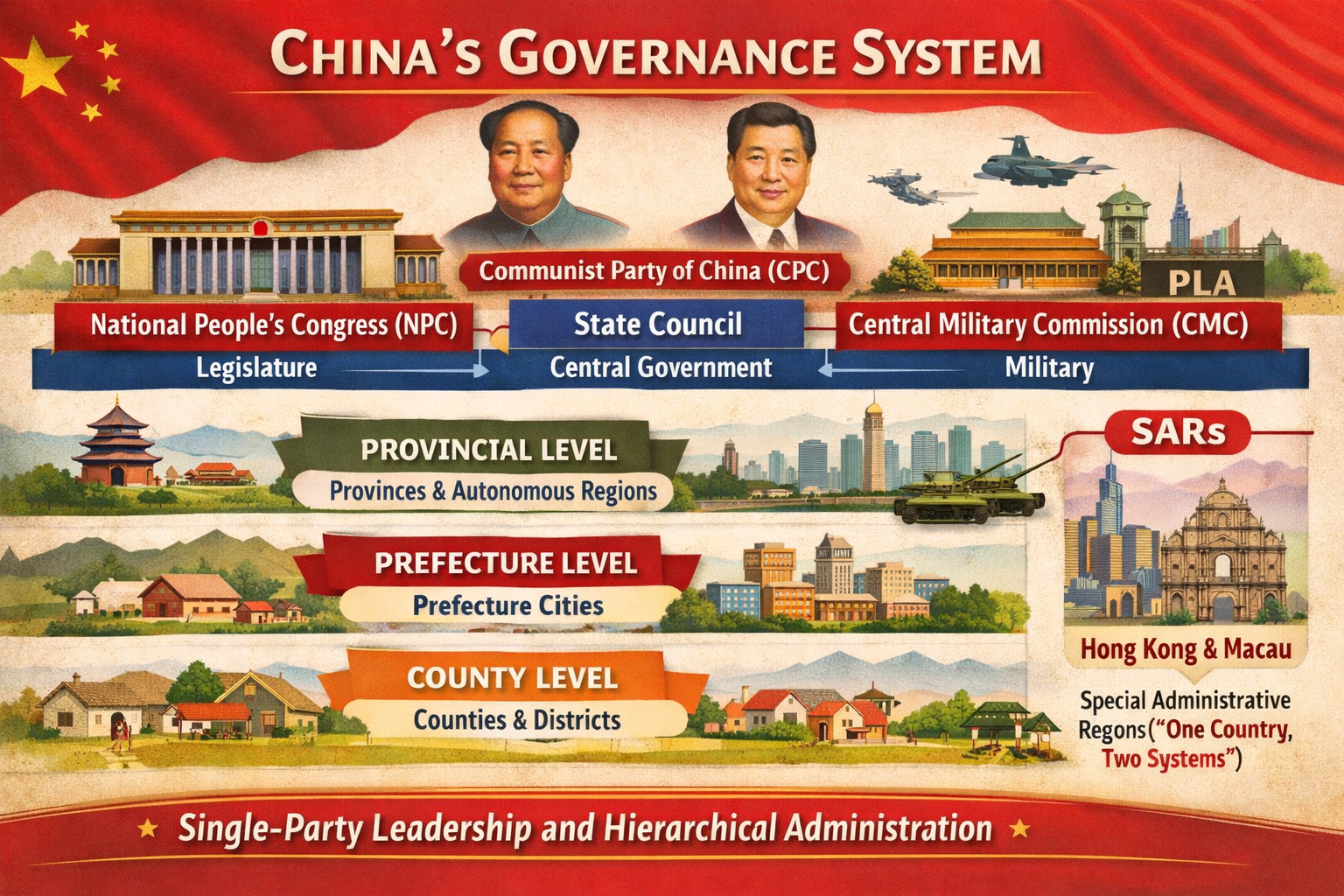
China’s central governance operates through three interlinked pillars:
- Party
- State
- Military
1. National People’s Congress (NPC)
Status: Highest organ of state power
Nature: Legislature (unicameral)
Functions
- Amends the Constitution
- Enacts national laws
- Approves major policies and plans
- Elects:
- President & Vice President
- Premier (Head of Government)
- Chairman of the Central Military Commission
- Chief Justice and Procurator-General
Composition
- ~3,000 deputies
- Indirectly elected from provinces, autonomous regions, municipalities, armed forces
The NPC meets annually; its powers are exercised year-round by the Standing Committee of the NPC.
2. President of the People’s Republic of China
Role: Head of State
Current Character: Largely ceremonial in theory, powerful in practice when combined with party leadership
Key Powers
- Promulgates laws
- Appoints officials
- Represents China internationally
In reality, the President’s authority stems from simultaneously holding:
- General Secretary of CPC
- Chairman of Central Military Commission
3. State Council (Central Government)
Status: Highest executive body
Head: Premier
Composition
- Premier
- Vice Premiers
- State Councillors
- Ministers
- Heads of commissions
Functions
- Implements laws and policies
- Manages economy, education, health, foreign affairs
- Supervises local governments
The State Council functions similarly to a cabinet, but operates under CPC oversight.
4. Judiciary System
Supreme People’s Court (SPC)
- Highest judicial authority
- Supervises lower courts
Supreme People’s Procuratorate (SPP)
- Highest prosecution and anti-corruption body
Judiciary is not independent in the Western sense and remains subordinate to Party leadership.
5. Central Military Commission (CMC)
- Commands the People’s Liberation Army (PLA)
- Headed by CPC leadership
- Ensures absolute party control over the military
How Is the Chinese Government Elected?
Election Model: Indirect and Hierarchical
China does not have direct national elections.
Process
- Village and grassroots elections – limited direct voting
- Local People’s Congresses elected
- Higher-level congresses elected by lower levels
- NPC elects central leadership
Key Reality
- All candidates are vetted by the CPC
- No opposition parties compete for power
- Political legitimacy derives from:
- Performance
- Stability
- Economic growth
- Nationalism
Administrative Structure of China
China follows a multi-tier administrative hierarchy, allowing centralized control with decentralized implementation.
Central Level Administration
Institutions
- State Council Ministries
- National Commissions
- CPC Central Committees
Responsibilities
- National policy formulation
- Defence and foreign affairs
- Macro-economic planning
- National development strategies (Five-Year Plans)
Provincial Level Administration
Administrative Units
- 23 Provinces
- 5 Autonomous Regions
- 4 Direct-Controlled Municipalities
- 2 Special Administrative Regions (SARs)
Governance Structure
- Provincial People’s Congress
- Provincial Government (Governor)
- Provincial CPC Secretary (most powerful authority)
Functions
- Policy execution
- Regional economic planning
- Public service delivery
- Coordination with central ministries
Party Secretary outranks Governor in political authority.
Prefecture Level Administration
Units
- Prefecture-level cities
- Autonomous prefectures
Functions
- Urban planning
- Industrial development
- Transport and infrastructure
- Social welfare administration
Acts as a bridge between province and county.
County Level Administration
Units
- Counties
- County-level cities
- Urban districts
Responsibilities
- Education
- Healthcare
- Local policing
- Revenue collection
- Grassroots governance
This level is critical for policy delivery and social stability.
Township and Village Level Administration
Township Level
- Townships and towns
- Implement county directives
- Manage local administration
Village Level
- Village Committees
- Limited self-governance
- Direct elections in some cases
This is the only level where direct democratic participation is visible.
Special Administrative Regions (SARs)
Hong Kong and Macau
Features
- “One Country, Two Systems”
- Separate legal, economic, and administrative systems
- High autonomy (except defence and foreign affairs)
Key Dimensions of China’s Governance Model
Strengths
- Policy continuity
- Rapid decision-making
- Strong state capacity
- Long-term planning
Limitations
- Limited political freedom
- Weak judicial independence
- Centralized power concentration
- Restricted civil liberties
Conclusion
China’s governance system represents a unique fusion of party supremacy, centralized authority, and administrative decentralization. While it diverges sharply from Western democratic norms, it has demonstrated remarkable capacity in economic transformation, infrastructure development, and poverty reduction. However, its long-term sustainability depends on balancing control with accountability, efficiency with inclusiveness, and growth with rights.
Understanding China’s administrative and political architecture is essential for engaging with its domestic policies and global ambitions.
Leave a Reply