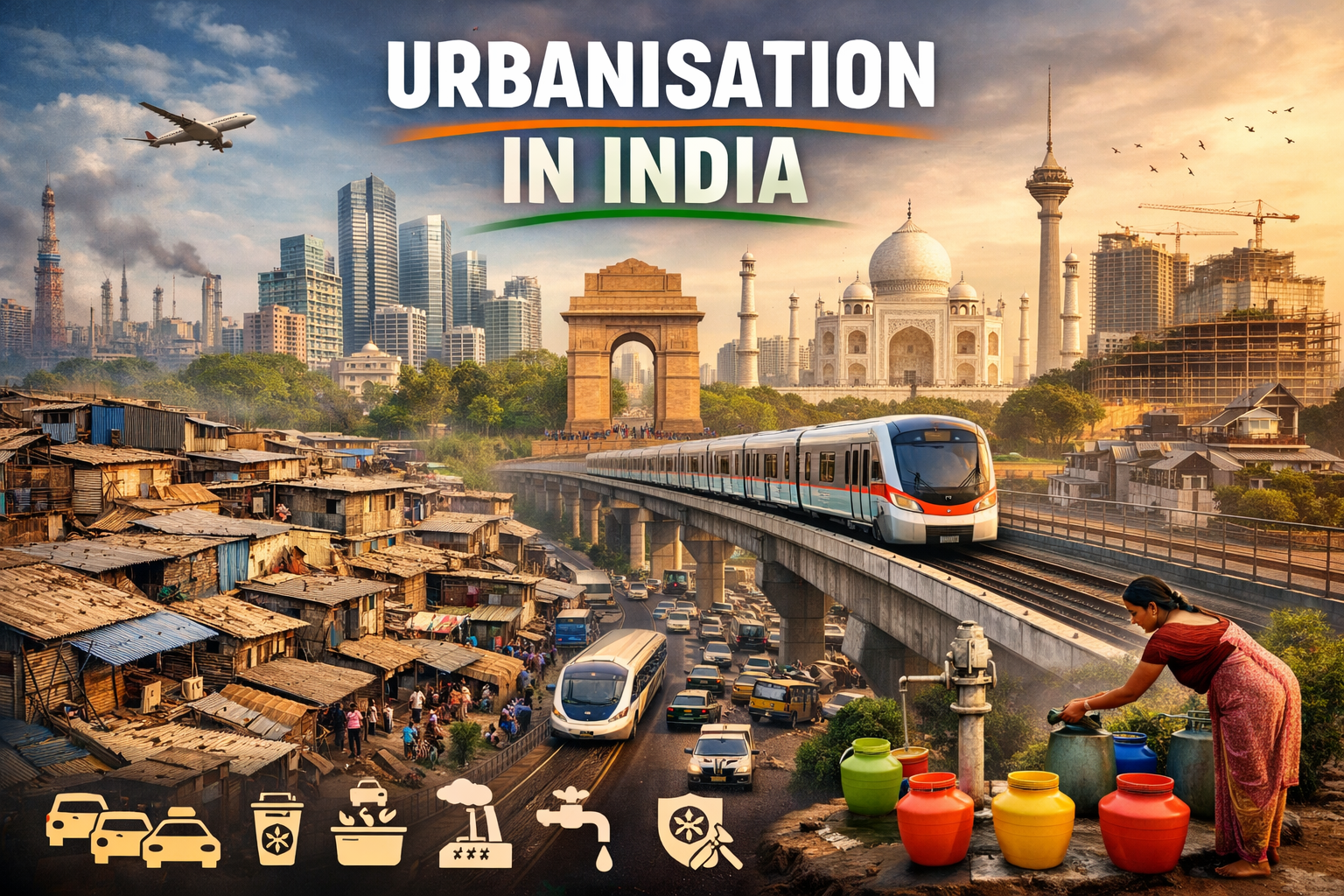
Urbanisation is one of the most powerful socio-economic transformations of the 21st century, reshaping how people live, work, and interact. In India—home to the world’s largest population—urbanisation is rapidly redefining our social landscape, economic potential, governance frameworks, and sustainability challenges.
Thank you for reading this post, don’t forget to subscribe!What is Urbanisation?
Urbanisation refers to the process where a growing share of a country’s population moves from rural areas to urban areas, and where cities and towns expand in population and geographic size. It is both a demographic shift and a structural one, implying changes in employment (more people in non-agricultural sectors), lifestyles, infrastructure needs, and economic systems.
What is Urbanism?
While urbanisation describes the process, urbanism refers to the way of life, cultural orientations, attitudes, and lifestyle that emerge in urban spaces. Urbanism captures how cities shape social behaviour, interactions, built environments, and the experiences of citizens. It includes patterns of work, leisure, transport, housing types, and community life that uniquely characterise city dwellers.
Census of India: Definition & Criteria of Urban Centre
The Census of India defines an urban area based on specific legal and statistical criteria:
Urban Criteria (Census)
- Statutory Towns: Places with a municipality, corporation, cantonment board, or notified area committee.
- Census Towns: Places satisfying all three of:
- At least 5,000 population.
- Minimum population density of 400 persons per sq. km.
- 75% or more of male main workforce engaged in non-agricultural activities.
Types of Urban Settlement
- Towns: Urban areas with populations under 100,000.
- Cities: Urban areas with over 100,000 people.
- Urban Agglomerations: Continuous urban spread including towns and their adjoining outgrowths.
- Metropolitan Cities: Urban agglomerations with populations exceeding one million.
Decadal Urbanisation Growth in India (1901–2011)
Decades of census data show that urbanisation in India has steadily increased over more than a century:
| Census Year | Urban Population (%) |
| 1901 | ~10.8% |
| 1911 | ~10.3% |
| 1921 | ~11.2% |
| 1931 | ~12.0% |
| 1941 | ~13.9% |
| 1951 | ~17.3% |
| 1961 | ~18.0% |
| 1971 | ~19.9% |
| 1981 | ~23.3% |
| 1991 | ~25.7% |
| 2001 | ~27.8% |
| 2011 | ~31.2% |
From about 11% urban in 1901, India’s urban population share rose to over 31% by 2011—a nearly threefold increase. Although slower compared to many other countries, this rise reflects sustained rural-to-urban migration and reclassification of rural areas into urban settlements.
According to recent estimates (e.g., Urban population ~36–37% by 2024–25), the trend continues upward, with forecasts suggesting 40% or more by 2036 and beyond.
Tempo of Urbanisation
The “tempo” refers to how fast urbanisation grows. Historically, urban growth accelerated in post-Independence India as industrialisation expanded, rural-urban migration increased, and economic opportunities concentrated in cities.
Urbanisation Across States & Union Territories
Urbanisation levels vary widely across Indian states and UTs:
Most Urbanised States/UTs
- Goa: Among the highest percentages of urban population.
- Delhi (NCT) and Chandigarh: Very high urban proportions (~97%+).
- Puducherry and Daman & Diu: Also high urban shares.
Major Trends
- Southern and Western states like Tamil Nadu, Maharashtra, Karnataka, Kerala show higher urban percentages.
- Northern and eastern states generally have lower urban shares, though rapidly increasing.
Note: The most recent full state-wise data from Census additions will be available after the 2027 census completion.
Why Urbanisation in India is Happening
Key drivers:
- Economic opportunities & industrialisation
- Better access to education and health services
- Rural employment stagnation
- Infrastructure, transport, and globalisation of cities
- Administrative reclassification of areas
Major Issues & Challenges of Urbanisation in India
While urbanisation can fuel economic growth and innovation, India’s rapid and often unplanned urban growth has triggered serious challenges:
1. Haphazard Construction & Urban Sprawl
Cities often expand outward without adequate planning, leading to loss of agricultural land, encroachment on flood plains, and fragile ecosystems.
2. Infrastructure Deficits
- Water supply often limited; pipe leakage, shortages.
- Poor sewerage and sanitation systems.
- Inadequate electricity, roads, public transport.
3. Transportation & Congestion
Public transport systems in many cities are overwhelmed; private vehicles dominate, causing severe congestion and pollution.
4. Waste Disposal & Pollution
Solid waste management is insufficient, leading to unmanaged garbage, landfill issues, and air and water pollution.
5. Drinking Water & Water Logging
Groundwater depletion, contamination, poor drainage, and urban flooding occur due to inadequate infrastructure.
6. Slums and Informal Settlements
Millions live in slums lacking basic services, security of tenure, sanitation, and healthcare, worsening inequality.
7. Crime & Social Challenges
Urban density and inequality can correlate with higher crime rates and social vulnerabilities.
How to Overcome Urbanisation Challenges
1. Planned Urban Development
Cities must adopt comprehensive spatial planning and enforcement of building codes to avoid sprawl.
2. Strengthening Infrastructure
- Expand reliable water supply and sanitation.
- Upgrade roads, drains, and utilities.
- Invest in Smart City planning.
3. Sustainable Transport Systems
- Promote public transport (metros, buses, RRTS) and non-motorised mobility.
- Manage parking and vehicle use.
4. Scientific Waste Management
- Segregation at source, recycling, bio-processing.
- Waste-to-energy and community participation.
5. Affordable Housing & Slum Upgradation
- Inclusive housing policies.
- Slum redevelopment with upgraded services.
6. Green & Resilient Cities
- Green belts, urban forests, and heat-resilient infrastructure.
- Flood-resistant drainage and climate-smart planning.
7. Policy & Governance
- Empower Urban Local Bodies (ULBs) through finance and technical capacity.
- Citizen participation for transparent governance.
- Policy reforms targeting sustainable urban futures.
National and state initiatives (like Smart Cities Mission, AMRUT, and others) reflect this direction and emphasise structural solutions alongside long-term planning.
Conclusion
Urbanisation in India is a multifaceted transformation bringing opportunities and challenges in equal measure. From a modest 10–12% urban population in 1901 to over a third today, cities are engines of innovation, jobs, and culture—but only if growth is planned, sustainable, and inclusive.
This journey will define the India of 2030 and beyond, from economic prosperity to social wellbeing and environmental resilience.
Leave a Reply