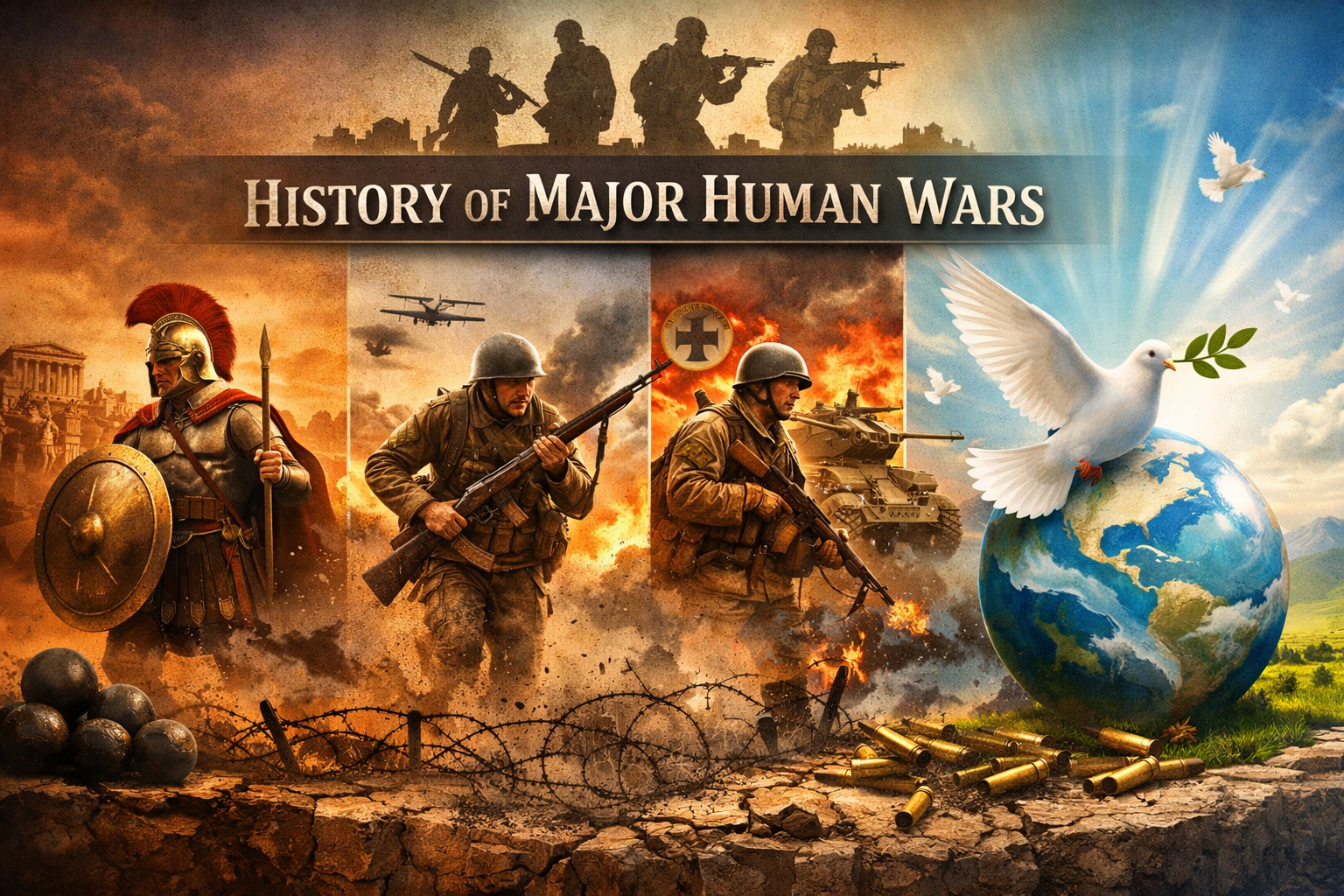
Introduction: Why Do Humans Wage War?
Thank you for reading this post, don’t forget to subscribe!War has been a constant companion of human civilization—shaping empires, redrawing borders, and influencing the course of history. From ancient tribal battles to global conflicts involving advanced technology, wars have resulted in unimaginable destruction and loss of life.
But the real question is: Why do humans repeatedly engage in war despite its devastating consequences?
The answer lies in a complex mix of power, resources, psychology, ego, and survival instincts. This blog explores the evolution of wars, their causes, escalation patterns, psychological triggers, and how humanity can move toward lasting peace.
1. Ancient Wars: The Foundation of Organized Conflict
Some of the earliest recorded wars were fought for survival, territory, and control over resources.
Key Examples
- Peloponnesian War (431–404 BCE)
- Punic Wars (264–146 BCE)
Causes
- Expansion of empires
- Access to trade routes
- Control over fertile land
Death Toll
Hundreds of thousands—significant for the population size at that time.
Insight
In ancient societies, war was often seen as a necessity rather than a choice. Leaders believed expansion ensured survival. Honor, pride, and dominance were central values, making compromise unlikely.
2. Medieval Wars: Religion and Power Collide
The medieval period witnessed wars driven by religion, feudal rivalries, and dynastic ambitions.
Key Examples
- Crusades (1095–1291)
- Hundred Years’ War (1337–1453)
Causes
- Religious ideology and control of holy lands
- Territorial disputes
- Royal succession conflicts
Death Toll
Millions over several centuries.
Insight
Religion became a powerful psychological tool. Leaders framed wars as divine missions, motivating masses to fight. This created strong group identities—“believers vs non-believers”—fuelling long-lasting conflicts.
3. Early Modern Wars: Rise of Nation-States and Ambition
As centralized states emerged, wars became more structured and large-scale.
Key Examples
- Thirty Years’ War (1618–1648)
- Napoleonic Wars (1803–1815)
Key Figure
- Napoleon Bonaparte
Causes
- Religious-political conflicts
- Nationalism
- Personal ambition of rulers
Death Toll
- ~8 million (Thirty Years’ War)
- ~3–6 million (Napoleonic Wars)
Insight
This period highlights how individual ego and leadership ambition can reshape global politics. National identity started becoming stronger, making wars more intense and widespread.
4. World Wars: The Deadliest Phase in Human History
World War I (1914–1918)
- World War I
- Death Toll: ~16 million
Trigger Event:
- Assassination of Archduke Franz Ferdinand
Causes
- Militarism
- Alliances
- Imperialism
- Nationalism
World War II (1939–1945)
- World War II
- Death Toll: ~70–85 million
Key Figure
- Adolf Hitler
Causes
- Rise of fascism
- Economic instability after WWI
- Expansionist policies
Insight
World Wars demonstrated how industrialization + ideology = mass destruction. Propaganda, nationalism, and economic distress created an environment where entire populations supported war.
5. Cold War Era: Fear Without Direct War
Key Events
- Cold War
- Vietnam War
- Korean War
Causes
- Ideological clash (Capitalism vs Communism)
- Superpower rivalry
Death Toll
Millions in proxy wars.
Insight
The Cold War shows how fear and suspicion alone can sustain global tension. Even without direct confrontation, indirect wars caused immense destruction.
6. Modern Conflicts: Complex and Multi-Dimensional Wars
Key Examples
- War in Afghanistan
- Iraq War
- Russia Ukraine War
Causes
- Terrorism
- Resource control (oil, gas)
- Geopolitical influence
Insight
Modern wars are less about conquest and more about strategic dominance and influence. Technology, media, and cyber warfare play a crucial role.
Psychological and Behavioural Aspects of War
War is not just political—it is deeply psychological.
1. Fear and Survival Instinct
Leaders often amplify threats to justify war.
2. “Us vs Them” Mentality
Humans naturally form groups, leading to division and dehumanization.
3. Obedience to Authority
People tend to follow orders—even if morally questionable.
4. Revenge and Historical Memory
Past conflicts create cycles of hatred and retaliation.
The Role of Money, Muscle Power, and Ego
1. Money (Economic Interests)
- Wars for oil, minerals, trade routes
- Military-industrial complex profits from war
2. Muscle Power (Military Strength)
- Arms race increases insecurity
- Strong nations impose dominance
3. Ego (Leadership and National Pride)
- Leaders avoid compromise to protect image
- National pride escalates conflicts
These three factors act as powerful catalysts, turning minor disputes into full-scale wars.
How Wars Escalate: Step-by-Step
- Political or territorial dispute
- Rise in tensions and propaganda
- Military mobilization
- Formation of alliances
- Trigger event (attack/assassination)
- Full-scale war
Once escalation begins, emotions often override logic, making resolution difficult.
Consequences of War
- Massive human casualties
- Economic collapse
- Refugee crises
- Mental trauma (PTSD)
- Destruction of infrastructure
- Long-term instability
How Can Wars Be Prevented?
1. Diplomacy and Dialogue
Open communication reduces misunderstanding.
2. Global Institutions
Organizations like United Nations promote peacekeeping.
3. Economic Cooperation
Trade relationships discourage conflict.
4. Education and Awareness
Promotes critical thinking and reduces manipulation.
5. Ethical Leadership
Leaders must prioritize humanity over ego.
Lessons from History
- War often begins with small unresolved conflicts
- Ego and pride can be more dangerous than weapons
- Economic inequality and instability fuel unrest
- Peace requires continuous effort, not passive hope
Conclusion: Can Humanity Outgrow War?
War is not an unavoidable destiny—it is a result of human decisions. History shows that while conflict may arise, how we respond determines whether it escalates into war.
The real progress of humanity lies not in winning wars, but in preventing them altogether.
A peaceful world is possible—but only when wisdom overcomes ego, and dialogue replaces destruction.
Leave a Reply