Introduction
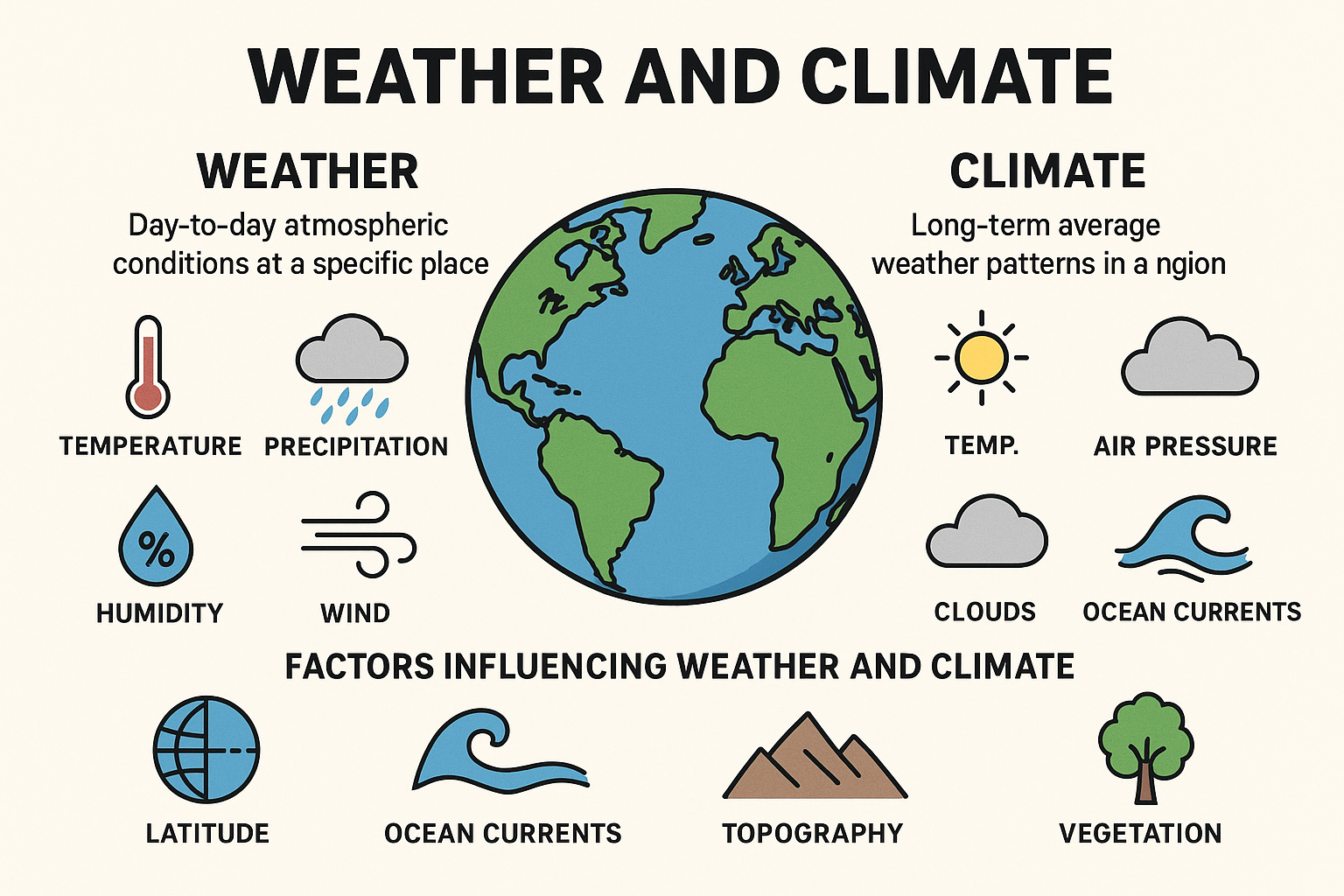
Thank you for reading this post, don’t forget to subscribe!Weather and climate are two fundamental concepts that shape life on Earth. While both deal with atmospheric conditions, they differ in scope, time scale, and influencing factors. Weather refers to short-term atmospheric conditions, while climate describes the long-term average patterns of weather in a region. Together, they influence ecosystems, human societies, agriculture, infrastructure, and global environmental policies.
In this blog, we will explore the scientific definitions, components, factors, and importance of weather and climate, along with their interrelationships and global significance.
1. What is Weather?
Definition:
Weather is the day-to-day state of the atmosphere in a specific location, described by variables such as temperature, humidity, precipitation, wind, cloud cover, and atmospheric pressure.
Time Scale:
Hours to a few days.
Example:
A sunny morning with 28°C temperature and light winds in Mumbai.
2. What is Climate?
Definition:
Climate refers to the long-term average of weather patterns in a region, typically measured over a period of 30 years or more (as per the World Meteorological Organization – WMO).
Time Scale:
Decades to centuries.
Example:
The monsoon climate of India, characterized by hot summers, seasonal heavy rains (June–September), and mild winters.
Difference Between Weather and Climate
| Aspect | Weather | Climate |
| Definition | Short-term atmospheric conditions at a specific time and place. | Long-term average of weather patterns over a region, typically 30 years or more. |
| Time Scale | Hours to days. | Decades to centuries. |
| Changeability | Changes rapidly within minutes or hours. | Changes gradually over long periods. |
| Measurement Focus | Current temperature, humidity, precipitation, wind speed, air pressure. | Statistical averages of temperature, precipitation, humidity, wind patterns over decades. |
| Geographical Scale | Local or regional. | Regional, continental, or global. |
| Example | A thunderstorm in Delhi on 14 August 2025. | The monsoon climate of India. |
| Study Branch | Meteorology. | Climatology. |
Scholarly Definitions
Weather
- Huschke, R.E. (1970) – Glossary of Meteorology, American Meteorological Society:
“The state of the atmosphere at a given time and place, with respect to variables such as temperature, moisture, wind velocity, and barometric pressure.”
- Barry, R.G. & Chorley, R.J. (2003) – Atmosphere, Weather and Climate:
“The instantaneous atmospheric conditions in a given location, subject to rapid variations.”
Climate
- World Meteorological Organization (WMO, 2017):
“The statistical description of the mean and variability of relevant quantities over a period of time ranging from months to thousands or millions of years.”
- Trewartha, G.T. (1981) – An Introduction to Climate:
“Climate represents the sum total of weather conditions and variations over a given region during a long interval of time.”
3. Key Components of Weather and Climate
Weather and climate are described by measurable atmospheric variables, often called meteorological elements. These include:
3.1 Temperature
- Definition: The measure of the warmth or coldness of the atmosphere.
- Influences: Solar radiation, latitude, altitude, ocean currents, and time of day.
- Units: Celsius (°C), Fahrenheit (°F), Kelvin (K).
3.2 Atmospheric Pressure
- Definition: The force exerted by the weight of air molecules on a given surface.
- Influences: Altitude, temperature, humidity.
- Units: Millibar (mb) or hectopascal (hPa).
3.3 Humidity
- Definition: The amount of water vapor in the air.
- Types:
- Absolute Humidity: Actual water vapor (g/m³).
- Relative Humidity (RH): Percentage of water vapor relative to maximum possible at that temperature.
- Specific Humidity: Water vapor per unit mass of air.
3.4 Precipitation
- Definition: Water falling from the atmosphere in various forms—rain, snow, sleet, hail.
- Importance: Essential for agriculture, hydrology, and ecosystem health.
3.5 Wind
- Definition: Movement of air from high-pressure to low-pressure areas.
- Measurement: Speed (km/h, m/s, knots) and direction (degrees or compass points).
3.6 Cloud Cover
- Definition: Fraction of the sky covered by clouds.
- Types: Cirrus, cumulus, stratus, nimbus, etc.
- Role: Influences sunlight, temperature, and precipitation.
4. Factors Influencing Weather and Climate
Several natural and anthropogenic factors shape atmospheric conditions:
- Latitude: Determines solar energy received.
- Altitude: Higher altitudes are cooler and have thinner air.
- Distance from Oceans: Coastal areas have milder climates due to water’s heat capacity.
- Ocean Currents: Warm currents raise temperatures; cold currents cool coastal climates.
- Topography: Mountains block winds and create rain shadows.
- Vegetation: Affects humidity, CO₂ absorption, and temperature regulation.
- Human Activities: Urban heat islands, deforestation, greenhouse gas emissions.
5. Relationship Between Weather and Climate
Weather and climate are interconnected. Climate sets the background conditions, while weather represents short-term fluctuations within that framework. For example, a cold day in a tropical region doesn’t change its overall warm climate.
6. Climate Classification
Climatologists use various classification systems, the most famous being Köppen Climate Classification:
- Tropical (A): Hot, humid, heavy rainfall (e.g., Amazon Basin).
- Dry (B): Deserts, semi-arid regions (e.g., Sahara).
- Temperate (C): Mild winters, warm summers (e.g., Mediterranean).
- Continental (D): Large temperature range, snow in winter (e.g., Siberia).
- Polar (E): Cold year-round (e.g., Antarctica).
7. Modern Tools for Weather and Climate Study
Meteorology and climatology use advanced instruments and technology:
- Weather Satellites – Global cloud cover, storms, temperature mapping.
- Radar Systems – Rainfall measurement, storm tracking.
- Weather Stations – Ground-level data on temperature, wind, pressure.
- Climate Models – Predict long-term changes and trends.
8. Importance of Studying Weather and Climate
- Agriculture: Crop planning and irrigation management.
- Disaster Management: Predicting cyclones, floods, droughts.
- Infrastructure Planning: Designing buildings resilient to local conditions.
- Public Health: Understanding heat waves, cold snaps, and disease spread.
- Climate Change Policy: International agreements like the Paris Accord.
9. Climate Change and Its Impact
Human-induced climate change is altering weather patterns and shifting climate zones:
- Increased frequency of extreme events (heat waves, storms).
- Melting ice caps and rising sea levels.
- Shifts in monsoon patterns affecting billions.
- Biodiversity loss due to habitat changes.
10. Conclusion
Weather and climate are dynamic, interconnected systems that influence every aspect of life on Earth. While weather provides the daily atmospheric mood, climate defines the long-term personality of a place. Understanding their components, interactions, and influencing factors is essential for sustainable development, environmental conservation, and adaptation to global change.
Leave a Reply