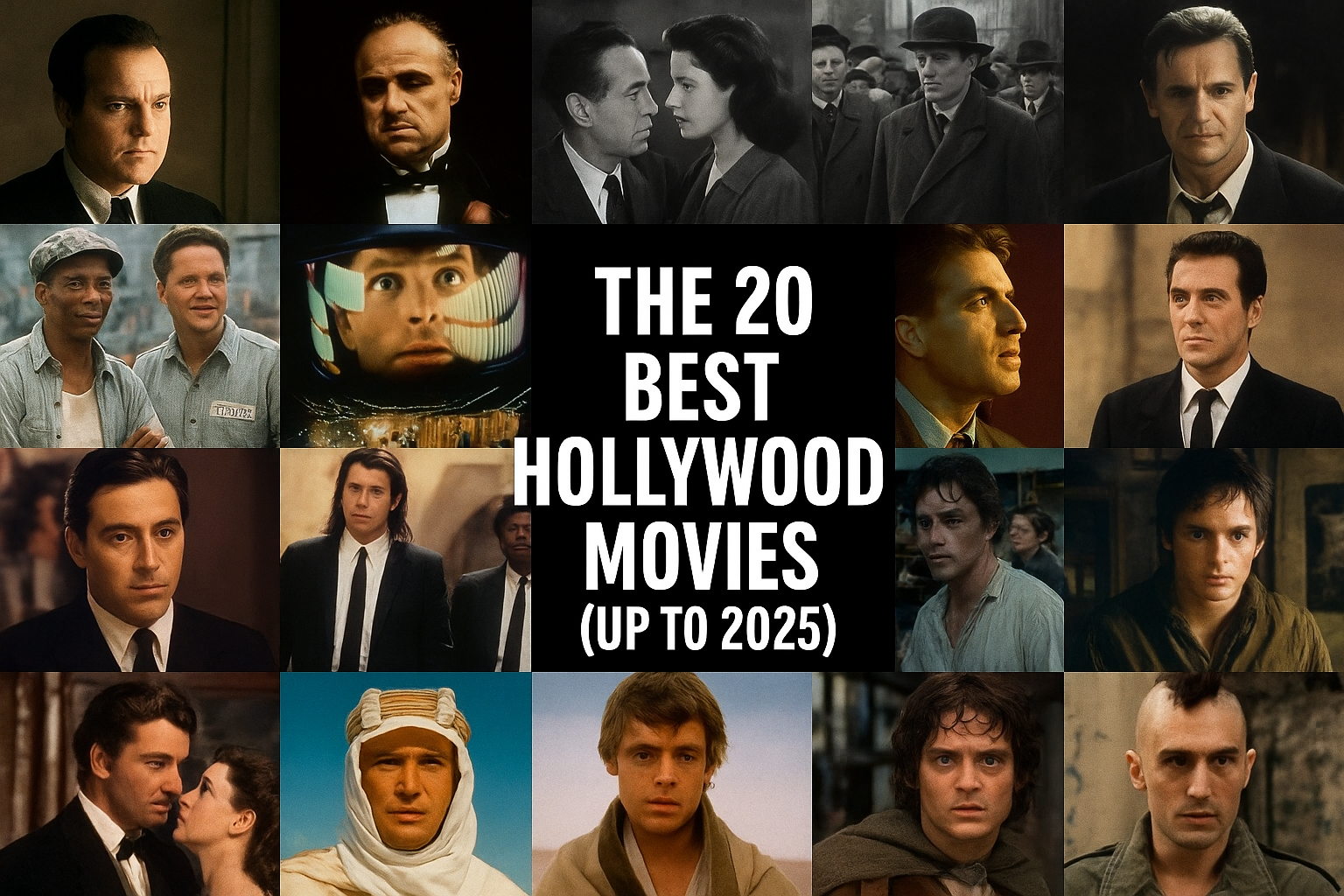
Cinema tastes are subjective, but some films keep showing up in critics’ polls, industry lists and audience rankings because they changed the language of film, pushed technical boundaries, or moved millions of viewers. This list of 20 best Hollywood movies (up to 2025) mixes critics’ favourites, audience-beloved classics, landmark achievements in craft, and culturally transformative works. The selection draws from long-running polls and indexes (like Sight & Sound, AFI, IMDb and Rotten Tomatoes) and critical consensus about cultural impact, innovation, craft, and longevity.
Thank you for reading this post, don’t forget to subscribe!Below you’ll find the selection criteria, the list with short readable reasons for each choice, and practical extras (watch order, FAQs).
How these 20 were chosen — the criteria & merits
To make a “best of all time” list useful and defensible, I used a blend of objective and qualitative criteria:
- Critical consensus & polls — recurrent appearance in major critics’ lists and decennial polls (Sight & Sound, AFI).
- Audience impact & longevity — presence on enduring audience charts (IMDb Top 250) and sustained popularity.
- Technical/craft innovation — cinematography, editing, production design, sound or storytelling techniques that influenced later filmmaking.
- Cultural and historical influence — films that altered public conversation, inspired other artists, or redefined a genre.
- Awards & recognition — Oscars, Cannes, BAFTAs and other major honours (used as one indicator, not the sole determinant). For example, Bong Joon Ho’s Parasite made history at the Oscars and is included because it reshaped notions about language and global recognition in awards culture.
These criteria balance “what critics deem historically important” with “what modern audiences keep returning to.” Below: 20 films that repeatedly meet several of those marks.
The 20 best Hollywood films (up to 2025) — and why to watch them
1. Citizen Kane (1941) — Orson Welles
Why it’s here: Often cited as a touchstone for modern filmmaking because of its narrative structure, deep-focus cinematography and bold storytelling. AFI and many critics name it among the most influential films ever.
Why watch: Study how visual style can tell character and theme; every filmmaker references its innovations.
2. The Godfather (1972) — Francis Ford Coppola
Why it’s here: A masterclass in adaptation, performance (Brando, Pacino) and creating mythic American family drama. Often top-ranked on AFI and audience lists.
Why watch: For acting, storytelling economy, and an elegant, quietly devastating score of family and power.
3. Casablanca (1942) — Michael Curtiz
Why it’s here: Iconic lines, romance against a wartime backdrop, and an evergreen cultural footprint; a staple on classic “greatest” lists.
Why watch: For iconic scenes, unforgettable dialogue, and a perfect blending of politics and romance.
4. Schindler’s List (1993) — Steven Spielberg
Why it’s here: A harrowing, responsibly rendered Holocaust film whose cinematography and moral clarity make it one of modern cinema’s most important works.
Why watch: For solemn historical witness, human storytelling, and technical restraint that amplifies emotion.
5. The Shawshank Redemption (1994) — Frank Darabont
Why it’s here: A cultural phenomenon: moderate awards attention but huge audience love and high IMDb rankings. It’s a storytelling triumph about hope, friendship, and time.
Why watch: If you want an emotionally satisfying, genuinely uplifting story with tight performances and craft.
6. 2001: A Space Odyssey (1968) — Stanley Kubrick
Why it’s here: A technical and philosophical landmark in cinematic storytelling and design—pioneering visual effects and elliptical narrative. Strong placement in critics’ polls.
Why watch: For jaw-dropping visuals, slow-burning ideas, and a film that rewards repeated viewings.
7. Vertigo (1958) — Alfred Hitchcock
Why it’s here: A psychological thriller that doubled as a case study in obsession, visual composition and subjective filmmaking. It routinely ranks high in critics’ polls.
Why watch: To experience how camera movement, mise-en-scène and score create psychological dread.
8. Seven Samurai (1954) — Akira Kurosawa (included for its global influence on Hollywood storytelling)
Why it’s here: Not Hollywood-made, but its structural and action choreography inspired countless Hollywood films (from Westerns to ensemble action movies). It’s essential to understand modern blockbuster grammar.
Why watch: For ensemble storytelling, brilliant staging of action, and the roots of many modern genres.
9. The Godfather Part II (1974) — Francis Ford Coppola
Why it’s here: A rare sequel that many argue equals or surpasses the original in narrative ambition and parallel storytelling (corrupting power vs. immigrant origins). Widely honoured and studied.
Why watch: For layered structure, superb performances, and an epic sense of American history.
10. Pulp Fiction (1994) — Quentin Tarantino
Why it’s here: Redefined indie cool and non-linear storytelling for a generation; kickstarted a wave of voice-driven, dialogue-centric filmmaking that influenced Hollywood in the 1990s and 2000s.
Why watch: For electrifying dialogue, memorable set pieces, and how style and story marry to create cultural momentum.
11. The Dark Knight (2008) — Christopher Nolan
Why it’s here: A superhero movie that achieved blockbuster scale while being taken seriously as drama—memorable performance (Heath Ledger), moral complexity, and technical craft. It sits high on audience lists.
Why watch: If you want genre cinema that pushes moral complexity and cinematic ambition at scale.
12. Parasite (2019) — Bong Joon Ho
Why it’s here: Historic — first non-English-language film to win the Academy Award for Best Picture — and a razor-sharp social satire wrapped in thriller beats. Its global critical and awards sweep made it a 21st-century landmark.
Why watch: For modern social commentary, tonal virtuosity (shifting between genres), and tight direction.
13. Gone with the Wind (1939) — Victor Fleming
Why it’s here: Monumental in production scope and box-office reach; a cinematic landmark of the studio era that shaped epic filmmaking.
Why watch: For classic Hollywood epic storytelling, set design, and star-making performances (and to understand how cinematic tastes and cultural readings evolve).
14. Lawrence of Arabia (1962) — David Lean
Why it’s here: A visual, editing and performance tour de force—a sweeping epic that defined scale in filmmaking (desert cinematography, careful pacing). Frequently ranked among the greatest epics.
Why watch: For epic cinematography, breathtaking location work, and a meditation on leadership and myth.
15. Star Wars: A New Hope (1977) — George Lucas
Why it’s here: Changed the entertainment industry (franchise filmmaking, modern blockbusters, visual effects and merchandising). Its influence on modern Hollywood is enormous.
Why watch: For classic adventure beats, iconic world-building, and a sense of wonder that launched a cultural phenomenon.
16. The Lord of the Rings: The Return of the King (2003) — Peter Jackson
Why it’s here: A modern fantasy apex that combined technical innovation (Weta digital and visual effects), narrative scale and awards recognition (Best Picture winner).
Why watch: For an emotionally satisfying epic conclusion, spectacle, and world-building that sets a high bar for modern franchise filmmaking.
17. Apocalypse Now (1979) — Francis Ford Coppola
Why it’s here: A hallucinatory Vietnam-war epic that pushed production limits and narrative form—intense sound design, improvisatory performances, and an atmosphere of descent into chaos.
Why watch: To experience how cinema can translate psychological and cultural chaos into sensory filmmaking.
18. Spirited Away (2001) — Hayao Miyazaki (anime with enormous Hollywood and global influence)
Why it’s here: Though Japanese, its global success (including an Academy Award for Best Animated Feature) influenced Hollywood animation storytellers; a masterpiece of imagination and visual poetry.
Why watch: For richly imagined animation, layered themes about growing up and modern life, and sublime visual design.
19. Bicycle Thieves (1948) — Vittorio De Sica (Italian neorealism, crucial to Hollywood auteurs)
Why it’s here: A human, ground-level portrayal of postwar life that influenced a generation of directors and introduced the power of neorealism to mainstream filmmaking.
Why watch: For emotionally honest storytelling, minimalism that reveals character, and a lesson in cinematic empathy.
20. Taxi Driver (1976) — Martin Scorsese
Why it’s here: A gritty, uncompromising portrait of alienation and urban decay with an iconic performance by Robert De Niro; it influenced the tone of American psychological dramas.
Why watch: For electrifying direction, a haunting score, and a portrait of obsession that still resonates.
Why you should watch (short & practical)
- To know the language of cinema: These films are often referenced, parodied and quoted — they’re cinema’s “vocabulary.”
- To see craft in action: Want to learn editing, lighting, acting or mise-en-scène? These are masterclasses.
- For cultural literacy: Many cultural conversations refer back to these films; watching them enriches your cultural fluency.
- For pleasure & challenge: Expect emotional highs (and sometimes discomfort) — great films make you feel and think.
Suggested viewing order (three quick paths)
- Chronological — see how style and technique evolve (start with Gone with the Wind, end with Parasite).
- By theme — watch pairings: The Godfather + The Godfather Part II; 2001 + Apocalypse Now (ambition and vision).
- Beginner-friendly — start with emotionally accessible crowd-pleasers (The Shawshank Redemption, Star Wars, The Godfather), then move to more demanding work (Vertigo, 2001).
FAQs (short)
Q: Are these all American films?
No — while many are Hollywood, the list includes international masterpieces (e.g., Seven Samurai, Bicycle Thieves, Spirited Away, Parasite) because world cinema has shaped Hollywood and modern taste.
Q: Is this list definitive?
Nothing is absolute in art. This list synthesizes critics’ polls, audience rankings and film-historical influence up to 2025. Different authorities (Sight & Sound, AFI, IMDb, Rotten Tomatoes) sometimes disagree; that disagreement is part of film culture.
Q: Where to stream these films?
Availability changes by region and time; check your local streaming services or rental platforms. (Tip: many of the classics are available on curated services like Criterion Channel or library archives.)
Leave a Reply