Introduction
Thank you for reading this post, don’t forget to subscribe!Population growth does not occur randomly—it follows social, economic, and historical rhythms. One of the most influential population phenomena of the modern era is the Baby Boom, a sudden and sustained rise in birth rates that reshaped societies, economies, and global demographics.
From post-war prosperity to changing family structures, the baby boom played a decisive role in the Demographic Transition of many countries. Understanding this phenomenon helps us decode today’s challenges related to ageing populations, employment, healthcare, and economic planning.
What Is a Baby Boom?
A Baby Boom refers to a significant and rapid increase in birth rates over a specific period, usually following a major historical or socio-economic event.
Key Characteristics
- Sudden rise in fertility rates
- Large cohort of children born within a short span
- Long-term demographic, social, and economic impact
Most Famous Example
- Post–World War II Baby Boom (1946–1964) in:
- United States
- Europe
- Canada
- Australia
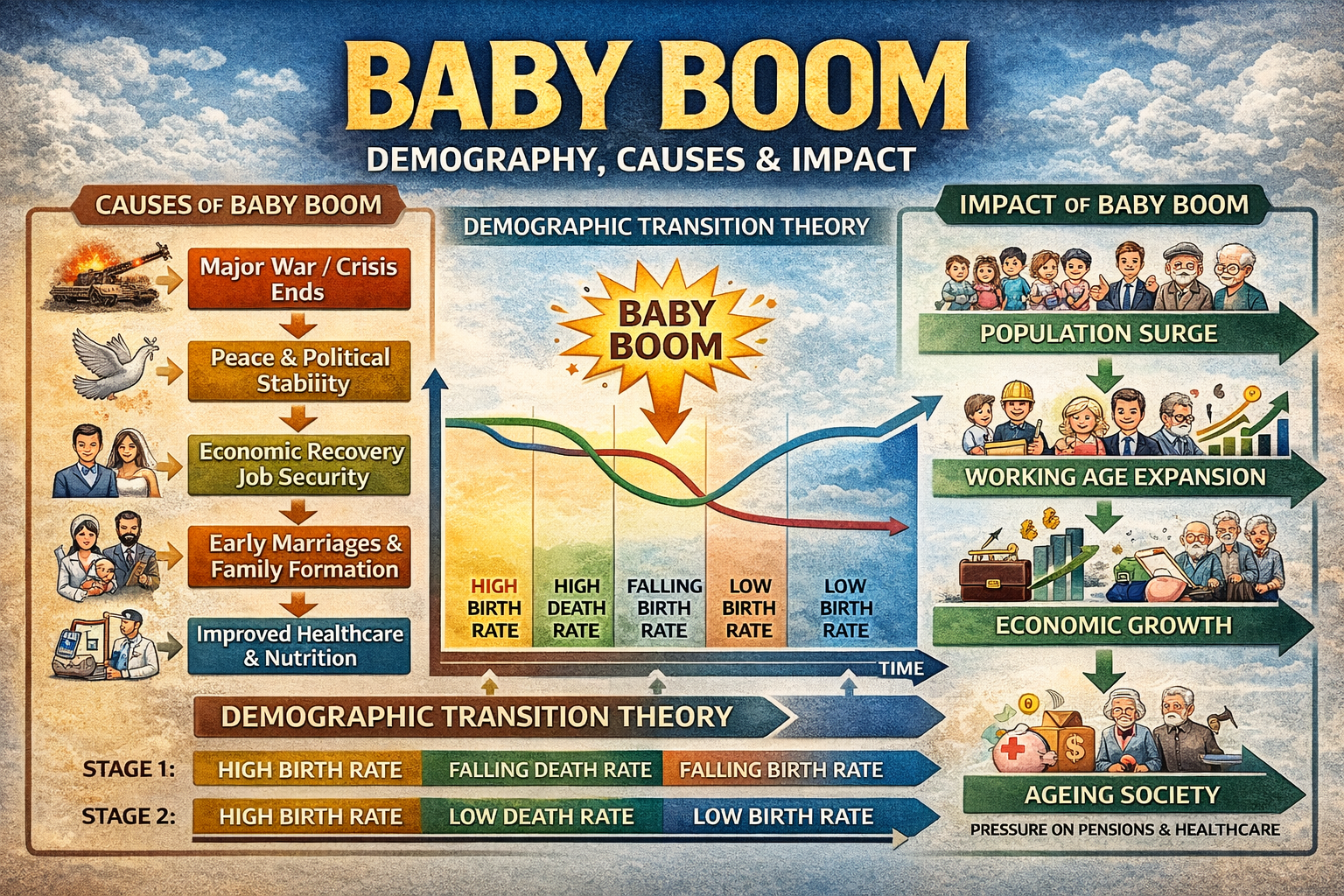
Why Did Baby Booms Occur?
Baby booms are not accidental—they result from favourable social and economic conditions.
Major Causes
- Post-war peace and optimism
- Economic stability and rising incomes
- Expansion of healthcare and nutrition
- Early marriages and family formation
- Government welfare and housing policies
- Cultural emphasis on family life
What Is Demographic Transition Theory (DTT)?
The Demographic Transition Theory explains how populations change over time as societies develop economically and socially.
It describes the transition from high birth and death rates to low birth and death rates, resulting in population stabilization.
Stages of Demographic Transition Theory
Stage 1: High Stationary
- High birth rates
- High death rates
- Slow population growth
- Pre-industrial societies
Stage 2: Early Expanding
- High birth rates
- Rapid decline in death rates
- Population explosion
- Improved sanitation and healthcare
Stage 3: Late Expanding
- Declining birth rates
- Low death rates
- Slowing population growth
- Urbanization and education
Stage 4: Low Stationary
- Low birth rates
- Low death rates
- Stable population
- Developed economies
(Some scholars add Stage 5: Population Decline)
Who Proposed and Propounded Demographic Transition Theory?
- Warren S. Thompson (1929)
First observed population patterns in industrialized countries. - Frank W. Notestein (1945)
Fully developed and popularized the theory, linking population change with modernization.
Later scholars expanded the theory with regional and policy-based interpretations.
How Is Baby Boom Linked to Demographic Transition?
The baby boom is not a separate theory—it is a phenomenon within the demographic transition process.
Key Relationship
- Occurs mainly during Stage 2 or early Stage 3
- Death rates fall faster than birth rates
- Results in rapid population growth
The post-WWII baby boom occurred when:
- Mortality had already declined
- Fertility temporarily increased due to social conditions
Why Is the Baby Boom Important in Demographic History?
1. Shaped Population Structure
- Created large youth cohorts
- Later led to population ageing
2. Economic Impact
- Boosted labour force decades later
- Stimulated consumption and housing markets
3. Social Transformation
- Expansion of education systems
- Rise of middle class
- Cultural shifts in family life
4. Policy Planning
- Influenced pension systems
- Healthcare and social security reforms
Baby Boom and Global Variations
| Region | Baby Boom Experience |
| USA & Europe | Post-WWII baby boom |
| Japan | Short but intense boom |
| India | No classic baby boom, but population surge during mortality decline |
| Africa | High fertility with delayed transition |
Baby Boom vs Population Explosion
| Aspect | Baby Boom | Population Explosion |
| Duration | Short-term | Long-term |
| Cause | Social optimism | Mortality decline |
| Nature | Temporary | Structural |
| Example | Post-WWII West | Developing countries |
Long-Term Consequences of Baby Boom
Positive
- Economic growth
- Demographic dividend
- Innovation and productivity
Challenges
- Ageing population
- Pension burden
- Healthcare pressure
- Shrinking workforce (later phase)
Why Baby Boom Is Still Relevant Today
Today’s issues like:
- Ageing societies
- Declining fertility
- Labour shortages
- Inter-generational inequality
are all after-effects of past baby booms.
Understanding baby boom dynamics helps policymakers design:
- Sustainable population policies
- Employment strategies
- Social security reforms
Conclusion
The Baby Boom is not merely a spike in births—it is a powerful demographic force that shaped modern history. Closely tied to the Demographic Transition Theory, it explains how societies move from survival to stability, from expansion to equilibrium.
Studying the baby boom allows us to understand the past population surge, manage present challenges, and prepare for the future demographic reality.
Leave a Reply