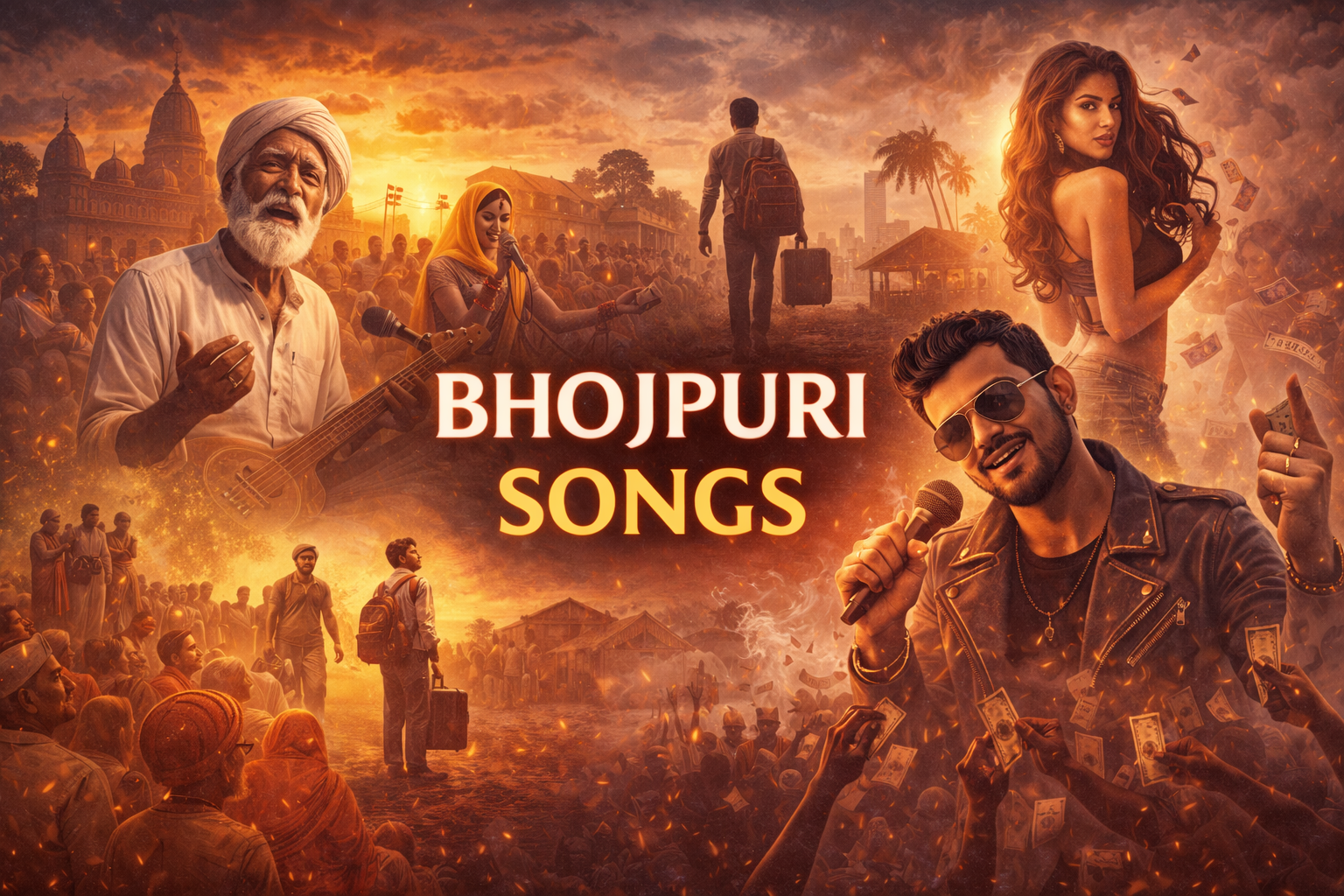
Introduction: Bhojpuri Songs as the Soul of a Civilization
Thank you for reading this post, don’t forget to subscribe!Bhojpuri songs are not merely forms of entertainment; they are the living archive of a people’s history, emotions, struggles, and aspirations. Rooted in the Bhojpuri-speaking regions of eastern Uttar Pradesh, western Bihar, and parts of Jharkhand, Bhojpuri folk music has historically functioned as a cultural compass, guiding social values, collective memory, and moral consciousness.
From birth to death, from joy to grief, from agriculture to migration, Bhojpuri songs accompany every phase of life. However, in recent decades, this rich tradition faces a serious crisis—vulgarisation, commodification of women, and erosion of cultural ethics, threatening a centuries-old legacy shaped by legends like Bhikhari Thakur, Mahendra Mishir, and Sharda Sinha.
This blog explores the history, cultural depth, social role, and contemporary challenges of Bhojpuri songs, while proposing a path for cultural renewal.
Historical Roots of Bhojpuri Songs
Oral Tradition and Folk Origins
Bhojpuri music evolved as an oral tradition, passed from generation to generation. It was never confined to elite spaces; rather, it flourished in:
- Fields and farms
- Riverbanks and ghats
- Courtyards of villages
- Worksites of labourers
These songs were collective expressions—authored by society, not individuals.
Bhojpuri Songs and Indian Freedom Struggle
Bhojpuri folk songs played a subtle yet powerful role during the freedom movement:
- Songs carried messages of resistance, unity, and sacrifice
- They spread nationalist consciousness among rural masses
- British authority often failed to understand their coded meanings
These songs mobilised emotions where formal political speeches could not reach.
Deep Cultural Embeddedness of Bhojpuri Songs
Songs Across the Life Cycle
Bhojpuri music touches every human transition:
- Sohar – Birth songs celebrating motherhood
- Mundan & Vivah Geet – Rituals, social bonds, and moral instruction
- Bidai & Bidesiya Geet – Pain of separation and migration
- Kaharwa & Jatsaar – Death and philosophical reflections
These songs are social textbooks, teaching values without formal instruction.
Festivals and Seasonal Rhythms
Bhojpuri songs are inseparable from festivals and seasons:
- Chhath Geet – Devotion, ecology, and gratitude to nature
- Kajari & Jhoola – Monsoon, love, longing, and fertility
- Phagua (Holi songs) – Social equality, satire, and joy
- Barahmasa – Twelve months of emotional and agrarian life
Thus, Bhojpuri songs are time-sensitive cultural expressions, aligned with nature and climate.
Bhojpuri Songs and Migration: Voice of the Displaced
Migration (Bides) is central to Bhojpuri identity.
- Songs express the pain of separation
- Women articulate loneliness, emotional labour, and resilience
- Men express alienation, hardship, and hope
These songs humanised migration long before sociologists studied it. They served as emotional therapy for displaced labourers, from colonial-era plantations to modern cities.
Social Reform and Moral Consciousness
Bhikhari Thakur: The Cultural Reformer
Known as the “Shakespeare of Bhojpuri”, Bhikhari Thakur used songs and theatre to address:
- Women’s dignity
- Migration trauma
- Caste oppression
- Alcoholism and social evils
His works like Bidesiya and Beti Bechwa remain unmatched in moral clarity.
Mahendra Mishir: Aesthetic Purity
Mahendra Mishir elevated Bhojpuri songs with:
- Linguistic elegance
- Emotional restraint
- Classical sensibility
His compositions preserved the purity of expression, resisting vulgar impulses.
Sharda Sinha: Voice of Cultural Integrity
Sharda Sinha became synonymous with:
- Chhath songs
- Folk purity
- Feminine dignity
She proved that popularity and cultural integrity can coexist.
Bhojpuri Songs as Mirror of Village Life
Bhojpuri folk music documents:
- Agricultural labour
- Gender roles
- Poverty and survival
- Collective celebrations
- Moral dilemmas
They are ethnographic records, offering insights into rural sociology and economics.
Contemporary Crisis: Vulgarisation and Cultural Distortion
In recent years, Bhojpuri songs have undergone a disturbing transformation:
Key Problems
- Obscene lyrics replacing poetic metaphor
- Women portrayed as consumable objects
- Aggressive male gaze and dominance
- Commercialisation driven by instant visibility
This distortion is not cultural evolution—it is cultural degradation.
Impact on Society and Youth
- Normalisation of misogyny
- Erosion of linguistic elegance
- Loss of moral sensitivity
- Cultural alienation among youth
Such content damages not only Bhojpuri culture but also social ethics.
How Legacy Artists Are Affected
The works of Bhikhari Thakur, Mahendra Mishir, Sharda Sinha, and countless folk contributors are overshadowed by sensationalism. Their legacy risks becoming archival rather than living tradition.
Responsibility of Makers and Consumers
Accountability of Creators
- Ethical responsibility in representation
- Cultural literacy among artists
- Respect for language and tradition
Responsibility of Consumers
- Conscious consumption
- Rejecting vulgar content
- Supporting folk and classical forms
Culture survives by collective choice.
Path Forward: Remedies and Cultural Renewal
1. Institutional Support
- Folk music academies
- Curriculum inclusion
- Grants for traditional artists
2. Media Responsibility
- Public broadcasters promoting folk purity
- Digital platforms curating ethical content
3. Cultural Literacy
- Teaching Bhojpuri literature in schools
- Documenting folk traditions
4. Community Revival
- Village festivals
- Folk competitions
- Intergenerational transmission
Conclusion: Saving the Soul of Bhojpuri Culture
Bhojpuri songs are not disposable content—they are cultural inheritance. Their degradation is not merely artistic loss but civilisational erosion.
Reviving Bhojpuri music means:
- Respecting women
- Honouring labour
- Valuing emotion over sensation
- Preserving cultural memory
The future of Bhojpuri culture depends on whether society chooses market-driven vulgarity or value-driven creativity.
The choice is ours.
Leave a Reply