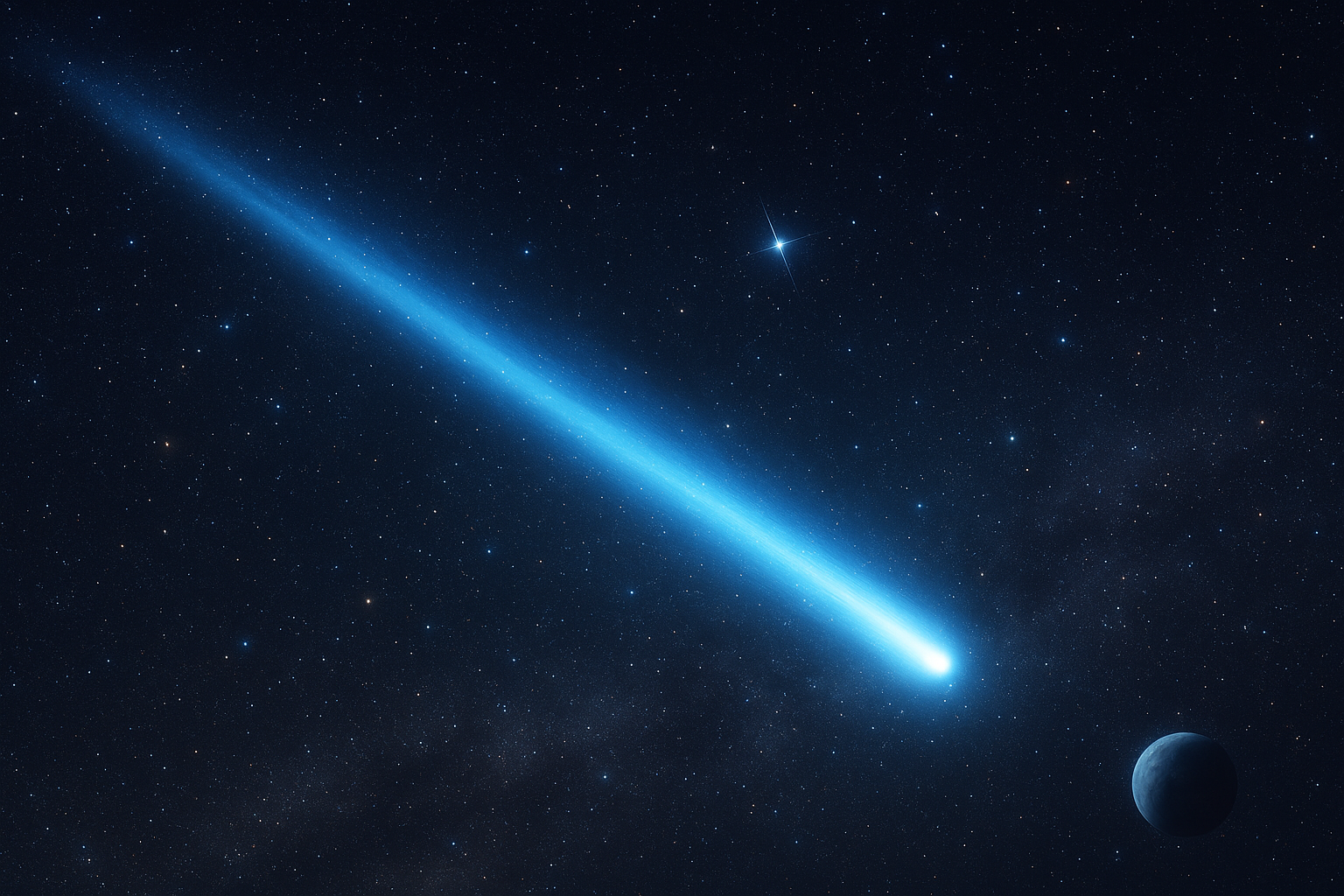
Introduction: A Visitor from the Deep Cosmos
Thank you for reading this post, don’t forget to subscribe!In July 2025, astronomers detected a celestial traveller unlike most others — 3I/ATLAS, an interstellar object racing through our Solar System from the vast unknown beyond. This cosmic wanderer is not a native of our Sun’s family but an interstellar visitor, making it only the third object in history confirmed to originate from another star system. Its discovery marks a new milestone in humanity’s exploration of the universe, offering scientists a rare glimpse into the materials and chemistry that shaped other distant worlds.
What Is 3I/ATLAS?
3I/ATLAS is an interstellar comet, meaning it originated outside our Solar System. It was discovered on July 1, 2025 by the Asteroid Terrestrial-impact Last Alert System (ATLAS) telescope in Chile. Its official designation is C/2025 N1 (ATLAS), but because it is the third interstellar object ever detected, it’s commonly known as 3I/ATLAS — where “3I” stands for “Third Interstellar” and “ATLAS” is the name of the survey that spotted it.
This discovery followed two previous interstellar guests — 1I/ʻOumuamua (2017) and 2I/Borisov (2019) — making 3I/ATLAS a significant addition to this elite group of cosmic visitors.
A Hyperbolic Journey Through the Solar System
Unlike ordinary comets bound by the Sun’s gravity, 3I/ATLAS follows a hyperbolic trajectory, meaning its orbit is open — it entered our Solar System from interstellar space and will leave it forever.
- Speed: ~130,000 mph (≈ 209,000 km/h) relative to the Sun.
- Closest approach to the Sun (Perihelion): Around October 29, 2025, at a distance of about 1.4 AU (inside Mars’ orbit).
- Closest approach to Earth: About 1.8 AU (≈ 270 million km) — posing no threat to our planet.
This rare passage offers a short window for astronomers to observe, analyse, and learn from its journey before it vanishes back into the cosmic dark.
Why Scientists Are So Excited About 3I/ATLAS
Each interstellar object gives scientists a one-of-a-kind opportunity to study material that did not form around our Sun. 3I/ATLAS is especially intriguing because:
- It’s larger and brighter than previous interstellar visitors — some estimates suggest its nucleus could be 5–6 km in diameter.
- It shows unusual behaviour — early observations revealed minimal non-gravitational acceleration, despite visible mass loss. This implies it may be denser or more massive than typical comets.
- It leaks water in an unusual way, as noted by NASA’s Hubble observations, hinting at a unique internal composition unlike any known Solar System comet.
Such anomalies have fuelled both excitement and debate in the scientific community, with some suggesting that 3I/ATLAS may reveal new insights into how planetary systems form and evolve in the galaxy.
What Makes 3I/ATLAS Different?
While 1I/ʻOumuamua appeared more like an asteroid and 2I/Borisov behaved like a classic comet, 3I/ATLAS displays a hybrid character — showing both cometary activity and unusually stable motion.
| Interstellar Object | Year Discovered | Type | Key Trait |
| 1I/ʻOumuamua | 2017 | Rocky or metallic | Cigar-shaped, no visible coma |
| 2I/Borisov | 2019 | Comet | Classic comet tail, icy nucleus |
| 3I/ATLAS | 2025 | Interstellar comet | Large, dense, water-emitting body |
3I/ATLAS seems to blur the lines between the two, offering an entirely new category of interstellar object.
Scientific Missions and Observations
Major space agencies like NASA and ESA quickly turned their attention to this cosmic traveller.
- The Hubble Space Telescope captured detailed images, estimating its nucleus and tracking its water emission patterns.
- The European Space Agency (ESA) released FAQs and observation data confirming its hyperbolic path and interstellar nature.
- Ground-based observatories across Chile, Hawaii, and Europe are conducting spectroscopic studies to compare its ices, dust, and gases with known Solar System comets.
Each dataset helps astronomers’ piece together a cosmic puzzle — what kind of environment could produce a body like 3I/ATLAS?
The Mystery Still Unfolds
Despite intensive study, several questions remain unanswered:
- Origin: Which star system did 3I/ATLAS come from? Current models cannot pinpoint its origin with precision.
- Composition: What are the exact proportions of water, methane, and organic compounds within it?
- Nature: Is it purely a natural comet, or could its behaviour reveal unknown interstellar physics or formation processes?
As Harvard astrophysicist Avi Loeb notes, the object’s lack of acceleration despite mass loss could indicate a surprisingly dense and heavy core, raising intriguing possibilities about its makeup.
Why 3I/ATLAS Matters for Astronomy
Every interstellar object is like a postcard from another world — a time capsule carrying materials forged around a different star. Studying 3I/ATLAS helps scientists:
- Understand how planetary systems form elsewhere.
- Estimate how often interstellar objects pass through our Solar System.
- Compare the chemistry of alien comets to those formed around our Sun.
These insights can reshape our understanding of how matter — and possibly even life’s building blocks — move between stars in the Milky Way.
A Glimpse into the Future
3I/ATLAS will soon fade from view, continuing its eternal voyage into interstellar space. Yet, the data it leaves behind will keep astronomers busy for years. Future missions, such as potential rapid-response probes, may one day chase such visitors for close-up study — allowing humanity to literally touch material from another star system.
Its brief visit reminds us of a profound truth: the Solar System is not isolated, but part of a dynamic, interconnected galaxy, where even small icy fragments can travel billions of kilometres to tell their story.
Conclusion: A Messenger from the Stars
The discovery of 3I/ATLAS represents far more than another comet sighting — it’s a message from the cosmos itself. Each interstellar traveller that graces our skies challenges what we know and expands what we can imagine. As 3I/ATLAS races back into the galactic void, it leaves behind not only trails of dust and water but also a deeper curiosity about our place in the universe.

Leave a Reply