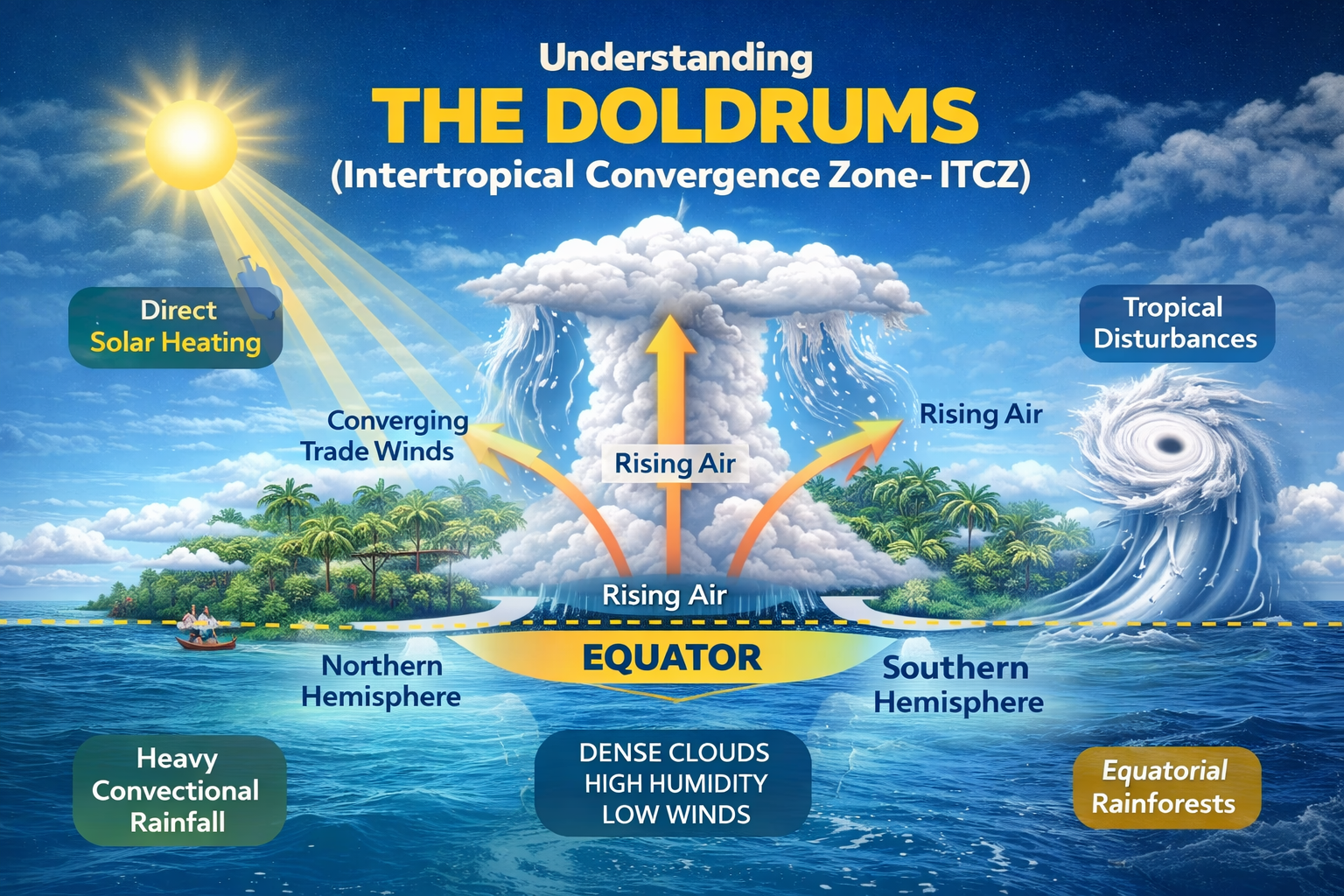
The Doldrums represent one of the most fascinating and climatically significant regions of the Earth. Located near the equator, this zone plays a crucial role in shaping global wind circulation, rainfall patterns, and climate systems. Though often associated with calm winds and oppressive heat, the Doldrums are far more dynamic and influential than commonly perceived.
Thank you for reading this post, don’t forget to subscribe!This blog explores the concept of Doldrums in geography, their origin, causes, importance, alternative names, and the factors that influence and are influenced by them.
What Are the Doldrums? (Meaning and Definition)
In geography, the Doldrums refer to a belt of low atmospheric pressure situated roughly between 5° North and 5° South of the Equator. This region is characterized by:
- Weak or variable winds
- High temperatures
- High humidity
- Frequent cloud formation and convectional rainfall
Scientifically, the Doldrums are where the trade winds of the Northern Hemisphere (northeast trade winds) and the Southern Hemisphere (southeast trade winds) converge and rise upward.
Why Is It Called “Doldrums”?
The term “doldrums” originates from old English maritime usage, meaning a state of inactivity, stagnation, or listlessness.
Historical Background
- During the age of sailing ships, sailors often became trapped in this zone for weeks or months due to the absence of steady winds.
- Ships relied entirely on wind power, and being stranded here led to shortages of food, water, and morale.
- This frustrating experience gave rise to the term “doldrums.”
Thus, the name reflects both physical calm and psychological stagnation experienced by early navigators.
Other Names of the Doldrums
The Doldrums are also known by several scientific and regional names:
1. Intertropical Convergence Zone (ITCZ)
This is the most widely used scientific term today. It emphasizes the convergence of trade winds from both hemispheres.
2. Equatorial Low-Pressure Belt
This name highlights the persistent low-pressure conditions created by intense solar heating.
3. Thermal Equator (in some contexts)
Since this region receives maximum solar radiation, it is sometimes associated with the thermal equator.
Concept of Doldrums in Geography
From a geographical perspective, the Doldrums are an integral part of the global atmospheric circulation system.
Key Characteristics
- Intense solar heating causes air to expand and rise
- Rising air creates low surface pressure
- As air rises, it cools, leading to condensation and rainfall
- Winds at the surface remain weak or variable
This rising air later moves poleward at higher altitudes, forming the Hadley Cell, a major component of global circulation.
Factors Influencing the Doldrums
Several natural factors determine the location, intensity, and behaviour of the Doldrums:
1. Solar Insolation
- The equatorial region receives direct vertical rays of the Sun.
- This leads to maximum heating and strong convection.
2. Earth’s Rotation
- The Coriolis force causes trade winds to deflect, aiding their convergence near the equator.
3. Seasonal Movement of the Sun
- The Doldrums shift northward and southward with the apparent movement of the Sun.
- This shift strongly affects monsoon systems, especially in South Asia and Africa.
4. Land–Sea Distribution
- Over continents, heating is more intense, strengthening convection.
- Over oceans, the Doldrums are more stable but still active.
5. Sea Surface Temperature
- Warm ocean currents enhance evaporation and rainfall in the Doldrum zone.
Factors Influenced by the Doldrums
The Doldrums, in turn, influence several global systems:
1. Global Rainfall Distribution
- Regions near the Doldrums receive heavy convectional rainfall.
- Equatorial rainforests such as the Amazon Basin, Congo Basin, and Indonesia exist largely due to this system.
2. Monsoon Circulation
- The seasonal movement of the ITCZ plays a critical role in Indian, African, and Australian monsoons.
3. Trade Wind System
- The convergence at the Doldrums helps maintain global wind balance.
4. Tropical Weather Systems
- Many tropical disturbances and cyclones originate near the ITCZ.
5. Marine and Atmospheric Ecosystems
- High rainfall and warm waters influence marine productivity and biodiversity.
Why Are the Doldrums Important?
The importance of the Doldrums can be understood from climatic, ecological, and geographical perspectives:
1. Climate Regulation
- They act as a heat redistribution mechanism, transferring energy from the equator to higher latitudes.
2. Source of Freshwater
- Persistent rainfall sustains major river systems and groundwater recharge.
3. Biodiversity Hotspots
- Dense tropical forests and coral ecosystems owe their existence to this climatic zone.
4. Navigation and Aviation
- Though historically dangerous for ships, modern understanding helps in route planning and weather forecasting.
5. Human Geography
- Settlement patterns, agriculture, and livelihoods in equatorial regions are deeply influenced by Doldrum-related climate.
Doldrums and Climate Change
With rising global temperatures:
- The intensity and position of the ITCZ may shift.
- Rainfall patterns could become more erratic.
- This may affect food security and ecosystems in tropical regions.
Hence, understanding the Doldrums is increasingly important in the context of global climate change.
Conclusion
The Doldrums are far more than a region of calm winds; they are a dynamic, powerful, and essential component of Earth’s atmospheric system. Known scientifically as the Intertropical Convergence Zone (ITCZ), they influence global winds, rainfall, monsoons, biodiversity, and climate balance.
From ancient sailors struggling with windless seas to modern climatologists studying global circulation, the Doldrums remain a subject of immense geographical significance. A clear understanding of this concept enriches our knowledge of how Earth functions as a connected and interdependent system.
Leave a Reply