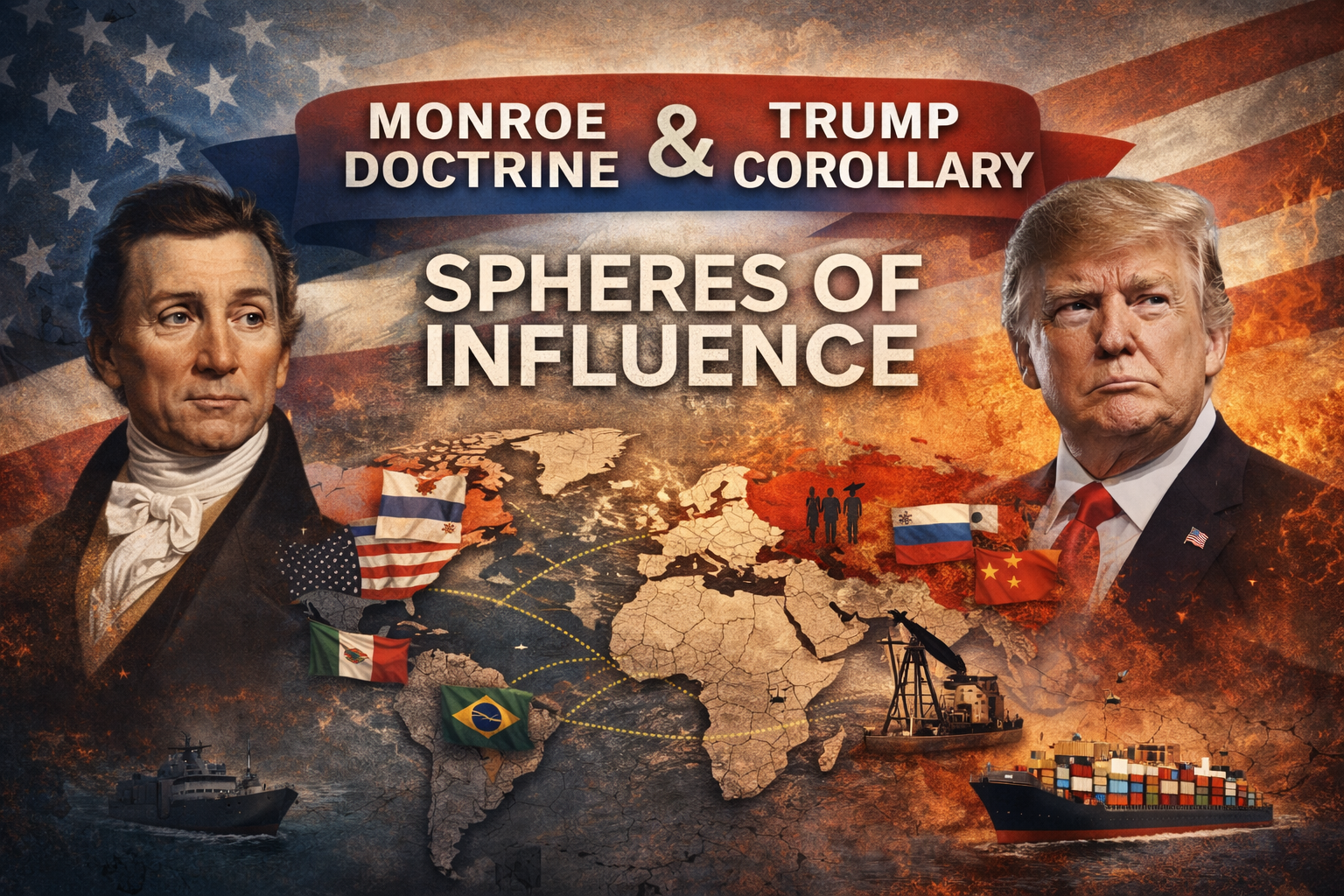
Foreign policy doctrines are not merely historical declarations; they are windows into how a nation sees itself and the world. From the early 19th century to the turbulence of the 21st, the United States has repeatedly articulated its vision of power, order, and influence through doctrines. Among them, the Monroe Doctrine stands as one of the most consequential—and controversial.
Thank you for reading this post, don’t forget to subscribe!In recent years, analysts have increasingly spoken of a “Trump Corollary”—not as a formal proclamation, but as a revived and reshaped worldview that echoes Monroe’s logic under modern geopolitical conditions.
Together, these ideas reflect a deeper question: Is the world returning to spheres of influence?
The Monroe Doctrine (1823): Origins and Meaning
The Monroe Doctrine, articulated by U.S. President James Monroe in his 1823 annual address to Congress, emerged at a time when newly independent Latin American nations were vulnerable to European recolonisation.
Core Principles
- No New European Colonisation in the Western Hemisphere
- Non-Interference by Europe in the affairs of the Americas
- Reciprocal Non-Intervention—the U.S. would stay out of European conflicts
- Separate Spheres: Europe and the Americas were distinct political worlds
At its heart, the doctrine was both defensive and aspirational:
- Defensive, because the U.S. lacked the military power to enforce it alone
- Aspirational, because it asserted moral and political leadership in the hemisphere
Initially symbolic, the Monroe Doctrine gained teeth only as U.S. power expanded in the late 19th and early 20th centuries.
From Doctrine to Dominance: Evolution Through Corollaries
Over time, the Monroe Doctrine was reinterpreted and expanded.
The Roosevelt Corollary (1904)
President Theodore Roosevelt transformed Monroe’s warning into justification for active intervention in Latin America, claiming the U.S. had a right to act as an “international police power.”
This marked a shift:
- From non-colonisation → regional dominance
- From principle → practice
The Western Hemisphere became, in effect, America’s strategic backyard.
What Is the “Trump Corollary”?
The Trump Corollary is not an official doctrine, but a conceptual framework used by scholars and analysts to describe Donald Trump’s foreign policy orientation.
It represents a modern reinterpretation of Monroe-style thinking, applied not only regionally but globally.
Key Characteristics
- America First Nationalism
Foreign policy driven primarily by perceived U.S. economic and strategic advantage. - Transactional Diplomacy
Alliances treated as deals, not commitments; security guarantees tied to burden-sharing. - Opposition to External Influence Near U.S. Borders
Strong resistance to Chinese, Russian, or Iranian presence in the Western Hemisphere. - Scepticism of Multilateralism
WTO, WHO, NATO, and climate frameworks viewed as constraints on sovereignty. - Economic Coercion as Strategy
Tariffs, sanctions, and secondary penalties used as geopolitical weapons.
In essence, the Trump Corollary revives Monroe’s sphere-of-influence logic, but replaces idealism with hard realism and economic leverage.
What Is It Called Combinedly?
There is no formal name, but in academic and strategic discourse it is often described as:
- Neo-Monroe Doctrine
- Monroe Doctrine 2.0
- Spheres-of-Influence Realism
- Unilateral Strategic Regionalism
Conceptually, it represents a fusion of:
- Monroe Doctrine (territorial exclusion)
- Roosevelt Corollary (interventionist logic)
- Trump Doctrine (economic nationalism and coercive realism)
How Does This Combined Doctrine Perceive the World Order?
This worldview rejects the post-Cold War assumption of a rules-based liberal international order.
Instead, it sees the world as:
- Multipolar
- Competitive
- Fragmented by Civilisation
Core Assumptions
- Great powers naturally dominate regions
- Global governance institutions are weak or biased
- Economic interdependence is a vulnerability, not a virtue
- Security is zero-sum, not collective
In this vision:
- The U.S. dominates the Western Hemisphere
- China dominates East Asia
- Russia asserts influence in Eastern Europe and Eurasia
This is a return to 19th-century power logic in a 21st-century system.
Feasibility in the Current World Order
What Makes It Feasible
- Decline of Multilateral Enforcement
- Rise of Nationalism Globally
- Strategic Rivalries (US–China, US–Russia)
- Weaponisation of Trade and Finance
What Limits Its Application
- Deep Economic Interdependence
- Rise of Middle Powers (India, Brazil, Indonesia)
- Technological Diffusion
- Resistance from Global South
Unlike 1823, today’s world is too interconnected for clean regional separation.
Geopolitical Implications
1. Fragmentation of Global Trade
Tariffs, sanctions, and blocs replace free trade, leading to:
- Supply chain re-shoring
- Inflationary pressures
- Regional economic blocs
2. Normalisation of Economic Warfare
Sanctions become routine, eroding trust in:
- Dollar dominance
- Global financial systems
3. Strategic Autonomy Movements
Countries like India pursue non-alignment 2.0, refusing binary choices.
4. Increased Regional Instability
Spheres of influence create:
- Proxy conflicts
- Coercive diplomacy
- Smaller states caught between powers
5. Decline of Normative Leadership
Human rights, democracy promotion, and climate cooperation become secondary to power politics.
Conclusion: A Doctrine for an Unsettled Age
The Monroe Doctrine was born in a world of empires.
The Trump Corollary operates in a world of contested globalisation.
Together, they symbolise a profound shift:
- From rules to power
- From globalism to spheres
- From collective security to strategic self-help
Whether this approach brings stability or chaos remains uncertain. What is clear, however, is that the age of unquestioned liberal internationalism is over, and doctrines once thought historical are once again shaping the future.
Leave a Reply