Blog

  • September 2025 Blood Moon: Everything You Need to Know About the Rare Total Lunar Eclipse

    September 2025 Blood Moon: Everything You Need to Know About the Rare Total Lunar Eclipse

    Introduction

    On September 7–8, 2025, the world will witness one of nature’s most breathtaking spectacles—a total lunar eclipse, commonly called the Blood Moon. For skywatchers, this is more than just an astronomical event; it’s a reminder of our shared humanity and our connection to the cosmos. With visibility across Asia, Africa, the Americas, and Oceania, billions of people will have the chance to pause, look up, and reflect under a red-hued moon.

    In this blog, we will explore the science behind a lunar eclipse, the unique significance of the 2025 Blood Moon, practical viewing tips, and the inspiring life lessons we can learn from this celestial event.

    What Is a Lunar Eclipse?

    A lunar eclipse occurs when the Earth moves directly between the Sun and the Moon, casting its shadow across the lunar surface. There are three main types:

    1. Penumbral Eclipse – when the Moon passes through Earth’s faint outer shadow (often barely noticeable).
    2. Partial Eclipse – when only a portion of the Moon enters Earth’s darker shadow (umbra).
    3. Total Eclipse (Blood Moon) – when the entire Moon passes into the umbra, turning a striking reddish-orange.

    The red glow happens because Earth’s atmosphere filters sunlight, scattering blue light and bending the remaining red/orange hues onto the Moon’s surface—a process similar to what gives us red sunrises and sunsets.

    Why the September 2025 Blood Moon Is Special

    • Global Reach: Over 7 billion people across continents will be able to view it.
    • Dramatic Visibility: The Moon will appear larger and more luminous than usual, with its fiery red colour lasting for several hours.
    • Rare Timing: Such widespread visibility of a full eclipse is uncommon—making this one of the most talked-about celestial events of the decade.

    Viewing Tips: How to Experience the 2025 Blood Moon

    1. Mark the Date: September 7–8, 2025. Check your local time zone for exact peak visibility.
    2. Choose Your Spot: Find an open area with minimal light pollution (parks, rooftops, or countryside locations).
    3. Bring Tools: While the eclipse is visible to the naked eye, binoculars or a telescope will enhance the view.
    4. Capture the Moment: Use a tripod for smartphone photography, or long-exposure settings for cameras.
    5. Stay Safe: Unlike solar eclipses, lunar eclipses are safe to watch directly—no protective glasses required.

    Lessons We Can Learn from the Blood Moon

    The Blood Moon is more than a beautiful event—it carries profound life lessons:

    1. We Are Part of Something Greater

    No matter where you stand on Earth, you will see the same Moon. It reminds us that beneath all differences—cultural, geographical, or political—we share the same sky.

    2. Life Moves in Cycles

    The eclipse shows us that darkness is temporary. Just as the shadow passes, so do our challenges. Every setback makes way for light again.

    3. Change Can Be Beautiful

    The Moon doesn’t resist the Earth’s shadow—it embraces it and turns radiant red. In life, too, embracing change often reveals unexpected beauty.

    4. Knowledge Deepens Wonder

    Understanding the science doesn’t take away from the magic—it enhances it. Similarly, in life, curiosity and learning make experiences richer.

    Cultural Significance of Lunar Eclipses

    Throughout history, lunar eclipses have been woven into myths and traditions:

    • In ancient India, eclipses were linked to the mythical demon Rahu, believed to swallow the Moon.
    • Native American tribes saw lunar eclipses as moments of renewal and reflection.
    • In modern times, they’ve become universal opportunities for community gatherings and stargazing events.

    This blend of science and symbolism makes the 2025 Blood Moon not just an astronomical event, but a cultural and spiritual one as well.

    Final Thoughts

    The September 2025 Blood Moon will be more than a skywatcher’s delight—it will be a global reminder of connection, resilience, and wonder. As the Earth’s shadow paints the Moon red, take a moment to pause, reflect, and feel inspired.

    Key Takeaway: Like the Moon, we too move through phases of light and shadow. But even in darkness, beauty can emerge.

    So, mark your calendar, gather your loved ones, and let the night sky remind you of the endless possibilities waiting to be discovered.

  • The Mother Ganga: Lifeline and Eternal Flow of India’s Civilization

    The Mother Ganga: Lifeline and Eternal Flow of India’s Civilization

    Introduction

    The Ganga River, often called Mother Ganga in India, is not just a river but a living symbol of faith, culture, and civilization. Flowing majestically for over 2,500 kilometers across the northern plains of India and Bangladesh, the Ganga nourishes millions of lives, shapes economies, inspires literature, and forms the spiritual backbone of Hindu civilization. Recognized as one of the most sacred rivers in the world, the Ganga is revered as a goddess, a purifier, and a lifeline.

    This article explores the history, geography, origin, spiritual significance, cultural role, economic importance, challenges, and solutions related to the Ganga River.

    Geographical Background and Origin

    • Origin: The Ganga originates from the Gangotri Glacier in the Himalayas (Uttarakhand) at a height of around 4,100 meters. At its source, it is called the Bhagirathi.
    • Confluence: At Devprayag, the Bhagirathi meets the Alaknanda, after which the river is officially known as the Ganga.
    • Length and Course: The Ganga flows for about 2,525 km, traversing the fertile plains of Uttarakhand, Uttar Pradesh, Bihar, Jharkhand, West Bengal, and finally merging into the Bay of Bengal through Bangladesh (where it is called the Padma).
    • Tributaries: Major tributaries include the Yamuna, Ghaghara, Gandak, Kosi, Son, Chambal, and Damodar.

    Historical Background

    The Ganga has been the cradle of Indian civilization for over 5,000 years:

    • The Indus–Ganga–Brahmaputra plain supported some of the earliest agricultural settlements.
    • Ancient cities like Varanasi, Pataliputra, Prayagraj, and Haridwar flourished on its banks.
    • Many empires—including the Mauryas, Guptas, and Mughals—prospered due to the fertile lands and trade routes along the river.
    • The Ganga has been immortalized in the Rigveda, Mahabharata, Ramayana, and Puranas, where it is revered as a divine and purifying force.

    Spiritual and Religious Significance

    The Ganga is not merely a river; it is worshipped as Goddess Ganga in Hinduism.

    • Symbol of Purity: Hindus believe that bathing in the Ganga washes away sins and ensures moksha (liberation from the cycle of birth and death).
    • Rituals and Festivals: Millions gather at the river during Kumbh Mela, Ganga Dussehra, and Kartik Purnima. Daily Ganga Aarti at Varanasi and Haridwar attracts devotees and tourists worldwide.
    • Final Rites: Immersing ashes in the Ganga is believed to liberate souls.
    • Pilgrimage Cities: Haridwar, Rishikesh, Varanasi, Prayagraj, and Gangotri are among the holiest cities on its banks.

    Cultural Influence

    • The river has inspired countless poems, songs, and art forms throughout Indian history.
    • Ganga is often personified as the mother figure in Indian folklore and literature.
    • Famous writers like Kalidasa, Tulsidas, and Rabindranath Tagore have referenced its sanctity.
    • Folk traditions, fairs, and local rituals across North India are closely tied to the river.

    Economic Importance

    The Ganga sustains one of the most fertile regions in the world:

    • Agriculture: The Gangetic plains produce rice, wheat, sugarcane, pulses, and oilseeds, feeding millions.
    • Industry: Many industries, including textile, leather, paper, and jute, are based near the Ganga basin.
    • Transport: The river historically served as a trade route. Today, the National Waterway-1 (from Prayagraj to Haldia) is being developed to boost inland water transport.
    • Fisheries and Livelihoods: Thousands depend on fishing and allied activities for survival.

    Social Importance

    • The Ganga binds together diverse languages, communities, and states under a shared cultural identity.
    • Villages, towns, and cities on its banks flourish due to irrigation, drinking water, and fertile soil.
    • The river provides livelihood to over 400 million people, making it one of the most densely populated river basins in the world.

    Environmental and Ecological Aspects

    • The Ganga supports rich biodiversity, including the endangered Ganges River Dolphin, freshwater turtles, and migratory birds.
    • However, modern challenges such as pollution, over-extraction, and climate change threaten its survival.
    • Government programs like Namami Gange aim to rejuvenate and protect the river.

    Challenges Facing the Ganga

    1. Industrial Waste & Pollution: Untreated sewage and toxic chemicals flow directly into the river.
    2. Urbanization: Encroachments, illegal sand mining, and infrastructure reduce natural flow.
    3. Climate Change: Melting glaciers in the Himalayas and erratic rainfall threaten seasonal flow.
    4. Population Pressure: Over 40% of India’s population depends on the Ganga basin, leading to overuse and degradation.

    Preserving and Protecting the Ganga: Solutions and Policy Recommendations

    1. Pollution Control

    • Establish stricter monitoring of industrial discharge and sewage treatment plants.
    • Incentivize industries to adopt eco-friendly technologies.
    • Expand wastewater recycling and reuse systems.

    2. People’s Awareness and Role

    • Educate communities on the impact of plastic waste, detergents, and untreated sewage.
    • Promote eco-friendly practices during rituals and festivals.
    • Encourage local participation in river-cleaning campaigns and youth-driven awareness programs.

    3. Policy and Governance

    • Strengthen the Namami Gange Mission with transparent monitoring and community involvement.
    • Introduce “Polluter Pays” principle to make industries accountable.
    • Develop river basin management authorities at the state and local level.
    • Integrate climate resilience policies for water conservation, rainwater harvesting, and sustainable irrigation.

    4. Technology and Innovation

    • Deploy modern systems for real-time water quality monitoring.
    • Promote bioremediation techniques for sewage treatment.
    • Use AI and satellite mapping to detect illegal encroachments and pollution hotspots.

    5. Community and Cultural Approach

    • Harness the faith and cultural connect with the Ganga to drive grassroots conservation movements.
    • Promote eco-tourism and river festivals that spread awareness.
    • Integrate Ganga protection themes into school curricula and social campaigns.

    Contemporary Relevance

    Despite challenges, the Ganga continues to:

    • Inspire eco-tourism and religious tourism.
    • Unite people across faiths and regions.
    • Remain central to India’s cultural diplomacy, with international projects to clean and preserve it.

    Conclusion

    The Ganga is more than a geographical entity; it is India’s lifeline, a cultural icon, and a spiritual guide. From nourishing fertile plains to inspiring spiritual awakening, from shaping empires to sustaining millions of livelihoods, the Ganga continues to flow as the eternal mother of Indian civilization.

    Preserving the Ganga requires collective action—a mix of policy, awareness, science, and spirituality. Protecting this sacred river is not only an environmental responsibility but also a cultural and moral duty for India and the world.

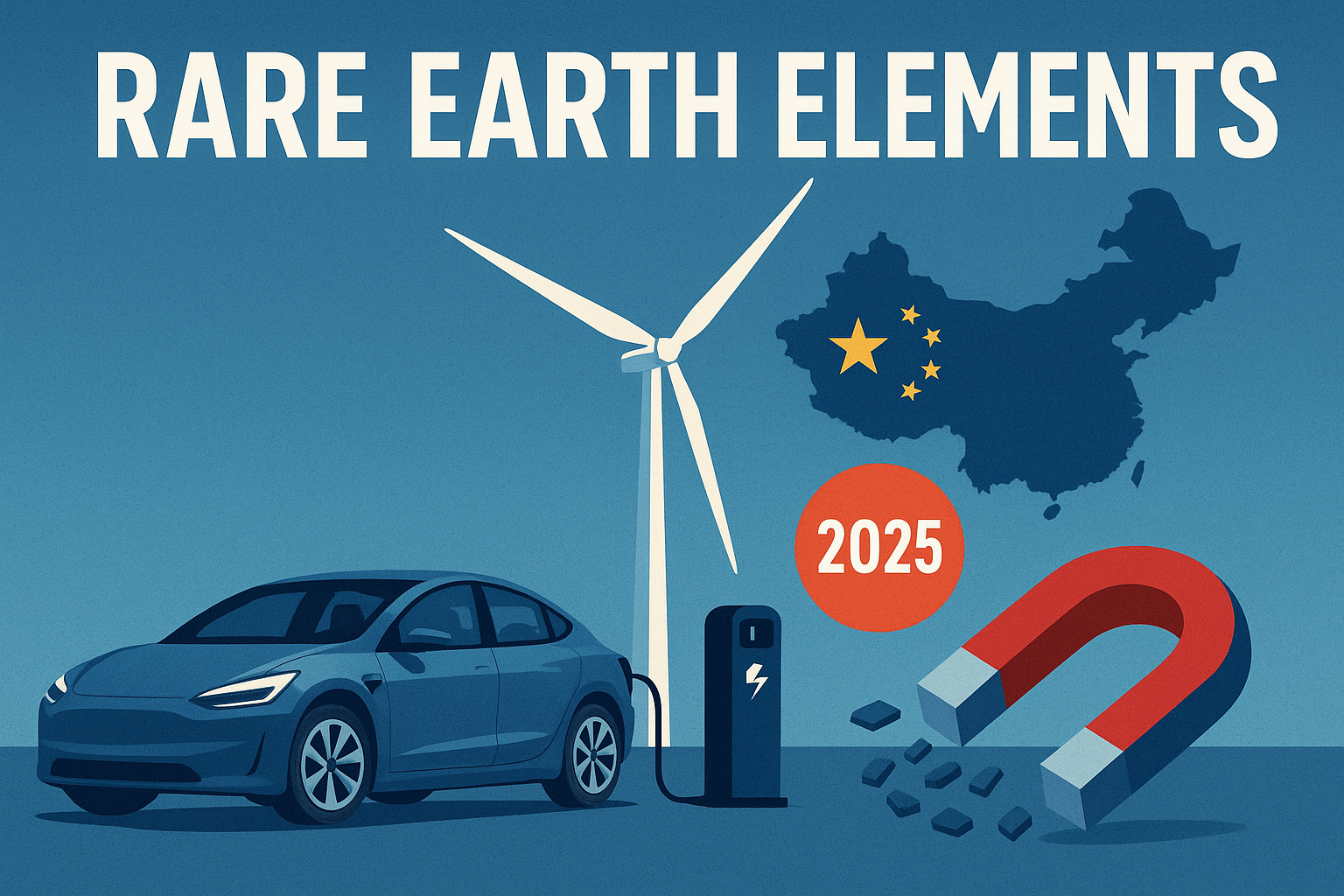
  • Rare Earth Elements in 2025: Resources Powering the Future of EVs, Wind, and Geopolitics

    Rare Earth Elements in 2025: Resources Powering the Future of EVs, Wind, and Geopolitics

    What are Rare Earth Elements (REEs)?

    Rare earth elements (REEs) are a group of 17 chemically similar elements: the 15 lanthanides, plus scandium and yttrium.

    • Light REEs: lanthanum, cerium, praseodymium, neodymium, samarium
    • Heavy REEs: europium, gadolinium, terbium, dysprosium, holmium, erbium, thulium, ytterbium, lutetium, plus yttrium

    Despite their name, REEs are not actually rare. Many are as abundant as copper in the Earth’s crust. What makes them “rare” is the challenge of finding concentrated, mineable deposits and the complex, costly, and environmentally challenging refining process required to separate them.

    Think of them as the vitamins of the modern economy: small in quantity but absolutely essential.

    Why Rare Earths Matter

    Rare earths give unique magnetic, optical, and catalytic properties. In small doses, they unlock technologies we rely on every day:

    • Permanent Magnets (NdFeB): Neodymium and praseodymium (NdPr), often with dysprosium (Dy) and terbium (Tb), create the world’s strongest magnets.
    • Catalysts & Polishing: Cerium and lanthanum are essential in oil refining, catalytic converters, and glass polishing.
    • Phosphors & Optics: Europium, terbium, and yttrium are used in displays, lasers, and Fiber optics.
    • Defence & Aerospace: Guidance systems, radar, drones, actuators, and advanced alloys all depend on REEs.

    A modern electric vehicle (EV) may use 2–3 kg of rare earth magnets, while a single wind turbine can contain hundreds of kilograms of REEs in its generator.

    In short, REEs are the quiet enablers of electrification, clean energy, and advanced Défence technology.

    Industries Dependent on Rare Earths

    1. Electric Vehicles (EVs) – Most EV motors use NdFeB magnets for efficiency and longer driving range.
    2. Renewable Energy – Direct-drive wind turbines rely heavily on REE magnets.
    3. Consumer Electronics – Smartphones, laptops, headphones, hard drives, and cameras.
    4. Industrial Automation – Robotics, CNC machines, precision motors.
    5. Defence & Aerospace – Missiles, radar, drones, jet engines, satellites.
    6. Energy & Chemicals – Oil refining, hydrogen fuel cells, and emissions control.

    Without REEs, many of these industries would slow down or require bulky, less efficient alternatives.

    The Geopolitics of Rare Earths

    Rare earths are not just a scientific curiosity—they’re a strategic resource.

    China’s Dominance

    • ~70% of global REE mining and ~85–90% of processing happens in China.
    • China also controls the midstream (separation, metals, and magnet production).
    • Export controls on dysprosium, terbium, and magnet-making technology give China a powerful geopolitical lever.

    The US Response

    • The US is reviving domestic REE supply through MP Materials (Mountain Pass, California) and Defence Production Act incentives.
    • The challenge: refining and magnet-making are still developing outside China.

    Europe’s Push

    • The EU Critical Raw Materials Act (2023) mandates that by 2030:
      • 10% of consumption comes from EU mining,
      • 40% is processed in the EU,
      • 25% comes from recycling.

    The Indo-Pacific & Allies

    • Australia’s Lynas remains the largest non-China REE producer, with expansions into the US and potential heavy-REE projects.
    • Japan, South Korea, and India are investing in joint ventures and supply diversification.

    Myanmar Factor

    • A major supplier of heavy REEs (like dysprosium and terbium).
    • Political instability and military crackdowns have repeatedly disrupted supply—adding volatility to global markets.

    Why the Spotlight in 2025?

    The world is paying unprecedented attention to REEs because:

    • Electrification boom: EVs, wind power, robotics, and data centres keep demand rising.
    • Geopolitical risks: China’s export licensing, Myanmar’s instability, and company-level shifts (like MP Materials adjusting supply) have spiked NdPr prices in 2025.
    • Policy shifts: The US and EU are pouring billions into REE refining, magnet plants, and recycling to reduce dependency.
    • Defence concerns: With global security tensions, supply chain resilience for REEs is a top defence priority.

    The Heart of the Matter: NdFeB Magnets

    Neodymium-Iron-Boron (NdFeB) magnets are the workhorses of the REE world.

    • They are 10x stronger than traditional ferrite magnets.
    • Found in everything from Tesla motors to offshore wind turbines.
    • Dysprosium and terbium are critical for high-temperature stability, making them vital for EVs and defence tech.

    Research is ongoing to:

    • Reduce Dy/Tb use through grain-boundary diffusion,
    • Recycle magnets from e-waste and old wind turbines,
    • Develop alternatives (manganese-based magnets, ferrites with new designs).

    But for now, NdFeB remains king.

    Risks and the Road Ahead

    • Single-point dependency: China’s dominance is a supply-chain risk.
    • Environmental challenges: Mining and refining are messy; cleaner tech is needed.
    • Market volatility: Prices of NdPr, Dy, Tb can swing dramatically on news of supply shifts.
    • Recycling limits: End-of-life EVs and turbines are only now beginning to provide scrap feedstock.

    Still, momentum is clear: global supply diversification is underway, and governments see REEs as central to both economic and national security.

    Final Word

    Rare earth elements are the hidden backbone of the modern economy. In 2025, they sit at the intersection of energy transition, industrial policy, and geopolitics.

    • They power EVs, wind turbines, smartphones, and defence tech.
    • They are dominated by China, but global players are racing to build alternative supply chains.
    • They are volatile but indispensable.

    In short: the future of clean energy, digital innovation, and national security depends on rare earths—and the world has finally woken up to that fact.

  • Buddha’s Four Noble Truths: Eternal Wisdom for Modern Life

    Buddha’s Four Noble Truths: Eternal Wisdom for Modern Life

    Introduction

    More than 2,500 years ago, Siddhartha Gautama—known as the Buddha—offered a profound framework for understanding human suffering and finding a path toward liberation. At the heart of his teachings are the Four Noble Truths (Arya Satya), which form the foundation of Buddhism. Far from being abstract religious doctrine, these truths are deeply practical insights into the challenges of human life. Today, in an era marked by stress, consumerism, and constant change, the Four Noble Truths remain strikingly relevant.

    The Four Noble Truths Explained

    1. Dukkha – The Truth of Suffering

    Buddha observed that life is inseparable from suffering. “Dukkha” does not mean pain alone; it also refers to dissatisfaction, impermanence, and the subtle unease of never being fully content. Birth, aging, illness, death, and even moments of joy—because they are fleeting—are tinged with dukkha.

    Modern relevance:

    In our time, stress, anxiety, climate uncertainty, and the pursuit of endless consumption mirror this truth. Acknowledging that dissatisfaction exists is the first step toward addressing it. Mental health discourse today echoes this—awareness precedes healing.

    2. Samudaya – The Truth of the Cause of Suffering

    Buddha taught that the root of suffering is craving (tanha) and attachment—our relentless desire for pleasure, possessions, recognition, or permanence. Ignorance (avidya) about the impermanent nature of life fuels this cycle.

    Modern relevance:

    The consumer-driven global economy thrives on constant craving—new gadgets, bigger houses, social media validation. This endless cycle of “wanting more” often leaves individuals restless and unfulfilled. Understanding this truth helps us see how desire traps us in a loop of dissatisfaction.

    3. Nirodha – The Truth of the Cessation of Suffering

    The Buddha assured that liberation from suffering is possible. By letting go of attachments and cravings, one can experience peace (nirvana)—a state beyond suffering, greed, hatred, and delusion.

    Modern relevance:

    In today’s fast-paced world, practices like mindfulness, meditation, and minimalism reflect this principle. Many studies highlight that contentment, gratitude, and conscious living reduce stress and enhance well-being. The possibility of inner peace is as real today as it was in ancient India.

    4. Magga – The Truth of the Path to End Suffering

    The way to end suffering is through the Noble Eightfold Path, a balanced approach covering right view, right intention, right speech, right action, right livelihood, right effort, right mindfulness, and right concentration.

    Modern relevance:

    The Eightfold Path resonates with contemporary values: ethical living (sustainability, responsible consumption), mental discipline (focus in a distracted world), and wisdom (critical thinking, empathy). It offers a roadmap not only for spiritual seekers but for anyone striving for a meaningful, harmonious life.

    Why the Four Noble Truths Matter Today

    1. Mental Health & Well-being – Rising depression, anxiety, and burnout show the need for inner frameworks to understand suffering and respond with compassion.
    2. Sustainable Living – In an age of climate crisis, the idea of reducing craving and living mindfully aligns with sustainability goals.
    3. Social Harmony – Right speech and right action emphasize ethical communication and non-violence, crucial in polarised societies.
    4. Personal Growth – The path highlights discipline, mindfulness, and wisdom—qualities equally important for success in modern professional and personal life.

    Conclusion

    The Buddha’s Four Noble Truths are not confined to monasteries or scriptures—they are universal principles that continue to guide humanity. By recognizing suffering, understanding its cause, realizing its cessation, and walking the Eightfold Path, individuals and societies can cultivate peace, resilience, and genuine happiness.

    In an uncertain 21st century, the Four Arya Satya remind us that while suffering is part of life, so too is the potential for liberation.

  • Chips and the Global Economy: How Semiconductors Shape Power, Growth, and India’s Emerging Role

    Chips and the Global Economy: How Semiconductors Shape Power, Growth, and India’s Emerging Role

    Introduction: Chips as the ‘New Oil’ of the 21st Century

    In the 20th century, oil determined global power, wealth, and conflicts. In the 21st century, the same is true for semiconductor chips. These tiny marvels of silicon power our smartphones, laptops, electric vehicles, satellites, fighter jets, cloud servers, and artificial intelligence systems.

    The global economy literally runs on chips—and nations are racing to secure their place in this trillion-dollar industry. For India, this race presents both challenges and once-in-a-century opportunities.

    1. From Transistors to Today: The Origins of Chips

    The story of chips begins in the 1940s and 50s with the invention of the transistor at Bell Labs, followed by the first integrated circuits. In 1971, Intel launched the first microprocessor (Intel 4004), igniting the personal computing revolution.

    Since then, Moore’s Law—the principle that chip power doubles every two years—has driven exponential growth. Today, advanced processors contain tens of billions of transistors, powering technologies from smartphones to artificial intelligence.

    2. The Scale of the Semiconductor Economy

    The semiconductor industry is one of the largest and most vital sectors of the global economy:

    • 2024 market size: ~$600 billion.
    • Projected 2030 size: Over $1 trillion, fuelled by demand in AI, 5G, IoT, electric vehicles, and cloud computing.
    • Chips directly or indirectly support $100+ trillion in global GDP, powering industries from consumer electronics to defence.

    Chips are not just products—they are value multipliers that enable trillion-dollar companies like Apple, Tesla, and Microsoft to thrive.

    3. Who Makes the World’s Chips?

    The global semiconductor supply chain is deeply interconnected yet highly concentrated:

    • Taiwan (TSMC): Manufactures ~60% of the world’s chips and over 90% of the most advanced chips.
    • South Korea (Samsung, SK Hynix): Dominates memory chips (DRAM, NAND).
    • United States (Intel, Nvidia, Qualcomm, AMD): Leads in design, AI chips, and cutting-edge R&D.
    • China (SMIC, Huawei): Growing fast but restricted in advanced chipmaking due to U.S. sanctions.
    • Japan & Netherlands (ASML, Tokyo Electron): Control critical chipmaking equipment, especially photolithography.

    This dependence makes the industry both collaborative and vulnerable—a single disruption can ripple across the globe.

    4. Chips in Geopolitics: Technology as Power

    Semiconductors are not just about smartphones or cars—they’re about national security and global influence.

    • US–China Rivalry: The U.S. has imposed export bans on advanced chips and tools to slow China’s military and AI ambitions. China, in turn, is investing billions in self-sufficiency.
    • Taiwan’s Silicon Shield: Taiwan’s chip dominance makes it a critical flashpoint—any conflict could destabilize the global economy.
    • Chip Alliances: Nations are forming blocs, like the US-Taiwan-South Korea-Japan Chip 4 Alliance, while the EU has launched the European Chips Act to reduce reliance on Asia.

    In the 21st century, control over chips is control over power.

    5. Chips in Daily Life and Future Tech

    Chips are everywhere:

    • Smartphones & laptops (Apple, Samsung, Lenovo).
    • Automobiles: EVs use 3,000–5,000 chips per vehicle.
    • Defence: Fighter jets, drones, and cyberwarfare systems rely on advanced processors.
    • Healthcare: MRI machines, robotic surgery, AI-based diagnostics.
    • AI & Cloud: Chips like Nvidia’s GPUs are the backbone of AI models, including ChatGPT.

    Emerging tech—autonomous vehicles, quantum computing, and the metaverse—will only intensify chip demand.

    6. India’s Current Status in the Semiconductor Race

    Strengths Today

    • Design Hub: India contributes 20%+ of the global chip design workforce, with giants like Intel, Qualcomm, Nvidia, and AMD running large R&D centres.
    • Massive Market: India is the second-largest smartphone market and a fast-growing hub for EVs, IoT, and AI adoption.
    • Rising Demand: By 2030, India’s semiconductor demand is expected to exceed $110 billion annually.

    Weaknesses

    • India currently has no large-scale chip fabs (manufacturing plants) and imports almost all semiconductors.
    • The lack of domestic production makes India highly dependent and vulnerable to supply chain shocks.

    7. Government Push: Building India’s Silicon Dream

    Recognizing the strategic importance of chips, the Indian government is making bold moves:

    • India Semiconductor Mission (ISM): $10 billion incentive program to attract global chipmakers.
    • PLI Scheme: To boost electronics and semiconductor manufacturing.
    • Recent Developments:
      • Micron (USA): Building a $2.75 billion assembly & testing facility in Gujarat.
      • Applied Materials: Opening a major semiconductor R&D lab in India.
      • Vedanta–Foxconn: Exploring large-scale chip fabrication projects.

    These moves show India’s intent to move from being just a design hub to becoming part of the global supply chain.

    8. India’s Future Prospects

    1. Strategic Advantage: As the U.S. and allies look for supply chain alternatives beyond China, India’s democratic and stable environment makes it attractive.
    2. Talent Powerhouse: India produces 1.5 million+ engineers yearly, giving it a strong base for chip design and future manufacturing.
    3. Fabless Model First: India could succeed initially as a fabless hub, focusing on design while outsourcing production.
    4. AI, EV, 5G Push: With India’s booming digital economy, local chipmaking could give it an edge in these high-growth areas.
    5. Long-Term Goal: If successful, India could become a global semiconductor hub by the 2030s, reducing dependence and reshaping global supply chains.

    9. Challenges Ahead

    • Capital-Intensive: A single fab cost $10–15 billion to set up.
    • Infrastructure Gaps: Stable electricity, water, logistics, and ecosystem readiness remain concerns.
    • Global Competition: Taiwan, Korea, and the U.S. already dominate advanced nodes. India must carve its niche strategically.

    10. Conclusion: Chips as the Currency of the Future

    Chips are the currency of power, growth, and innovation in today’s world. They decide who leads in AI, defence, healthcare, and digital economies.

    Globally, the semiconductor industry is a battleground of economics and geopolitics. For India, it is a once-in-a-generation chance to move up the value chain—from a net importer to a global hub.

    If India successfully builds its semiconductor ecosystem, it won’t just secure its own digital future but also contribute to a more resilient, diversified, and balanced global chip industry.

    In short, just as oil defined the 20th century, chips will define the 21st—and India wants a seat at that table.

  • How India can Harness its Demographic Dividend for Future Growth

    How India can Harness its Demographic Dividend for Future Growth

    India, with over 1.4 billion people, is today the world’s most populous country. More importantly, nearly 65% of its population is below the age of 35, and over 50% is under 25 years. This unique age structure gives India a golden opportunity: a demographic dividend that, if utilized wisely, can fuel economic growth, innovation, and sustainable development for decades. However, to convert this potential into real progress, India must focus on building human capital and ensuring inclusive growth.

    What is Demographic Dividend?

    The demographic dividend refers to the economic growth potential that arises from a shift in a country’s age structure, particularly when the working-age population (15–64 years) is larger than the dependent population (children and elderly). This means more people are available to work, save, invest, and drive productivity—if they are adequately skilled, educated, and healthy.

    For India, this window of opportunity is expected to remain open until 2055, making the coming decades critical for policymaking.

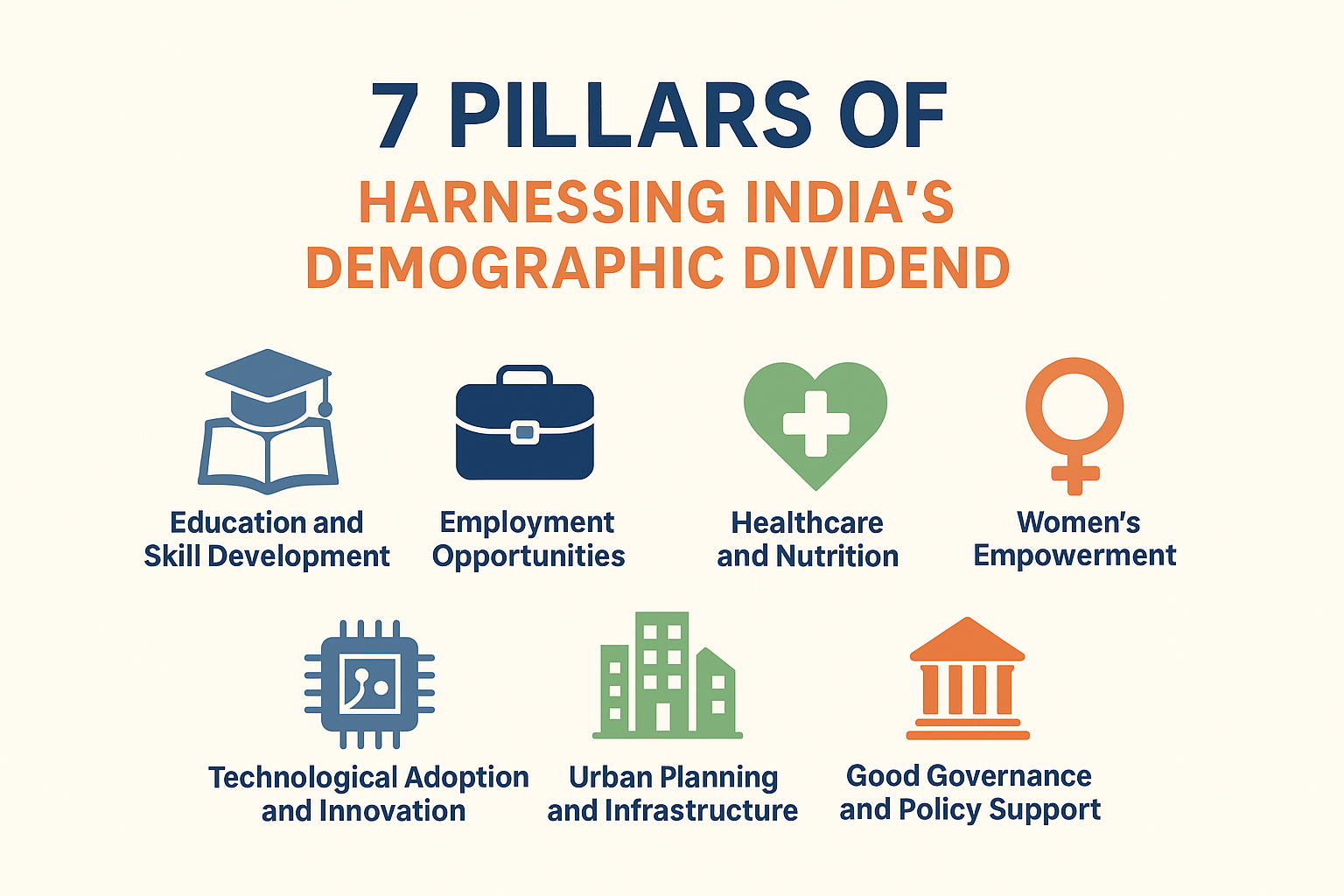
    Key Dimensions Where India Must Focus

    1. Education and Skill Development

    • Quality Education: India must improve school education outcomes, focusing not just on enrolment but on actual learning levels.
    • Vocational & Technical Training: With automation and AI reshaping industries, the government should invest in skill development programs aligned with future jobs in sectors like green energy, digital technology, healthcare, and advanced manufacturing.
    • Higher Education Reforms: Indian universities must become global centres of innovation, research, and entrepreneurship.

    An educated and skilled workforce is the foundation of any successful demographic dividend.

    2. Employment Opportunities

    • Job Creation in Formal Sector: The focus must shift from informal, low-paying jobs to formal employment with social security benefits.
    • Entrepreneurship Ecosystem: Encouraging startups through easier credit, tax benefits, and innovation hubs can generate new opportunities.
    • Rural Employment Diversification: Beyond agriculture, rural youth should be supported in areas like food processing, logistics, e-commerce, and handicrafts.

    Without sufficient jobs, the dividend can turn into a demographic burden.

    3. Healthcare and Nutrition

    • Universal Healthcare Access: A healthy workforce is a productive workforce. Investments in affordable healthcare, preventive care, and mental health are essential.
    • Women & Child Health: Tackling malnutrition and maternal health ensures future generations are strong and capable.
    • Healthy Lifestyle Campaigns: Awareness against lifestyle diseases, rising among youth, is necessary for long-term productivity.

    4. Women’s Empowerment

    • Increase Female Workforce Participation: Currently, only about 24% of Indian women are in the labour force, compared to the global average of 47%.
    • Workplace Equality & Safety: Laws and corporate policies must ensure safe working conditions, equal pay, and career advancement opportunities.
    • Supportive Infrastructure: Expanding crèches, maternity benefits, and flexible work policies can encourage more women to join the workforce.

    No country can achieve its full potential if half its population remains underutilized.

    5. Technological Adoption and Innovation

    • Digital Literacy: The government’s Digital India push should reach every village, ensuring internet access and digital skills.
    • R&D and Innovation Hubs: Incentivizing research in AI, biotechnology, renewable energy, and space can make India a global leader.
    • Public-Private Partnerships: Collaboration with private sector and global firms can accelerate innovation and job creation.

    6. Urban Planning and Infrastructure

    • Smart Cities: As migration to cities rises, India needs well-planned urban centres with affordable housing, efficient transport, and sustainable resources.
    • Green Infrastructure: Renewable energy, electric mobility, and eco-friendly buildings should form the backbone of future growth.
    • Rural Infrastructure: Roads, electricity, internet connectivity, and clean water in villages are equally important for balanced development.

    7. Good Governance and Policy Support

    • Labour Reforms: Simplifying labour laws and ensuring worker protection can attract investments.
    • Ease of Doing Business: Reducing red tape and corruption encourages domestic and foreign investments.
    • Decentralised Development: State governments should have greater autonomy to design education, employment, and health policies as per local needs.

    Challenges India Must Address

    While the opportunities are immense, India faces challenges such as:

    • Rising unemployment and underemployment among educated youth.
    • Skill-job mismatch.
    • Gender inequality in the workforce.
    • Regional disparities in education, health, and jobs.
    • Pressure on natural resources due to population size.

    If these are not addressed, the demographic dividend could instead become a demographic disaster.

    Conclusion: A People-Centric Approach

    India’s demographic dividend is not automatic—it requires strategic investments in people. By focusing on education, skills, health, women’s empowerment, innovation, and inclusive governance, India can transform its young population into a powerhouse of productivity and creativity.

    As the world’s largest pool of youth, India has the chance to shape the 21st century global economy. The time to act is now—because the demographic window won’t stay open forever.

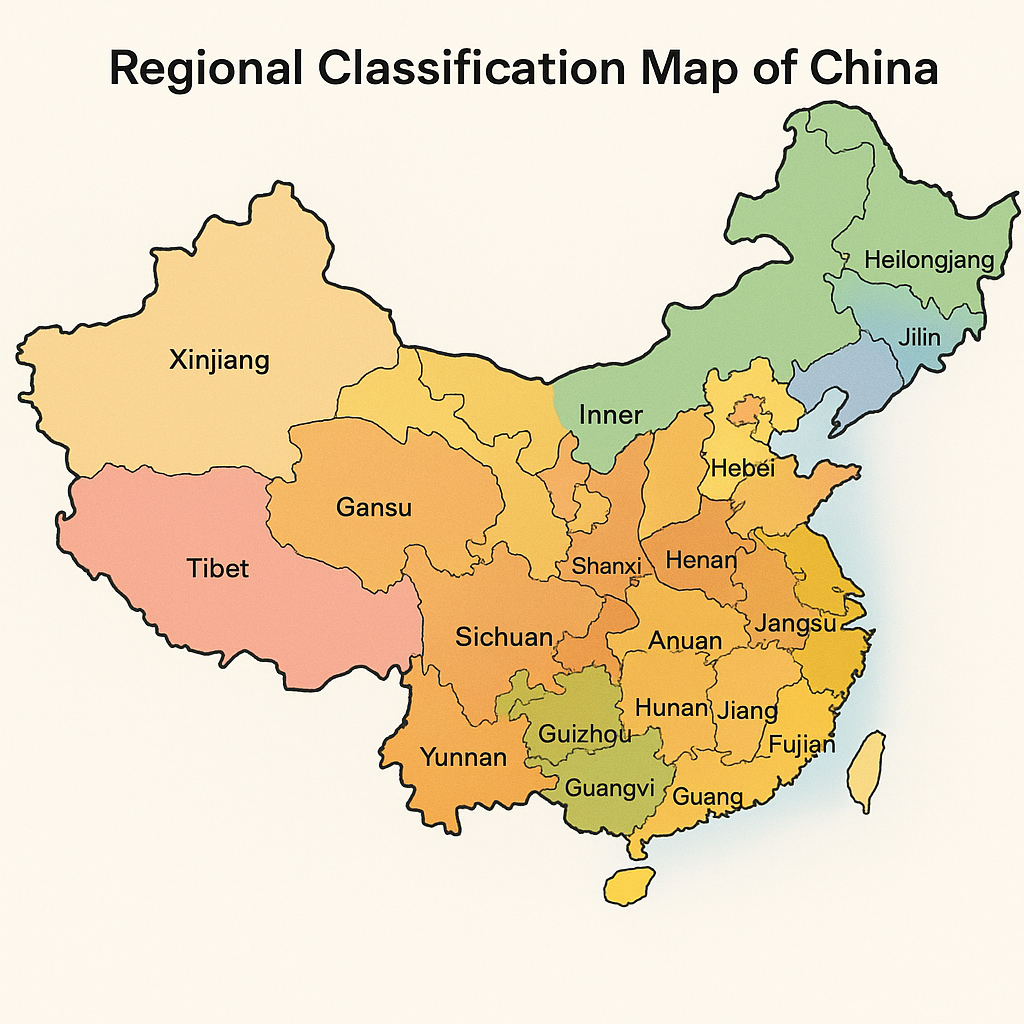
  • China’s Regional Classification: Know about Provinces, Economy, Culture, and Demography

    China’s Regional Classification: Know about Provinces, Economy, Culture, and Demography

    China, the world’s second most populous country (about 1.41 billion people in 2025, recently overtaken by India), remains one of the most diverse nations on Earth in terms of geography, economy, and culture. It is divided into 34 provincial-level administrative units: 23 provinces, 5 autonomous regions, 4 municipalities, and 2 Special Administrative Regions (SARs).

    Understanding China’s regional classification is key to appreciating its socio-economic strengths, demographic contrasts, and cultural richness.

    China’s Regional Division

    Broadly, China can be divided into seven major regions:

    1. North China – Beijing, Tianjin, Hebei, Shanxi, Inner Mongolia
    2. Northeast China – Heilongjiang, Jilin, Liaoning
    3. East China – Shanghai, Jiangsu, Zhejiang, Anhui, Fujian, Jiangxi, Shandong
    4. South Central China – Henan, Hubei, Hunan, Guangdong, Guangxi, Hainan
    5. Southwest China – Sichuan, Chongqing, Guizhou, Yunnan, Tibet (Xizang)
    6. Northwest China – Shaanxi, Gansu, Qinghai, Ningxia, Xinjiang
    7. Special Administrative Regions – Hong Kong, Macau

    1. North China – Political and Industrial Core

    • Key Provinces & Cities: Beijing (capital), Tianjin, Shijiazhuang (Hebei), Taiyuan (Shanxi), Hohhot (Inner Mongolia).
    • Features: Political hub, steel and heavy industry, rare earths in Inner Mongolia.
    • Importance: Beijing is the political, cultural, and diplomatic capital of China.

    2. Northeast China – The “Rust Belt” Industrial Base

    • Key Cities: Shenyang, Dalian, Harbin, Changchun.
    • Features: Old industrial heartland (steel, machinery, automobiles), fertile farmland (soybeans, maize).
    • Demographics: Population decline due to ageing and out-migration.
    • Importance: Strategic revival under China’s Northeast Revitalization Plan.

    3. East China – Economic Powerhouse

    • Key Provinces & Cities: Shanghai, Nanjing, Hangzhou, Jinan, Fuzhou, Hefei.
    • Features: Finance, high-tech, manufacturing, trade.
    • Importance: Shanghai is China’s financial hub, while Jiangsu and Zhejiang are among the wealthiest provinces.

    4. South Central China – Agriculture and Trade Hub

    • Key Cities: Guangzhou, Shenzhen, Wuhan, Zhengzhou, Changsha, Nanning, Haikou.
    • Features:
      • Guangdong = “World’s Factory” for electronics & exports.
      • Henan = “Breadbasket of China” with massive grain output.
      • Hubei (Wuhan) = transport & tech hub.
    • Cultural Blend: Cantonese, Hakka, and Zhuang (Guangxi).

    5. Southwest China – Ethnic & Geographic Diversity

    • Key Cities: Chengdu, Chongqing, Kunming, Guiyang, Lhasa.
    • Features:
      • Resource-rich (hydropower, minerals).
      • Chengdu = booming tech city, Chongqing = industrial base.
      • Tibet = culturally unique & strategically significant.
    • Importance: Crucial for China’s Western Development Strategy & Belt and Road Initiative (BRI).

    6. Northwest China – Resource Frontier

    • Key Cities: Xi’an, Lanzhou, Xining, Yinchuan, Urumqi.
    • Features:
      • Rich in coal, oil, natural gas, solar, wind.
      • Xi’an = historic Silk Road capital.
      • Xinjiang = strategic trade route with Central Asia.
    • Culture: Ethnic mix – Uyghur, Hui, Kazakh.
    • Importance: Vital for energy security & Belt and Road trade corridors.

    7. Special Administrative Regions – Global Gateways

    • Hong Kong: Global financial hub, tourism, services.
    • Macau: Entertainment & tourism economy with Portuguese-Chinese heritage.

    Why Regional Classification Matters

    • Economic Role: Coastal East and South dominate exports & finance, while interior regions provide agriculture, resources, and energy.
    • Cultural Diversity: From Tibetan Buddhism in the southwest to Cantonese lifestyle in the south, and Mongolian heritage in the north.
    • Demographics: East & South have dense populations; Northeast faces decline; Tibet & Xinjiang remain sparsely populated but strategic.
    • Strategic Importance: Xinjiang, Tibet, and Hong Kong serve as geopolitical pivot regions.

    Conclusion

    China may no longer be the world’s most populous country—India has taken that spot—but it remains an economic giant, cultural mosaic, and strategic powerhouse. Each region and province contribute uniquely: from Beijing’s political influence to Shanghai’s financial dominance, from Guangdong’s export strength to Tibet’s spiritual and geopolitical weight.

    For policymakers, businesses, and scholars, grasping China’s regional classification provides the roadmap to understanding its internal diversity and global role.

  • India vs China: A Socio-Economic and Demographic Picture (2025)

    India vs China: A Socio-Economic and Demographic Picture (2025)

    Introduction

    India and China are two of the world’s oldest civilizations and today’s most influential emerging powers. Together, they shape global economics, demographics, culture, and geopolitics. While they share some common ground, their paths of development, governance, and societal structures differ in striking ways.

    This blog explores India vs China through key lenses: economy, demography, religion, culture, governance, and regions—offering updated facts and insights for 2025.

    “India and China share ancient civilizational roots but walk very different modern roads.”

    1. Economy: Scale, Growth and Structure

    Commonalities

    • Both are Asian economic giants with strong roles in global trade.
    • Manufacturing, infrastructure, and technology are central to both growth models.

    Key Differences

    • China: World’s second-largest economy by nominal GDP, historically manufacturing-driven, and export-oriented.
    • India: Smaller in size but growing faster, powered by services, IT, and digital innovation.

    According to the IMF, China has higher GDP per capita, while India is expected to grow faster than China in 2025, making it one of the world’s fastest-growing large economies.

    “China’s strength lies in scale and manufacturing; India’s edge lies in services and youthful dynamism.”

    2. Demography: The Population Power

    Shared Feature

    • Both countries hold over 1.4 billion people each, shaping global labour and consumption trends.

    Differences

    • India: Recently overtook China as the world’s most populous country (~1.46 billion). It has a younger population, offering a demographic dividend if harnessed properly.
    • China: Around 1.41 billion people, but facing a shrinking and aging population, with fertility well below replacement level.

    This means India has a longer demographic window of opportunity, while China faces a rising dependency burden.

    3. Religion and Social Fabric

    India

    • A land of religious diversity: Hinduism, Islam, Christianity, Sikhism, Buddhism, Jainism, and more.
    • Religion is deeply intertwined with festivals, politics, and social identity.

    China

    • Officially more secular, but Buddhism, Daoism, Confucianism, Islam, and Christianity exist alongside folk religions.
    • The state regulates religious practice, making it less visible in public policy compared to India.

    “India’s pluralism contrasts with China’s state-centric secularism.”

    4. Culture: Ancient Heritage, Modern Influence

    Shared Civilizational Traits

    • Rich histories, philosophies, literature, and classical arts.
    • Deep respect for family, education, and traditions.

    Differences

    • Language: India is multilingual with 22+ scheduled languages; China is dominated by Mandarin with unified script traditions.
    • Cultural exports: India shines in Bollywood, yoga, spirituality; China in cinema, cuisine, technology-driven soft power.

    5. Governance & Administrative Structure

    India — Federal Democracy

    • 28 states and 8 union territories with autonomy.
    • World’s largest democracy, with elections, multiparty competition, and judicial independence.
    • Policies differ across states, making India a laboratory of reforms.

    China — Unitary One-Party State

    • Provinces, autonomous regions, municipalities governed under a centralized Communist Party structure.
    • High capacity for top-down execution, but limited political pluralism.

    “India thrives on diversity and debate; China excels in centralized coordination.”

    6. Regional & Geopolitical Dimensions

    • Both nations have vast, diverse geographies—from Himalayas to coastlines—that shape economies and lifestyles.
    • Ongoing border disputes along the Himalayas affect bilateral relations.
    • Both are members of BRICS, SCO, and G20, often cooperating but also competing for influence in Asia.

    7. Urbanization & Migration

    • China: Higher urbanization, with planned mega-city clusters (Beijing, Shanghai, Shenzhen).
    • India: Rapid urbanization with tier-2 and tier-3 cities growing fast, but with more informal economies.
    • Both face challenges in housing, infrastructure, and job creation.

    8. Technology & Innovation

    • China: Leads in 5G, AI, EVs, renewable energy, and hardware manufacturing.
    • India: Strong in IT services, startups, digital payments, and software exports.
    • Both are investing in green tech, space research, and AI to secure future competitiveness.

    9. Challenges Ahead

    Shared Challenges

    • Climate change & sustainability.
    • Job creation for massive labour forces.
    • Urban congestion, inequality, and health care gaps.

    India’s Challenges

    • Boosting manufacturing.
    • Harnessing demographic dividend.
    • Bridging infrastructure gaps.

    China’s Challenges

    • Aging society & shrinking workforce.
    • Transitioning from investment-driven growth.
    • Real estate and debt risks.

    Conclusion: Two Civilizations, Two Paths

    India and China stand as pillars of Asia and key players in the global economy.

    • China: Industrial powerhouse, but facing demographic headwinds and structural rebalancing.
    • India: Democratic, young, and fast-growing, with services-driven growth and untapped potential.

    “China’s present scale and India’s future promise define the 21st century Asian story.”

    Both nations, despite their differences, will shape global trade, technology, and geopolitics for decades to come. The world must understand their commonalities and divergences to navigate the future of global order.

    Table: China and India through Fact and Figures (Data source: UN, WB, UNICEF, PLFS, UNESCO etc.)

    IndicatorIndiaChina
    Population1,450,936,000 (2024)1,408,975,000 (2024)
    Population growth (annual %)+0.9% (2024)−0.1% (2024)
    Median age~29.0 years (2024–25 est.)~40.0 years (2024–25 est.)
    GDP (nominal, current US$)US$ 3.91 trillion (2024)US$ 18+ trillion (2024)
    GDP per capita (current US$)US$ 2,697 (2024)US$ ~13,300 (2024)
    Real GDP growth (annual %)~6.5% (2024)~5.0% (2024)
    Unemployment rate (total)~4.2% (latest ILO-modelled estimate)~4.6% (latest ILO-modelled estimate)
    Labor force composition — Agriculture (% of employment)~43.5% (2023)~22.3% (2023)
    Labor force composition — Industry (% of employment)~24% (2023)~29% (2023)
    Labor force composition — Services (% of employment)~32.5% (2023)~48.8% (2023)
    Literacy — adult (15+)~80.9% (national PLFS / recent surveys)~96–97% (latest WB/UN estimates for adults)
    Infant mortality rate (deaths per 1,000 live births)~27 / 1,000 (most recent UN/WB estimate)~4.5 / 1,000 (most recent official estimate)
    Under-5 mortality (per 1,000 live births)~28 / 1,000 (2023)~7 / 1,000 (2023–24 est.)
    Life expectancy at birth~72 years (2023)~77–78 years (2021–2023)
    Human Development Index (HDI)0.685 (rank ~130) (2023 data release)0.797 (rank ~78) (2023 data release)
    Gini coefficient (income inequality)~25.5 (2022 WDI estimate — recent World Bank processing)~35.7 (latest nationally reported / WDI ~2021)
    Poverty (extreme poverty <$3.20/day PPP)Low single digits (recent estimates show large reductions)Near-zero (most recent global poverty estimates)
    Urbanization (share of population in urban areas)~35–40% (rising rapidly; large rural share)~67%+ (2023–24)
    CO₂ emissions per capita~2.1 tCO₂ / person (2023)~9.4 tCO₂ / person (2023)
    Internet users (% pop.)~56% (latest World Bank / national surveys)~78% (latest World Bank / national surveys)
    Women in national parliament (share)~14% (lower house / most recent composition)~27% (most recent composition)
  • Double Income No Kids (DINK): A Rising Lifestyle Trend in India

    Introduction

    In today’s rapidly changing India, family life no longer follows the one-size-fits-all model of the past. Increasingly, urban couples are embracing the DINK lifestyle—Double Income, No Kids. Once a Western concept, this phenomenon has now taken root in Indian cities, reflecting changing aspirations, rising living costs, and the desire for personal freedom.

    From Bengaluru’s tech corridors to Mumbai’s financial hubs and Delhi’s cosmopolitan neighbourhoods, the DINK lifestyle is redefining what marriage and family mean in 21st-century India.

    Origin and Global Background of DINK

    The phrase “Double Income, No Kids” gained popularity in the 1980s in the United States, where childfree couples with higher disposable incomes were seen as lucrative markets for luxury goods, travel, and entertainment.

    In India, the idea remained marginal until the 2000s, when globalization, corporate growth, and women’s rising workforce participation created fertile ground for such choices.

    Today, the DINK lifestyle is no longer limited to “elite metros”—it is expanding into Tier-2 and Tier-3 cities, reshaping family dynamics.

    Why Is the DINK Lifestyle Growing in India?

    1. High Cost of Raising a Child
      • Reports suggest that raising a child in urban India can cost anywhere between ₹1.5 crore to ₹3 crore up to the age of 21.
      • For many couples, this cost feels overwhelming, especially when housing and healthcare expenses are already soaring.
    2. Career-Centric Aspirations
      • Cities like Bengaluru, Gurugram, Pune, and Hyderabad have a large millennial workforce. Many couples prioritize career growth, promotions, and even overseas opportunities.
    3. Changing Attitudes
      • Platforms like Shaadi.com recently reported that in some states, nearly 65% of newlyweds openly consider delaying or opting out of parenthood.
      • Social media further normalizes the idea, with hashtags like #ChildfreeIndia and #DINKLife gaining traction.
    4. Desire for Lifestyle Freedom
      • Frequent travel, fine dining, pet parenting (DINKWAD: Double Income, No Kids, With A Dog), and early retirement goals are often prioritized.
    5. Environmental Concerns
      • A section of Indian youth feels ethically conflicted about bringing children into a world facing climate crises and overcrowding.

    Pros of DINK in the Indian Context

    • Financial Cushion
      • With no childcare expenses, couples save and invest heavily. Financial advisors even note that DINK couples are better placed for FIRE (Financial Independence, Retire Early).
    • Empowered Women
      • Indian women, especially in metros, increasingly see motherhood as optional—not compulsory—leading to greater autonomy.
    • Boost to Lifestyle Economy
      • From luxury travel to real estate, DINK couples are high-spending consumers who fuel India’s experience-driven economy.
    • Reduced Strain on Overpopulation
      • India is still the most populous country in the world; lower birth rates in urban hubs may ease pressure on resources.

    Cons of DINK for Indian Society

    • Generational Gap & Social Stigma
      • In traditional Indian families, choosing not to have children is often criticized as “selfish” or “against dharma.”
      • Couples face pressure from parents and relatives to conform.
    • Demographic Challenges Ahead
      • While India currently enjoys a demographic dividend, a rapid fall in fertility rates (already seen in many states like Kerala, Tamil Nadu, etc.) could lead to an aging population crisis in coming decades.
    • Old-Age Security
      • In a culture where children traditionally care for aging parents, childfree couples may feel anxious about old-age support.
    • Cultural Continuity
      • Questions arise about passing on traditions, rituals, and cultural practices without the next generation.

    Socio-Economic Impact of DINK in India

    1. Consumerism Over Parenthood
      • Sectors like tourism, wellness, fashion, and luxury goods benefit as DINK couples channel disposable income into lifestyle choices.
    2. Housing Trends
      • Smaller households fuel demand for compact, high-end apartments in metro cities.
    3. Education Sector Challenges
      • If fertility rates drop further, schools and child-product industries may face reduced demand in urban areas.
    4. Workforce Balance
      • DINK couples contribute actively to India’s economic growth today, but fewer children could lead to a workforce gap in 30–40 years.

    Cultural Impact

    • Redefinition of Marriage: Parenthood is no longer seen as the natural “next step.”
    • Rise of Pet Parenting: DINKWAD households treat pets as family, a growing cultural shift in India.
    • Changing Rituals: Traditional ceremonies like annaprashan (first rice ceremony) or upanayana (sacred thread ceremony) lose relevance for childfree couples.
    • New Acceptance: Media portrayals of independent, childfree couples are gradually normalizing the choice.

    Statement of India’s DINK Couples

    • A Bengaluru IT couple says: “We travel abroad twice a year, maintain investments, and adopted two pets. We don’t feel the need for kids to validate our marriage.”
    • A Mumbai banker shares: “Raising a child in Mumbai would cost us a fortune. We’d rather focus on building wealth and retiring early.”

    These voices reflect a rising urban sentiment—where self-fulfilment outweighs traditional expectations.

    Conclusion

    The DINK lifestyle in India represents both opportunity and challenge. On the one hand, it empowers couples with financial freedom, gender equality, and lifestyle choices. On the other, it raises critical concerns for India’s demographic future, cultural continuity, and social fabric.

    As India evolves, the key lies in respecting personal freedom while also preparing policies for old-age care, pension reforms, and balanced population strategies.

    The Double Income No Kids phenomenon is more than just a lifestyle—it is a sign of India’s transition into a modern, urban, and individualistic society.

  • The World’s 15 Best Wealth Creators and their Timeless Investing Styles

    The World’s 15 Best Wealth Creators and their Timeless Investing Styles

    Wealth creation has always fascinated humankind. From legendary stock market investors to visionary entrepreneurs, a handful of individuals have left a mark on global financial history by creating immense wealth. What sets them apart is not just the money they made, but the unique investing philosophies, risk-taking ability, and human characteristics that defined their journey.

    In this blog, we will explore the world’s 15 greatest wealth creators, their style of investing, and the traits that shaped their success. These stories are not just about billions of dollars — they are lessons in patience, foresight, and resilience.

    1. Warren Buffett – The Oracle of Omaha

    • Investing Style: Value Investing
    • Key Traits:  Patience, simplicity, discipline

    Buffett, through Berkshire Hathaway, turned value investing into an art. His mantra of buying undervalued companies with strong fundamentals and holding them long-term has made him one of the richest men alive.

    2. Charlie Munger – The Architect of Rationality

    • Investing Style: Mental models, long-term compounding
    • Key Traits: Rationality, wisdom, clear thinking

    Buffett’s lifelong partner, Munger focused on multidisciplinary thinking. He believed in investing only when the odds were heavily in favour, teaching the world the power of patience and clarity.

    3. Rakesh Jhunjhunwala – The Indian Big Bull

    • Investing Style: Contrarian value investing with high conviction
    • Key Traits: Courage, optimism, foresight

    Often called India’s Warren Buffett, Jhunjhunwala turned a small investment into billions by spotting India’s growth story early and betting big on sectors like aviation, finance, and healthcare.

    4. Peter Lynch – The Retail Investor’s Hero

    • Investing Style: “Invest in what you know”
    • Key Traits: Observation, curiosity, practical sense

    As manager of the Fidelity Magellan Fund, Lynch generated 29% annual returns. He popularized the idea that ordinary people can spot great investments in daily life before Wall Street does.

    5. George Soros – The Man Who Broke the Bank of England

    • Investing Style: Global macro, currency speculation
    • Key Traits: Boldness, instinct, adaptability

    Soros became famous for shorting the British pound in 1992 and earning $1 billion in a single day. He believed in reflexivity — the idea that markets influence fundamentals, not just the other way around.

    6. Ray Dalio – The Principles-Driven Investor

    • Investing Style: Macro, risk parity, diversification
    • Key Traits: Systematic thinking, discipline, humility to learn

    Founder of Bridgewater Associates, Dalio built the world’s largest hedge fund on the principle of radical transparency. His strategies emphasize balancing risks rather than chasing returns.

    7. Benjamin Graham – The Father of Value Investing

    • Investing Style: Margin of safety, deep value investing
    • Key Traits: Analytical mindset, prudence

    Teacher of Buffett and author of The Intelligent Investor, Graham’s idea of buying stocks below intrinsic value shaped modern investing. His cautious approach remains timeless.

    8. Elon Musk – The Visionary Entrepreneur

    • Investing Style: Innovation-driven entrepreneurship
    • Key Traits: Bold risk-taking, futuristic vision, perseverance

    Musk built wealth not by stock picking but by building transformative companies — Tesla, SpaceX, Neuralink. His relentless pursuit of future-defining industries shows wealth can be created by vision as much as by capital.

    9. Jeff Bezos – The Master of Compounding Growth

    • Investing Style: Long-term reinvestment, customer obsession
    • Key Traits: Patience, innovation, customer-first approach

    Amazon started as an online bookstore and became a trillion-dollar empire. Bezos focused on reinvesting profits into growth rather than short-term returns.

    10. Mukesh Ambani – The Indian Business Titan

    • Investing Style: Aggressive expansion, disruption, integration
    • Key Traits: Strategic foresight, bold execution

    Ambani transformed Reliance from petrochemicals into a diversified empire, disrupting telecom with Jio and expanding into retail and digital platforms.

    11. Mark Zuckerberg – The Social Media Mogul

    • Investing Style: Network effects, tech dominance
    • Key Traits: Innovation, adaptability, ambition

    Zuckerberg created Facebook (now Meta) and built wealth by leveraging network effects — the more people join, the more valuable the platform becomes.

    12. Steve Jobs – The Innovator Who Changed the World

    • Investing Style: Creativity, design-driven innovation
    • Key Traits: Visionary thinking, persistence, perfectionism

    Jobs didn’t just create wealth, he reshaped industries — from personal computing to smartphones. His genius shows that wealth comes from reimagining consumer experience.

    13. Jack Ma – The E-Commerce Pioneer of China

    • Investing Style: Scale, entrepreneurship, digital disruption
    • Key Traits: Resilience, storytelling, ambition

    From a teacher to billionaire founder of Alibaba, Jack Ma proved how digital platforms can transform economies and build massive wealth.

    14. Andrew Carnegie – The Steel Magnate

    • Investing Style: Industrial entrepreneurship
    • Key Traits: Philanthropy, hard work, foresight

    One of the wealthiest men of the 19th century, Carnegie built his fortune in steel and later gave away most of it, leaving a legacy of philanthropy.

    15. John D. Rockefeller – The Oil King

    • Investing Style: Monopoly building, vertical integration
    • Key Traits: Ruthlessness, efficiency, vision

    Founder of Standard Oil, Rockefeller became the richest man in modern history by creating an oil empire. He demonstrated how consolidation and efficiency can generate massive wealth.

    Key Lessons from the World’s Best Wealth Creators

    1. Patience beats speed – Buffett, Munger, and Bezos proved compounding works wonders with time.
    2. Think big, act bold – Musk, Jobs, and Ambani created industries, not just companies.
    3. Diversify risks – Dalio and Soros remind us of adaptability in uncertain markets.
    4. Stay grounded – From Carnegie’s philanthropy to Jhunjhunwala’s optimism, humility plays a role.
    5. Innovation pays – Zuckerberg, Ma, and Musk show the wealth of tomorrow belongs to innovators.

    Final Thoughts

    Wealth creation is not just about money — it’s about vision, character, and discipline. These 15 icons show us that whether you are a value investor, a risk-taker, or an innovator, success comes when clarity of thought meets courage of action.

    For anyone aspiring to build wealth, the lesson is simple: adopt a philosophy, stay consistent, and let compounding do its magic.