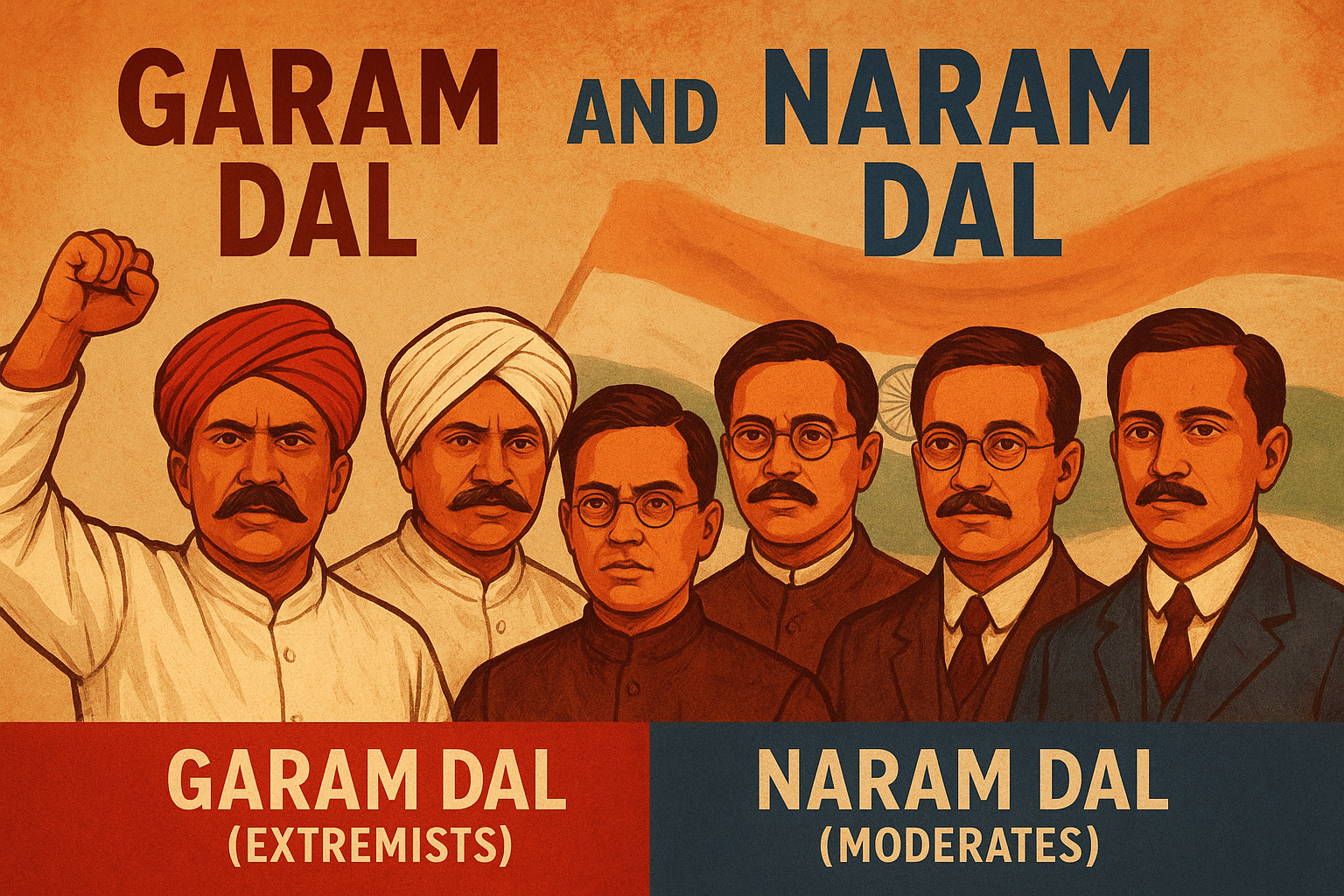
Introduction
Thank you for reading this post, don’t forget to subscribe!The Indian freedom struggle was not a monolithic movement—it was a vibrant mix of ideas, strategies, and personalities. Within the Indian National Congress (INC), two prominent ideological streams emerged in the late 19th and early 20th centuries:
- Garam Dal (“Hot Party” or Extremists) – Advocated assertive, sometimes confrontational methods to achieve self-rule.
- Naram Dal (“Soft Party” or Moderates) – Favoured gradual reforms through dialogue, petitions, and constitutional means.
These two groups may have differed in approach, but both played a crucial role in igniting the flame of Indian nationalism.
Historical Background – The Split of 1907
The ideological differences reached a peak during the Surat Session of the Indian National Congress in 1907.
- Naram Dal leaders wanted to work within the framework of British rule, believing in persuasion and reform.
- Garam Dal leaders sought swaraj (self-rule) through more direct action, mass mobilization, and pressure on the colonial government.
The split reflected not only political differences but also contrasting temperaments and visions for India’s future.
Naram Dal – The Moderates
The Moderates were pioneers of the Congress movement (1885–1905). They believed that British rule could be reformed and that Indians could gradually gain self-governing rights. Their methods included:
- Petitions and memorials to the British Parliament
- Press campaigns
- Participation in legislative councils
- Education and political awareness campaigns
Key Naram Dal Leaders
1. Dadabhai Naoroji (1825–1917)
- Known as the Grand Old Man of India.
- First Indian MP in the British House of Commons.
- Propounded the Drain Theory, exposing economic exploitation by the British.
2. Gopal Krishna Gokhale (1866–1915)
- Founder of the Servants of India Society.
- Advocated constitutional reforms, education, and social progress.
- Mentor to Mahatma Gandhi in his early political career.
3. Surendranath Banerjee (1848–1925)
- One of the earliest nationalist leaders and founder of the Indian National Association.
- Emphasized political unity, moderate demands, and civil rights.
Garam Dal – The Extremists
The Extremists emerged in the first decade of the 20th century. They believed freedom was the birthright of every Indian and must be achieved through assertive, sometimes radical, means. Their strategies included:
- Boycott of British goods
- Swadeshi and promotion of indigenous industries
- Public demonstrations and political agitation
- Mass mobilization of youth
Key Garam Dal Leaders
1. Bal Gangadhar Tilak (1856–1920)
- Famously declared, “Swaraj is my birthright and I shall have it!”
- Revived Ganesh Utsav and Shivaji festivals for political mobilization.
- Edited newspapers Kesari (Marathi) and The Maratha (English).
2. Bipin Chandra Pal (1858–1932)
- Known as the Father of Revolutionary Thoughts in India.
- Strong advocate of Swadeshi, boycott, and national education.
3. Lala Lajpat Rai (1865–1928)
- Popularly called the Punjab Kesari (Lion of Punjab).
- Played a key role in the Swadeshi movement.
- Injured during protests against the Simon Commission, later succumbing to his injuries.
The Lal–Bal–Pal Triumvirate
The Garam Dal was personified by Lala Lajpat Rai, Bal Gangadhar Tilak, and Bipin Chandra Pal—collectively known as Lal–Bal–Pal. Their fiery speeches, bold actions, and uncompromising stance inspired a generation of young Indians.
Differences Between Garam Dal and Naram Dal
| Aspect | Naram Dal (Moderates) | Garam Dal (Extremists) |
| Aim | Gradual self-governance within the British Empire | Immediate self-rule (Swaraj) |
| Method | Constitutional reforms, petitions, negotiations | Boycott, Swadeshi, protests, mass movement |
| Approach | Faith in British justice and liberalism | Distrust of British intentions |
| Leaders | Dadabhai Naoroji, Gokhale, Surendranath Banerjee | Tilak, Lajpat Rai, Bipin Chandra Pal |
Impact on the Freedom Struggle
While their paths diverged, both factions contributed significantly:
- Naram Dal built the early political foundation, created awareness, and gave the movement legitimacy in the eyes of the world.
- Garam Dal ignited mass participation, gave emotional momentum, and challenged colonial authority directly.
Eventually, the experience of both groups shaped Mahatma Gandhi’s strategy, which combined elements of mass movement (Extremists) with disciplined non-violent methods (Moderates).
Conclusion
The Garam Dal and Naram Dal represent two sides of the same coin in India’s freedom struggle—one slow and steady, the other fiery and urgent. Both were indispensable in steering India toward independence. Their legacy reminds us that in any great movement, diversity of thought and strategy can be a strength, not a weakness.
| Leader | Faction | Slogan | Meaning / Context |
| Bal Gangadhar Tilak | Garam Dal | “Swaraj is my birthright and I shall have it!” | Asserted the right to self-rule; became the rallying cry for Extremists. |
| Lala Lajpat Rai | Garam Dal | “Every blow aimed at me will prove a nail in the coffin of British rule.” | Said after being injured during the Simon Commission protest (1928). |
| Bipin Chandra Pal | Garam Dal | “No religion can be held higher than truth and no government can be held higher than self-rule.” | Emphasized nationalism over blind obedience to colonial authority. |
| Dadabhai Naoroji | Naram Dal | “Self-government is the only government which will improve India.” | Advocated gradual reforms towards self-rule within the British framework. |
| Gopal Krishna Gokhale | Naram Dal | “India’s salvation will come through constitutional methods.” | Encouraged moderate, non-confrontational approaches to reform. |
| Surendranath Banerjee | Naram Dal | “Liberty is the breath of a nation’s life.” | Highlighted the importance of political freedom for national progress. |
Leave a Reply