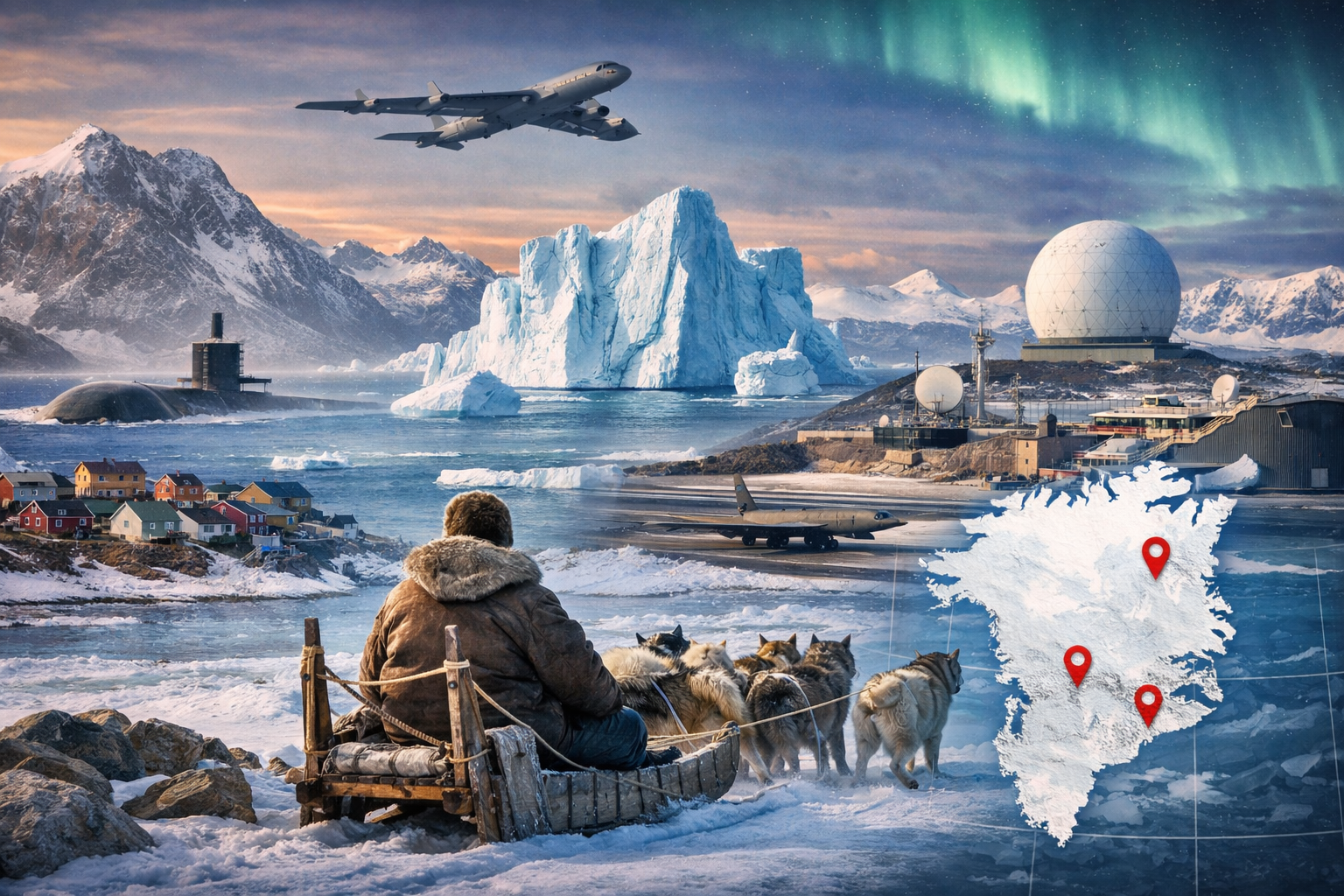
Introduction: A Frozen Giant with a Warm Global Role
Thank you for reading this post, don’t forget to subscribe!Greenland, the world’s largest island — with an area of more than 2.16 million square kilometres — is mostly covered by ice and snow. It sits between the Arctic and Atlantic Oceans, at the northern edge of the North American continent. Though physically massive, its population is small, and life revolves around ice, sea and harsh climatic conditions.
For centuries, Greenland was a remote outpost of Arctic explorers. Today it has become central to global geopolitics, climate science, and strategic competition between world powers.
Ancient Roots and Colonial History
Early Settlement — Indigenous and Viking Presence
- Indigenous Inuit Peoples: Greenland’s first residents arrived around 4,500 years ago, migrating from North America in small boats. Inuit ancestors adapted to the harsh Arctic environment with ingenuity.
- Viking Arrival: Between the 10th–11th centuries, Norse explorers led by Erik the Red — exiled from Iceland — established settlements in southern Greenland. These Norse communities survived for centuries, trading with Europe.
Danish Rule and Modern Autonomy
- Colonial Era: By the 18th century, Denmark began asserting control, ultimately integrating Greenland into the Danish Realm.
- 20th Century Shifts: In 1953, Greenland ceased being a colonial territory and became part of Denmark’s kingdom under a new constitution.
- Home Rule (1979): Greenland gained internal self-governance, allowing it to manage many internal affairs.
- Self-Government Act (2009): Expanded autonomy and recognized the possibility of full independence in the future.
Today, Greenland remains an autonomous territory of the Kingdom of Denmark, with Denmark responsible for defence and foreign affairs.
Geographic and Environmental Profile
Greenland’s geography is awe-inspiring:
- Ice Sheet Dominance: About 80% of the island is covered by thick ice — the second largest ice body in the world after Antarctica.
- Arctic Climate: Arctic and sub-arctic weather brings extreme cold, short summers, and dramatic seasonal contrasts.
- Climate Change Impact: The Arctic is warming almost four times faster than the global average, causing rapid ice melt that has major implications for global sea levels, weather patterns, and ocean currents — giving Greenland outsized environmental influence.
Demographic and Cultural Landscape
Greenland has a small, resilient population:
- Population: Around 56,000–57,000 people spread over vast distances.
- Ethnicity: Predominantly Inuit (around 89%), with small Danish and other Nordic communities.
- Languages: Kalaallisut (Greenlandic) is official; Danish and English are also widely spoken.
- Capital City: Nuuk — home to nearly 20,000 people and the political and economic hub.
Greenland’s culture blends ancient Inuit traditions — fishing, hunting, story-telling, and community — with modern European influences.
Socio-Economic Reality
Greenland’s economy is unique and distinctive:
Main Economic Drivers
- Fishing and Seafood: Dominates exports — accounting for more than 90% of total exports.
- Government Employment: Roughly 40–60% of the workforce is employed by public sector.
- Tourism: Increasingly important, with growing cruise and adventure travel.
Dependence on Denmark
Greenland’s public revenues are heavily subsidized by Denmark — roughly half the government’s budget comes from annual block grants from Copenhagen.
Mineral Potential
The island sits atop vast untapped resources — rare earth elements, zinc, copper, gold, uranium, and possible oil and gas — though environmental concerns and technical challenges have limited large-scale extraction.
Fishing remains the core, with mining and tourism as emerging horizons.
Why Greenland Matters to the World
Greenland’s importance goes far beyond its small population:
Climate Change and Environmental Influence
Greenland’s ice sheet plays a huge role in global sea level, weather systems, and ocean currents — meaning changes here have worldwide effects.
Melting ice is also revealing previously inaccessible natural resources and opening potential shipping routes through the Arctic.
🇺🇸 Why the U.S. Is Eyeing Greenland — and Trump’s Interest
The idea of the U.S. buying or gaining control of Greenland might seem like modern-day geopolitical fantasy — but it’s rooted in history and strategic calculation.
Strategic Geography — Military Advantage
Greenland sits at a crucial point between North America and Europe. The U.S. already maintains Thule Air Base, its northernmost military installation, crucial for northern defence and early missile warning systems.
President Trump’s renewed interest stems from national security concerns — controlling Arctic approaches, observing Russian activity, and securing early warning and defensive capabilities in the North Atlantic.
Untapped Economic Wealth
Greenland is rich in rare earth minerals — crucial for everything from electric vehicles and phones to military technology. Currently, the U.S. relies heavily on imports (especially from China) for these materials. Greenland’s deposits could alter that balance, reducing reliance on foreign supplies.
Emerging Arctic Shipping Routes
Melting Arctic ice opens shorter maritime corridors between Europe and Asia, bypassing traditional canals. Greenland’s location makes it key to controlling future Arctic trade patterns.
Geopolitical Competition
The Arctic is becoming a new arena of great-power rivalry. China and Russia are increasing their Arctic presence. For the U.S., stronger influence — or at least assured access — in Greenland is seen as essential for long-term strategic advantage.
Trump, Purchase Proposals & Political Realities
Trump first floated the idea of buying Greenland in 2019, calling it a “large real estate deal.” The suggestion was strongly rejected by Denmark, which insists “Greenland belongs to Greenlanders and is not for sale.”
Most legal and diplomatic experts argue that international law and the right to self-determination make purchase unlikely. Nevertheless, Trump’s interest — and U.S. increased strategic focus on the Arctic — emphasizes how Greenland sits at the crossroads of global power dynamics.
Conclusion: Why Greenland Will Stay in the Spotlight
Greenland may be icy and sparsely populated, but it is a centrepiece of climate science, strategic defence, global economics, and future trade routes.
As the Arctic transforms due to climate change, the island’s importance is only growing. Whether it becomes an independent nation, deepens ties with Denmark, expands partnerships with the U.S., or remains a gateway for geopolitical competition, Greenland will continue to shape global affairs for decades to come.
Leave a Reply