Introduction
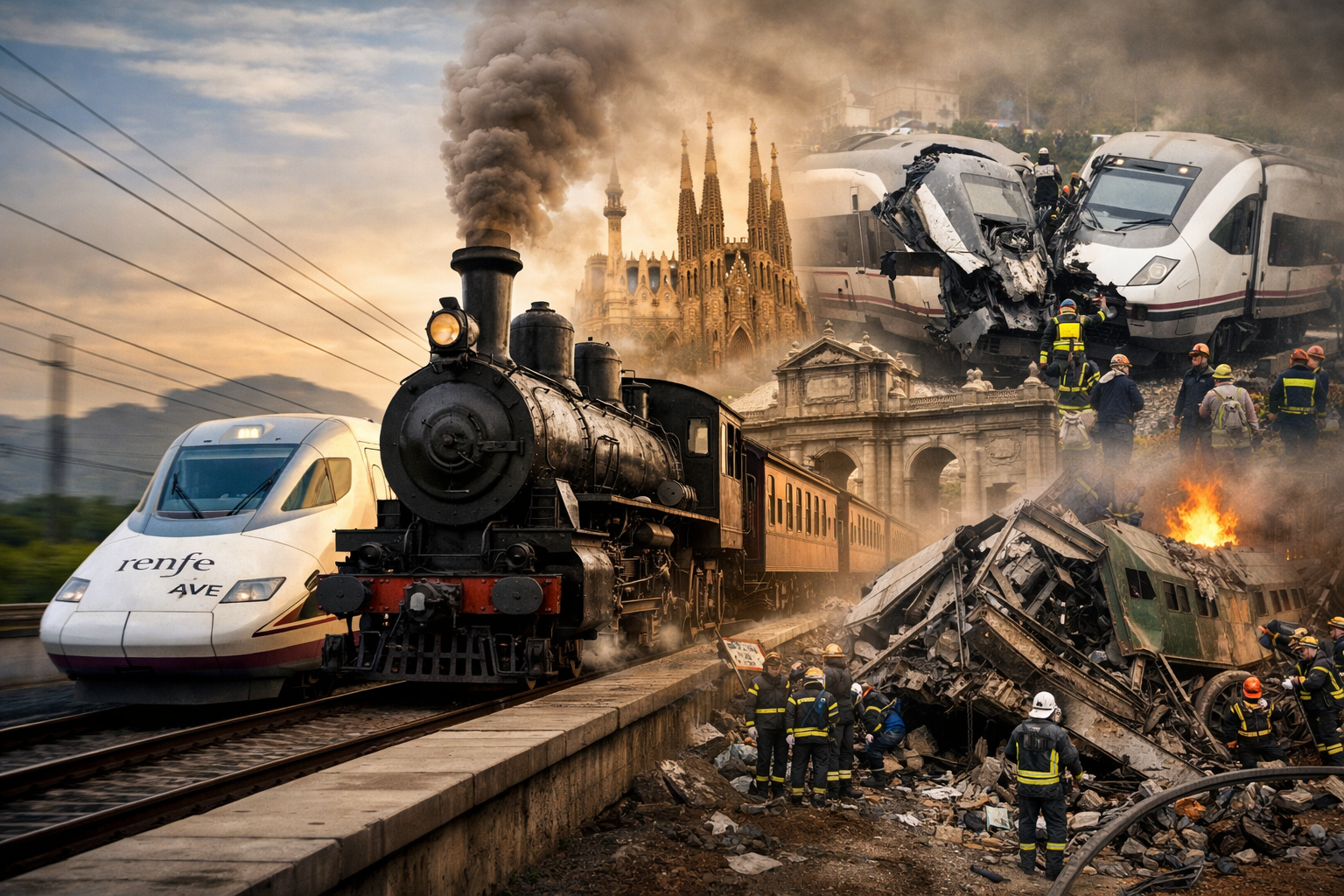
Thank you for reading this post, don’t forget to subscribe!Spain is renowned for one of the most advanced and extensive railway systems in Europe, especially its high-speed network. Yet behind this story of innovation lies a complex history of accidents that have shaped safety policies and public perceptions. From the very first steam line in the 19th century to the tragic 2026 collision near Adamuz, this post explores the evolution of Spanish railways, their specialties, why accidents happen, and what gaps still remain.
The Beginning: Spain’s First Railway
The history of railway transport in Spain began in the mid-19th century. The first railway line on the Iberian Peninsula was inaugurated on 28 October 1848, connecting Barcelona and Mataró, spanning about 29 kilometres and primarily serving both passenger and freight needs. This marked Spain’s entry into the age of steam transport and catalysed rapid railway expansion across the country.
This early progress laid the groundwork for a national network that would later evolve into state-owned operations and, eventually, high-speed lines.
Spain’s Railways: What Makes Them Special?
Spain’s railway system has several notable features:
1. Extensive High-Speed Network
Spain operates the longest high-speed rail network in Europe and the second longest in the world, with nearly 4,000 km of dedicated lines.
The first high-speed route, AVE (Alta Velocidad Española), opened in 1992, linking Madrid, Córdoba and Seville at speeds surpassing 300 km/h, transforming inter-city travel.
2. Multiple Operators and Modern Services
While Renfe remains the national operator (with AVE, Avant, Alvia, and other brands), private firms like Iryo, Ouigo España also now compete in passenger rail services.
3. Diverse Track Gauges
Unlike many European nations that standardized early, Spain historically adopted the Iberian broad gauge (1,668 mm) for its traditional lines and standard gauge (1,435 mm) on high-speed routes—a choice that has both strategic and legacy impacts on interoperability.
Daily Use: How Many People Ride Spanish Trains?
Spain’s rail network is a backbone of mobility. While daily passenger figures can vary by source and year, Spain’s high-speed trains alone carried over 25 million passengers in 2024, indicating sustained heavy use.
Counting conventional, commuter (Cercanías), regional, and freight traffic together, hundreds of thousands of people use trains daily, making rail one of the most important means of intercity and suburban transport in Spain.
Historical Train Accidents in Spain
Railway accidents have occurred throughout Spain’s rail history—some due to human error, infrastructure issues, or technical failures. Here are key incidents:
1884 Alcudia Bridge Disaster
One of Spain’s earliest tragic accidents occurred when a locomotive derailed off the Alcudia bridge in Ciudad Real province, killing around 59 people.
Chinchilla Train Collision (2003)
On 3 June 2003, a passenger train and a freight train ended up on the same track due to human error, resulting in 19 deaths and around 50 injuries.
Torre del Bierzo Rail Disaster (1944)
This multi-train collision inside a tunnel led to significant fatalities, with estimates up to 100 deaths, and remains one of the deadliest rail accidents in Spanish history.
Castelldefels Accident (2010)
This incident wasn’t a traditional train crash but a collision with pedestrians crossing tracks near a station, resulting in 12 deaths—a stark reminder of how rail accidents can also involve public risk scenarios.
Santiago de Compostela Derailment (2013)
Perhaps the most infamous modern accident occurred in 2013, when an AVE train derailed due to excessive speed on a sharp curve, leading to 80 deaths and over 140 injuries. Investigations pointed to driver distraction and a lack of enforced speed-control safeguards.
The 2026 High-Speed Collision
In January 2026, two high-speed trains collided near Adamuz, Córdoba, claiming at least 39 lives and injuring over 120 people, making it Spain’s deadliest rail disaster of the 2020s.
One train derailed on a straight section and collided with an oncoming service. Early official assessments suggest infrastructure or mechanical failure rather than human error, as speeds were within limits and both trains were recently inspected.
This collision took place on the very network that is often touted as among the safest in Europe—a stark reminder of how even modern railroads remain vulnerable under certain conditions.
Why Do Train Accidents Happen in Spain?
Rail incidents result from a combination of factors:
Human Error
The 2003 Chinchilla and 2013 Santiago accidents underline how human mistakes, such as miscommunication or failure to observe speed limits, can have devastating consequences.
Technical and Infrastructure Issues
The 2026 collision and earlier warnings from unions about track condition point to potential technical failings or infrastructure wear that can contribute to accidents.
Legacy Gaps
Despite modern high-speed lines, older conventional routes sometimes suffer from deferred maintenance or outdated signalling systems. Critics argue that investment has been skewed toward cutting-edge corridors while conventional networks lag.
Public Behaviour
Non-railway factors—like pedestrians on tracks (as seen in Castelldefels)—also pose risks alongside traditional accidents.
Safety Lacunae and Challenges
Spanish rail safety overall fares better than many European averages, but gaps remain:
- Maintenance Disparities: Focus on high-speed corridors has sometimes left conventional lines less upgraded.
- Signalling and Automation: Past crashes highlighted needs for automatic train control in places where human vigilance alone wasn’t enough.
- Resource Allocation: Balancing investment across network segments and ensuring uniform safety standards continue to challenge planners.
Conclusion
Spain’s railway story is a blend of pioneering milestones and sobering accidents. From the first steam line of 1848 to its world-leading high-speed corridors, the Spanish railway has revolutionized travel. Yet, accidents—whether human-caused, technical, or infrastructure-related—underscore the importance of continuous safety investment, modernization, and oversight.
As the country grieves and investigates the 2026 Adamuz collision, rail authorities and the public alike face a pivotal moment to further strengthen Spain’s rail safety culture for future generations.
Leave a Reply