Introduction
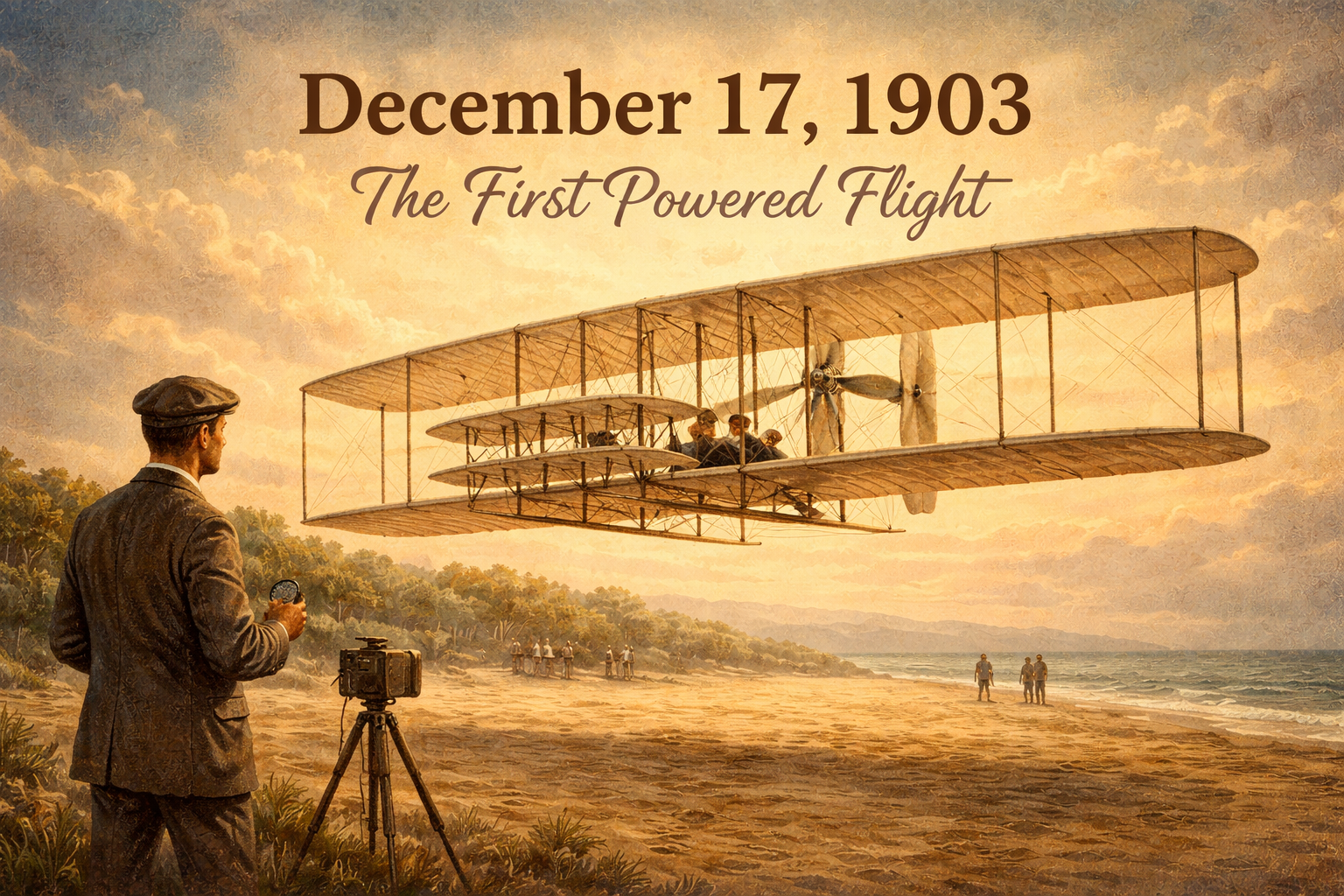
Thank you for reading this post, don’t forget to subscribe!December 17, 1903, stands as one of the most transformative dates in human history. On this cold, windy morning near Kitty Hawk, North Carolina, two self-taught engineers and visionaries—Wilbur and Orville Wright—successfully achieved the world’s first powered, controlled, and sustained flight of a heavier-than-air aircraft.
What lasted only 12 seconds in the air forever altered humanity’s relationship with the sky and laid the foundation for modern aviation.
The World Before Flight
For centuries, human flight remained a dream confined to mythology, sketches, and failed experiments. While balloons and gliders had achieved limited success, controlled powered flight remained elusive. Many experts of the late 19th century even declared it impossible.
The Wright brothers, owners of a bicycle shop in Dayton, Ohio, refused to accept that belief.
Who Were the Wright Brothers?
Wilbur Wright (1867–1912)
A thoughtful and analytical mind, Wilbur focused heavily on aerodynamics and flight control.
Orville Wright (1871–1948)
Mechanically gifted, Orville specialized in engines, construction, and hands-on experimentation.
Neither brother had a college degree, yet their methodical experimentation, data collection, and engineering intuition set them apart from all previous aviation pioneers.
Why Kitty Hawk?
The Wright brothers chose Kitty Hawk for three critical reasons:
- Strong, steady winds ideal for lift
- Soft sand dunes that reduced crash damage
- Isolation, allowing uninterrupted experiments
Between 1900 and 1903, they conducted extensive glider tests, gradually solving the most critical problem of flight—control.
The Wright Flyer: A Revolutionary Machine
The aircraft that made history was called the Wright Flyer. Its key features included:
- A 12-horsepower gasoline engine, built by the brothers themselves
- Twin wooden propellers, designed using their own aerodynamic calculations
- A wing-warping system, allowing control of roll, pitch, and yaw
- A wooden frame covered with muslin fabric
Unlike previous attempts, the Wright Flyer could be steered and stabilized in the air.
December 17, 1903: The Historic Flight
On the morning of December 17, amid freezing winds, the brothers prepared for their attempt.
The First Flight
- Pilot: Orville Wright
- Distance: 120 feet (36.5 meters)
- Duration: 12 seconds
This brief flight marked the first successful powered, controlled flight in human history.
Subsequent Flights That Day
Three more flights followed, with the final one piloted by Wilbur Wright covering 852 feet in 59 seconds—proving that powered flight was not a fluke but a repeatable achievement.
Why This Flight Was Revolutionary
The Wright brothers accomplished something no one else had:
- Powered takeoff
- Sustained flight
- Controlled navigation
- Safe landing
Their success combined engineering, aerodynamics, propulsion, and control—the four pillars of aviation.
Initial Skepticism and Later Recognition
Despite their achievement, the Wright brothers initially faced widespread skepticism. Newspapers ignored the story, and many scientists doubted their claims.
However, by 1908, public demonstrations in Europe and the United States silenced critics. Governments soon recognized the military and commercial potential of flight.
Impact on the Modern World
The Wright brothers’ success reshaped civilization:
- Birth of commercial aviation
- Transformation of global travel and trade
- Advancements in military aviation
- Expansion of scientific research and space exploration
From passenger jets to space shuttles, every modern aircraft traces its lineage back to that sandy beach at Kitty Hawk.
Legacy of December 17, 1903
Today, December 17 is commemorated as a milestone in human ingenuity. The Wright brothers’ journey teaches us that persistence, experimentation, and belief in possibility can overcome even the most deeply held limitations.
What began as a fragile wooden machine lifted humanity into the age of flight.
Conclusion
On December 17, 1903, Wilbur and Orville Wright proved that humans could do more than dream of flying—they could build it, control it, and master it.
In just 12 seconds, they changed the course of history forever.
Leave a Reply