Introduction
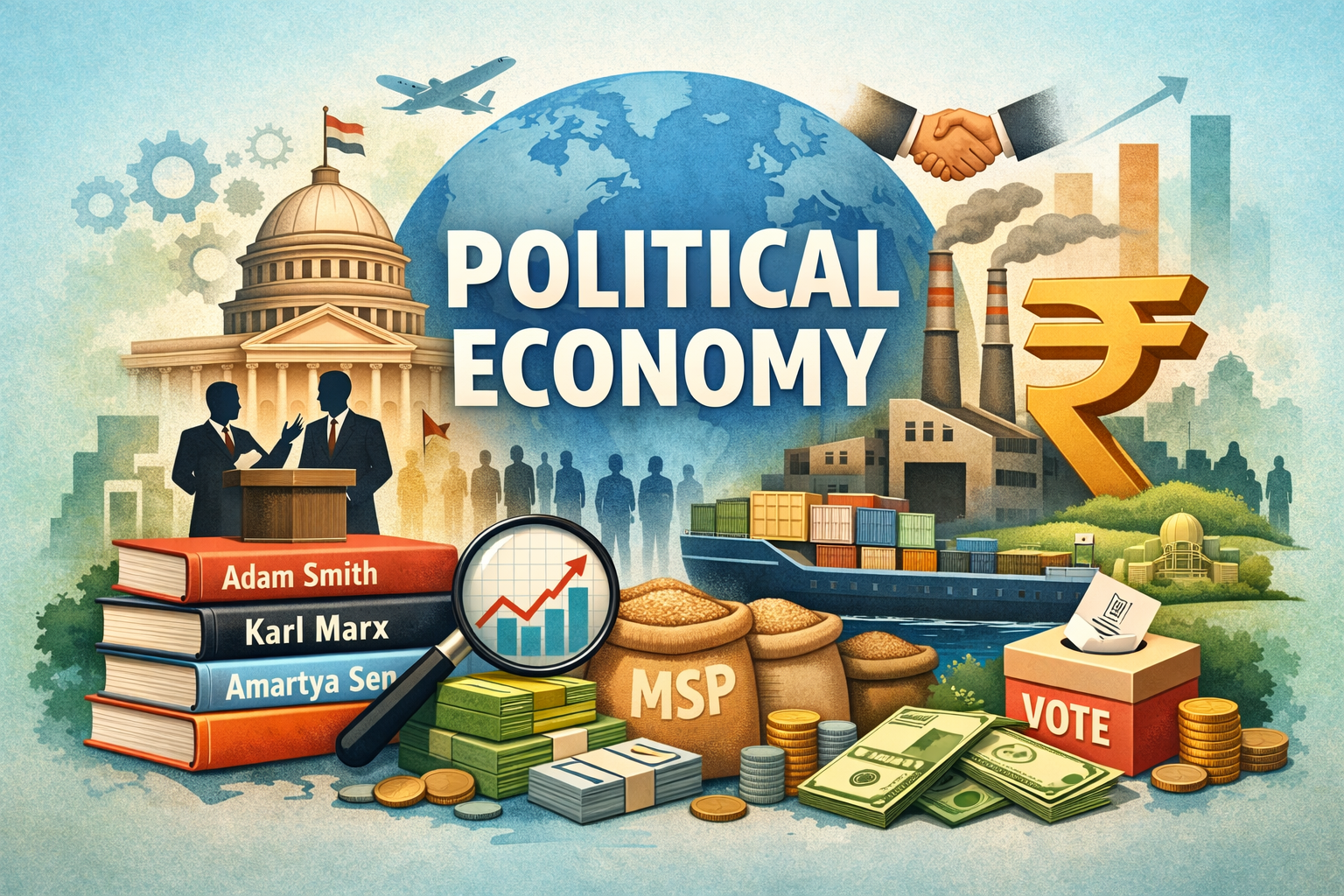
Thank you for reading this post, don’t forget to subscribe!Political economy is one of the most powerful and interdisciplinary concepts in social sciences. It connects economics and politics, explaining how power, governance, institutions, and policies influence economic outcomes—and vice versa.
In simple terms, political economy helps us understand who gets what, when, and how in a society. It examines how laws, political decisions, institutions, and social structures shape production, distribution, and consumption of wealth.
Today, political economy is not merely a theoretical field; it shapes debates around inequality, welfare policies, globalization, climate change, and development.
What is Political Economy?
Definition
Political economy can be defined as:
The study of how political institutions, political environment, and economic systems influence each other.
It examines the interaction between:
- The State (government, political institutions)
- The Market (firms, consumers, capital, trade)
- Society (citizens, social groups, classes, interest groups)
Unlike pure economics—which often assumes markets operate independently—political economy argues that economic decisions are embedded within political power structures.
Understanding Political Economy with Examples
1. Subsidy Policies
When a government provides fertilizer subsidies to farmers, the decision is not purely economic. It reflects:
- Political pressures from farmers
- Electoral considerations
- Budgetary constraints
- Ideological stance on welfare
This is political economy in action.
2. Minimum Support Price (MSP) in India
India’s MSP policy is not just about market price determination. It reflects:
- Farmer mobilization
- Rural vote bank politics
- Food security concerns
- Fiscal sustainability
Thus, the MSP debate is deeply political-economic in nature.
3. Global Trade Agreements
When countries negotiate trade deals, economic interests intersect with:
- Geopolitical strategy
- Domestic political lobbying
- National security concerns
Political economy helps explain why economically beneficial policies are sometimes rejected due to political reasons.
Origin and Historical Evolution of Political Economy
1. Early Origins (16th–18th Century)
The term “political economy” emerged in Europe when scholars began studying national wealth and governance together.
One early contributor was Antoine de Montchrestien, who used the term in 1615.
2. Classical Political Economy (18th–19th Century)
The field matured during the Enlightenment period.
Adam Smith
In The Wealth of Nations (1776), Smith argued that markets guided by the “invisible hand” could allocate resources efficiently—but he also emphasized the role of the state in justice, defence, and public goods.
David Ricardo
Ricardo developed theories of comparative advantage and income distribution among landlords, workers, and capitalists.
John Stuart Mill
Mill refined liberal political economy, integrating liberty and social reform.
Classical political economy focused on:
- Production
- Distribution of income
- Role of land, labour, and capital
3. Marxist Political Economy
A major transformation occurred with Karl Marx.
Marx argued that capitalism is based on exploitation of labour and class struggle. His work analysed:
- Surplus value
- Capital accumulation
- Class conflict
- State as instrument of ruling class
Marxist political economy influenced socialist movements and critiques of capitalism globally.
4. Neoclassical Shift (Late 19th Century)
Economics became more mathematical and separated from politics. The discipline began calling itself simply “economics,” focusing on:
- Supply and demand
- Individual rational choice
- Market equilibrium
Political aspects were temporarily sidelined.
5. Modern Political Economy (20th–21st Century)
Political economy revived strongly in the 20th century through:
- Public choice theory
- Institutional economics
- Development economics
- International political economy
Key modern scholars include:
- Douglass North – Role of institutions in economic development
- Amartya Sen – Development as freedom
- Daron Acemoglu – Institutions and prosperity
Today, political economy examines democracy, inequality, corruption, climate policy, digital economy, and globalization.
Core Themes in Political Economy
- Power and Resource Distribution
- Institutions and Governance
- Inequality and Welfare
- Development and Underdevelopment
- Globalization and Trade
- Political Incentives in Economic Policy
Is Political Economy Still Relevant?
Absolutely—perhaps more than ever.
Why?
- Rising global inequality
- Climate finance debates
- Trade wars
- Welfare state expansion
- Digital monopolies
- Geopolitical tensions
Purely economic explanations are insufficient. Political economy explains:
- Why reforms succeed or fail
- Why corruption persists
- Why some countries grow faster
- Why redistribution policies are controversial
Political Economy Lens for Understanding India
India provides a rich case study of political economy.
1. Liberalization Reforms (1991)
Economic reforms in 1991 were not purely economic decisions. They were shaped by:
- Balance of payments crisis
- Political leadership
- International institutions
- Domestic interest groups
Thus, reform was a political-economic transformation.
2. Welfare Politics
Schemes such as:
- MGNREGA
- Food Security Act
- Direct Benefit Transfer
reflect the interaction between electoral politics and redistribution.
3. Federalism and Resource Allocation
India’s fiscal federalism—Finance Commission transfers, GST Council decisions—illustrates political bargaining between states and the Union government.
4. Agricultural Reforms and Protests
The farm law reforms debate showed:
- Market reform goals
- Farmer mobilization
- Electoral consequences
- Policy rollback
Political economy explains why economically “efficient” policies may face resistance.
5. Political Economy of Development
India’s growth story includes:
- Service-led growth
- Informal sector dominance
- Demographic dividend
- Regional disparities
Understanding these requires studying institutions, governance capacity, and political incentives.
Strengths and Criticisms of Political Economy
Strengths
✔ Integrates economics with real-world politics
✔ Explains policy outcomes better
✔ Helps understand inequality
✔ Useful for governance reforms
Criticisms
✖ Can be too broad
✖ Sometimes ideological
✖ Lacks mathematical precision compared to mainstream economics
Yet, its interdisciplinary richness is also its strength.
Conclusion
Political economy is not just an academic concept—it is a lens to understand the world. From Adam Smith’s classical insights to Marx’s critique of capitalism, from institutional theories to modern development debates, political economy continues to evolve.
In India, political economy explains:
- Welfare expansion
- Reform challenges
- Federal negotiations
- Inequality
- Democratic development
In an era of climate change, globalization shifts, and rising inequality, political economy remains indispensable for policymakers, researchers, and citizens alike.
Understanding political economy means understanding how power shapes prosperity—and how prosperity reshapes power.
Leave a Reply