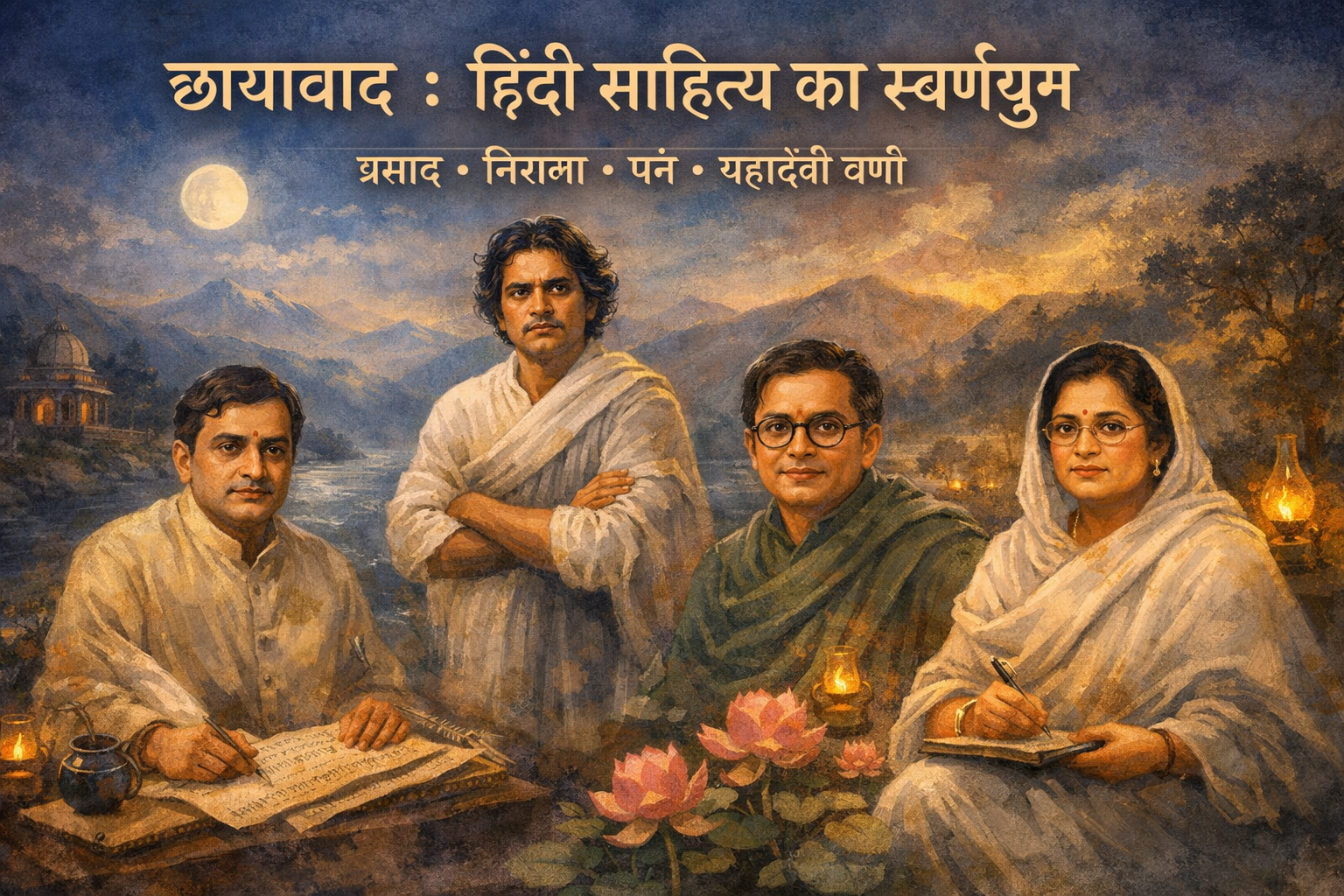
In the history of Hindi literature, Chhayavad is not merely a poetic movement; it is a profound cultural and philosophical awakening. It marks a phase when poetry turned inward—exploring the depths of the human soul, emotions, and imagination—while remaining deeply rooted in Indian spiritual and aesthetic traditions. The movement reached its zenith under four towering literary figures: Jaishankar Prasad, Suryakant Tripathi ‘Nirala’, Sumitranandan Pant, and Mahadevi Verma, collectively known as the four pillars of Chhayavad.
Thank you for reading this post, don’t forget to subscribe!What is Chhayavad?
Chhayavad was a major romantic–mystical movement in Hindi poetry that flourished roughly between 1918 and 1936. It emphasized individual experience, emotional depth, spiritual inquiry, and the beauty of nature, distinguishing itself sharply from earlier didactic and moralistic traditions.
The term Chhayavad literally means “the poetry of shadows”—suggesting subtle emotions, inner feelings, and symbolic expression rather than overt narration. This movement gave voice to the poet’s inner self and marked the rise of personal lyricism in modern Hindi poetry.
Historical and Literary Background
Chhayavad emerged during a period of social transformation in India—under colonial rule, rising nationalist consciousness, and renewed interest in Indian philosophy. Influenced by Indian Vedantic thought, Bhakti poetry, and Western Romanticism, Chhayavad created a uniquely Indian form of romantic poetry.
Key Characteristics of Chhayavad Poetry
1. Subjective Expression
Chhayavad poetry places the poet’s inner world at the center—personal joy, sorrow, longing, struggle, and self-reflection dominate the verse.
2. Mysticism and Spirituality
A deep sense of mysticism connects the soul (atman), nature, and the infinite (brahman). Poetry becomes a medium of spiritual exploration.
3. Nature as a Living Presence
Nature is not merely scenic but personified—rivers, clouds, flowers, moonlight, and seasons reflect human emotions and inner states.
4. Aesthetic Beauty and Imagination
Chhayavad poetry is rich in imagery, symbolism, musicality, and refined emotional expression, appealing strongly to aesthetic sensibility.
5. Refined and Classical Language
Poets favored Sanskritized Hindi, ornate metaphors, and rhythmic flow, giving the poetry a dignified and lyrical tone.
6. Spiritualized Concept of Love
Love in Chhayavad is often transcendental, elevating human affection to a divine or metaphysical plane.
The Four Pillars of Chhayavad
1. Jaishankar Prasad (1889–1937)
The Philosopher and Architect of Chhayavad
Literary Contribution
Jaishankar Prasad infused Chhayavad with philosophical depth, Indian spiritual traditions, and historical consciousness. His poetry blends emotion with metaphysical inquiry.
Distinctive Features
- Profound mysticism
- Vedantic and cultural symbolism
- Majestic and Sanskritized diction
Major Works
Poetry
- Kamayani (Epic poem; masterpiece of Chhayavad)
- Ansu (Tears)
- Jharna
- Lahar
Drama
- Skandagupta
- Chandragupta
- Dhruvaswamini
2. Suryakant Tripathi ‘Nirala’ (1896–1961)
The Revolutionary Voice of Chhayavad
Literary Contribution
Nirala brought rebellion, realism, and social awareness into Chhayavad, challenging conventional forms and emotions.
Distinctive Features
- Free verse experimentation
- Emotional intensity and empathy
- Bold individuality and social critique
Major Works
Poetry
- Anamika
- Parimal
- Gitika
- Ram Ki Shakti Puja
- Saroj Smriti
Prose
- Kulli Bhat
- Billesur Bakriha
3. Sumitranandan Pant (1900–1977)
The Poet of Nature and Beauty
Literary Contribution
Pant elevated Chhayavad through exquisite nature poetry, celebrating harmony between humans and the natural world.
Distinctive Features
- Sensuous imagery
- Gentle lyricism
- Visual richness and musical flow
Major Works
- Pallav
- Gunjan
- Granthi
- Yugant
- Lokayatan
4. Mahadevi Verma (1907–1987)
The Soul of Chhayavad and the Poet of Compassion
Literary Contribution
Mahadevi Verma enriched Chhayavad with intense emotional sensitivity, feminine consciousness, and lyrical sorrow.
Distinctive Features
- Themes of pain, separation, and yearning
- Subtle mysticism
- Deep empathy and compassion
Major Works
Poetry
- Nihar
- Rashmi
- Neerja
- Sandhyageet
Prose
- Shrinkhala Ki Kadiyan
- Atit Ke Chitra
- Mera Parivar
Literary and Cultural Significance of Chhayavad
- Established individual expression as the core of modern Hindi poetry
- Integrated Indian philosophy with modern sensibility
- Elevated poetic language and aesthetics
- Paved the way for later movements such as Progressivism and Experimentalism
Conclusion
Chhayavad represents a luminous chapter in Hindi literature—where poetry became introspective, spiritual, and deeply human. The philosophical vision of Prasad, the rebellious spirit of Nirala, the aesthetic grace of Pant, and the emotional depth of Mahadevi Verma together shaped a movement that continues to inspire readers and scholars alike.
Chhayavad is not merely a literary movement—it is the celebration of the human soul through poetry.
Leave a Reply