Introduction
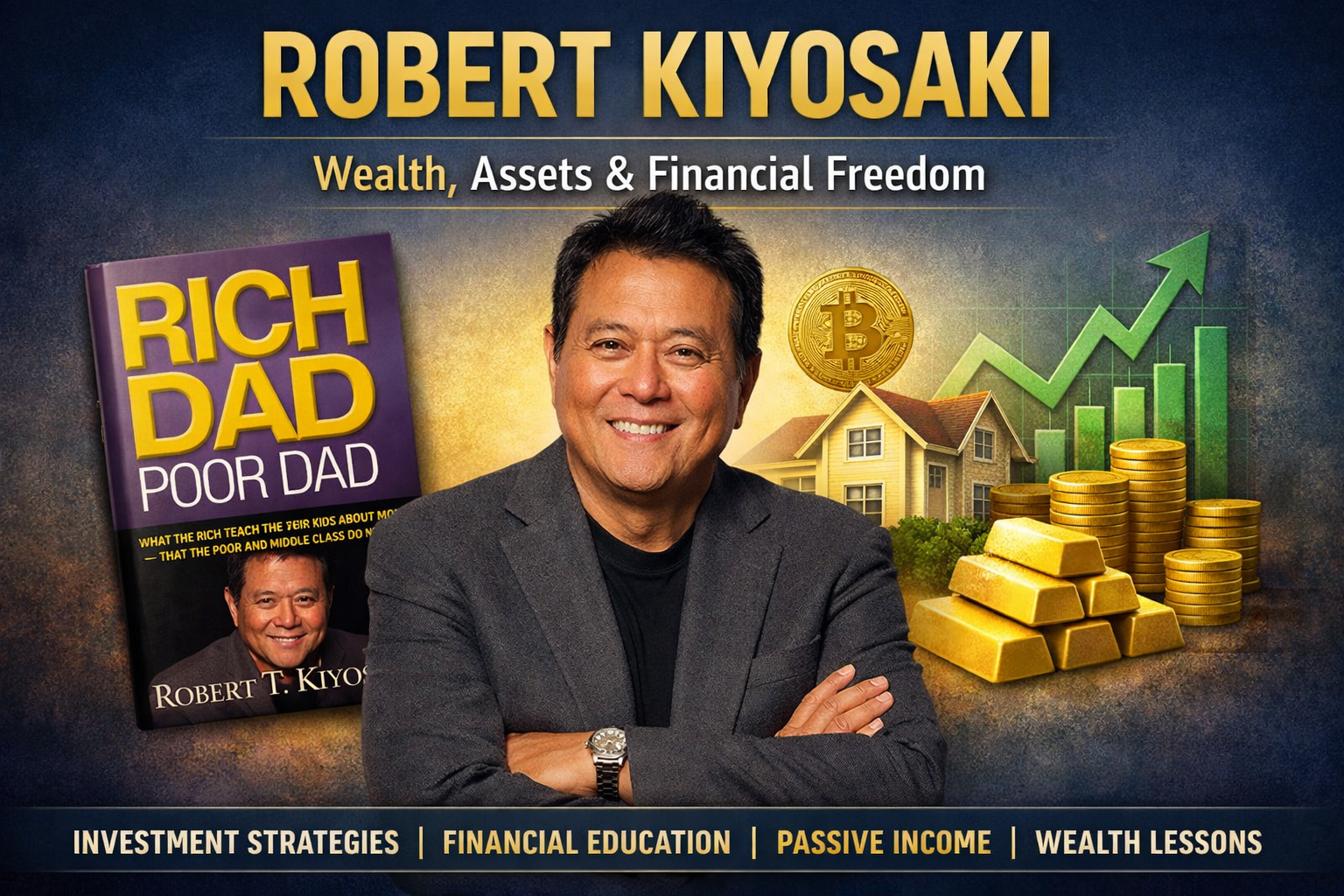
Thank you for reading this post, don’t forget to subscribe!Robert T. Kiyosaki is one of the most influential personal finance educators of modern times. Best known as the author of Rich Dad Poor Dad, Kiyosaki challenged traditional beliefs about money, education, jobs, and investing. Loved by millions and criticized by many, his ideas sparked a global conversation on financial literacy and wealth creation beyond salaried employment.
This article explores who Robert Kiyosaki is, what made him famous, his teachings for wealth creators, his investment philosophy, his estimated wealth, and a critical evaluation of his methods, enabling readers to learn from his insights while avoiding common pitfalls.
Early Life and Biography
Robert Toru Kiyosaki was born on April 8, 1947, in Hilo, Hawaii, USA. He is a fourth-generation Japanese-American. His upbringing played a pivotal role in shaping his financial philosophy.
Kiyosaki often contrasts the influence of two father figures in his life:
- “Poor Dad” – his biological father, a highly educated man who worked for the government and believed in job security.
- “Rich Dad” – the father of his best friend, an entrepreneur with little formal education but strong business instincts.
This contrast became the foundation of Rich Dad Poor Dad and his lifelong mission to promote financial education outside the formal schooling system.
Education and Early Career
- Graduated from U.S. Merchant Marine Academy
- Served as a Marine Corps helicopter pilot during the Vietnam War
- Later worked in sales at Xerox, where he developed strong persuasion and communication skills
- Entered entrepreneurship in the 1970s, experiencing both major successes and failures
What Made Robert Kiyosaki Famous?
Kiyosaki rose to global fame with the publication of Rich Dad Poor Dad (1997).
Why the Book Became a Phenomenon:
- Challenged the idea that formal education guarantees financial success
- Introduced simple yet powerful concepts like:
- “Assets vs Liabilities”
- “Pay yourself first”
- “The rich don’t work for money; money works for them”
- Written in a conversational, story-driven style accessible to ordinary readers
The book has sold over 40 million copies worldwide, translated into dozens of languages, and became one of the best-selling personal finance books of all time.
Core Teachings for Wealth Creators
Robert Kiyosaki’s philosophy is built around financial intelligence (FIQ) rather than academic intelligence (IQ).
1. Assets vs Liabilities
Kiyosaki’s most famous lesson:
“An asset puts money in your pocket. A liability takes money out.”
According to him:
- Assets include businesses, rental real estate, stocks, bonds, and intellectual property
- Liabilities include consumer debt and personal expenses disguised as investments
2. Financial Education Is Missing in Schools
Kiyosaki argues that schools teach people to:
- Work for money
- Seek job security
- Avoid mistakes
But wealth creators:
- Learn money skills
- Take calculated risks
- Embrace failure as education
3. Cash Flow Over Salary
He emphasizes:
- Passive income
- Recurring cash flow
- Financial independence over high income
4. Mindset of the Rich
According to Kiyosaki:
- Poor say: “I can’t afford it”
- Rich ask: “How can I afford it?”
Robert Kiyosaki’s Style of Investing
Kiyosaki is not a traditional investor. His approach is entrepreneurial and aggressive, focused on control rather than diversification.
Key Investment Preferences:
- Real Estate: Income-generating rental properties using leverage (good debt)
- Businesses: Ownership over employment
- Paper Assets: Stocks, commodities, gold, silver
- Alternative Assets: Bitcoin and blockchain-based assets (in recent years)
His Investment Philosophy:
- Use debt strategically
- Focus on cash-flow-positive investments
- Invest in assets that provide tax advantages
- Learn the rules of money and play the game intelligently
Best Robert Kiyosaki Quotes on Wealth Creation
“It’s not how much money you make, but how much money you keep.”
“The single most powerful asset we all have is our mind.”
“The rich buy assets. The poor only have expenses.”
“Workers work hard enough to not get fired. Owners pay just enough so workers won’t quit.”
“If you want to be rich, you need to be financially literate.”
Robert Kiyosaki’s Estimated Wealth (Up to Date)
Robert Kiyosaki’s net worth is widely estimated between USD 80 million to 100 million.
Sources of Wealth:
- Book royalties (Rich Dad Poor Dad series)
- Seminars and educational programs
- Licensing of the “Rich Dad” brand
- Real estate investments
- Business ventures
It is important to note that Kiyosaki himself has openly discussed filing for bankruptcy in one of his companies, reinforcing his belief that failure is part of entrepreneurship.
Critical Evaluation of Kiyosaki’s Investment Methods
Strengths
- Popularized financial literacy globally
- Encouraged entrepreneurship and asset ownership
- Simplified complex financial ideas
- Shifted mindset from job dependency to ownership
Concerns and Criticisms
- Oversimplification of “assets vs liabilities”
- Heavy reliance on leverage may not suit conservative investors
- Seminar-based business model criticized as expensive
- Real estate success depends heavily on market timing and skills
- Not all advice is universally applicable across countries
What Investors Should Learn — and Avoid
Learn:
- Importance of financial education
- Cash flow thinking
- Mindset shift toward ownership
Avoid:
- Blindly copying leverage-heavy strategies
- Ignoring risk management
- Assuming wealth creation is quick or easy
Kiyosaki’s methods work best for educated, disciplined, and experienced investors, not beginners chasing shortcuts.
Legacy and Impact
Robert Kiyosaki transformed how millions think about money. Whether admired or criticized, his influence on personal finance education is undeniable. He opened doors to conversations about:
- Financial independence
- Passive income
- Entrepreneurship
- Alternative investing
His true legacy lies not in the wealth he accumulated, but in the financial curiosity he ignited worldwide.
Conclusion
Robert Kiyosaki is more than a financial author—he is a movement builder. His teachings challenge conventional thinking, inspire self-education, and empower individuals to take control of their financial future. While his strategies demand caution and critical thinking, the core message remains powerful:
Financial freedom begins with financial education.

Leave a Reply