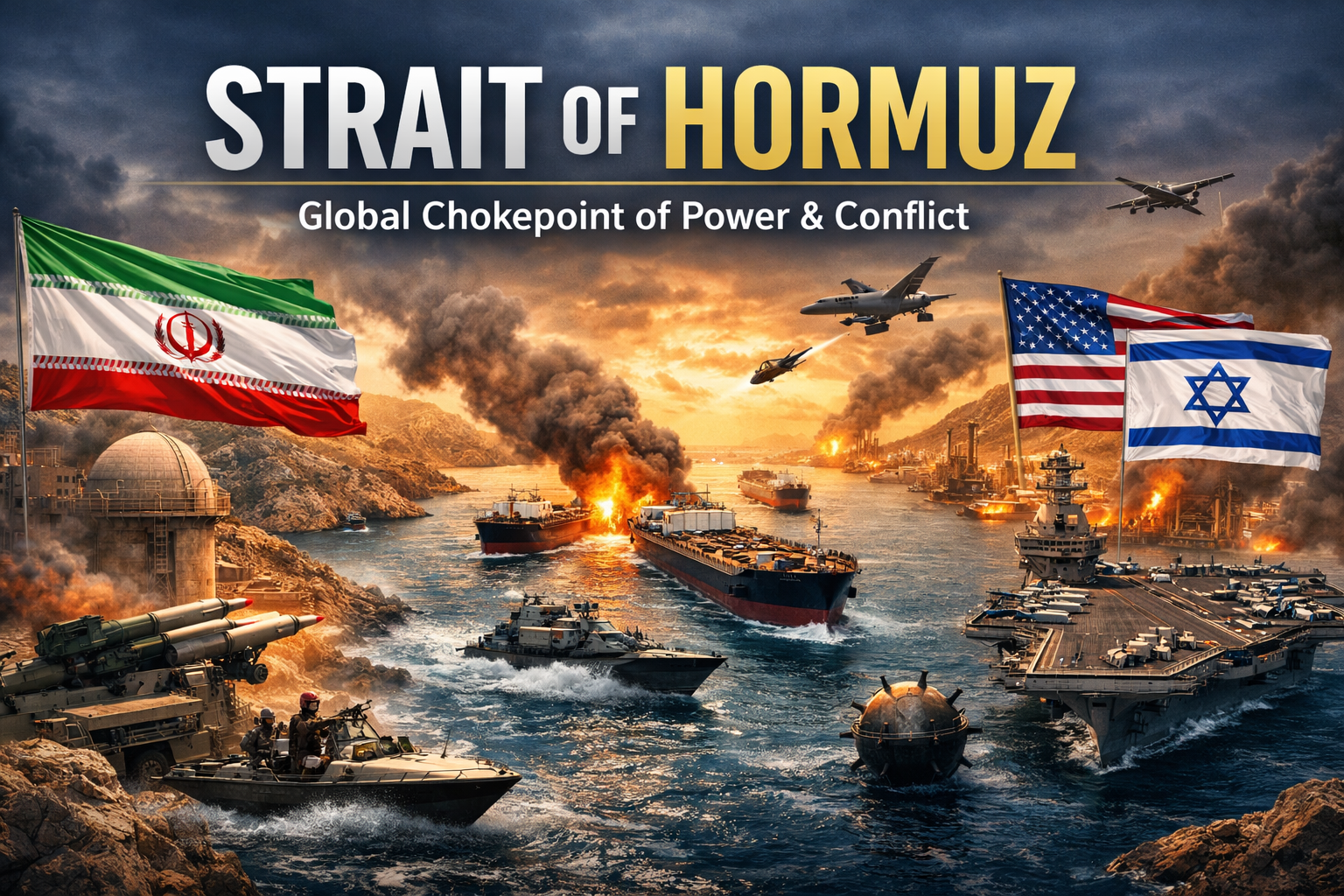
Introduction
Thank you for reading this post, don’t forget to subscribe!The Strait of Hormuz is one of the most critical maritime passages in the world. Though narrow in size, it holds immense influence over global energy markets, geopolitics, and international trade. In 2026, it has once again become the epicentre of global tension amid conflict involving Iran, United States, and Israel.
What is the Strait of Hormuz?
The Strait of Hormuz is a narrow sea passage connecting the Persian Gulf with the Gulf of Oman, and ultimately the Arabian Sea.
- Width: ~33 km at narrowest point
- Shipping lanes: Only ~3 km wide in each direction
- Bordered by: Iran (north) and Oman/UAE (south)
It functions as a global energy artery, transporting oil and gas from Gulf countries to the rest of the world.
Meaning of the Word “Hormuz”
The term “Hormuz” is believed to originate from:
- Persian roots, possibly linked to “Hormoz” or “Hormuzd”, referring to Ahura Mazda, the supreme deity in Zoroastrianism
- Historically associated with the ancient trading centre Hormuz Island
Thus, the name symbolizes divine power and ancient trade legacy.
Why is the Strait of Hormuz So Important?
1. Energy Lifeline of the World
- Around 20% of global oil supply passes through this strait
- Major exporters: Saudi Arabia, Iraq, UAE, Kuwait, Iran
- Also critical for LNG (Liquefied Natural Gas)
Any disruption directly impacts:
- Fuel prices
- Inflation
- Global economy
2. Chokepoint of Global Trade
The Strait is a “maritime chokepoint”—a narrow passage where trade can be easily controlled or disrupted.
- No practical alternative routes for most Gulf oil
- Even temporary blockages trigger global panic
3. Financial & Economic Impact
Recent events show:
- Oil prices surged above $100/barrel during conflict
- Supply chain disruptions affected fertilizers, food, and metals
- Global markets reacted instantly to ceasefire news
Geographical Features that Make It Unique
Narrow and Easily Controllable
- Extremely narrow shipping corridor
- Ships must pass through fixed lanes → easy to monitor and target
Proximity to Iran
- Northern coastline entirely controlled by Iran
- Iranian islands and military bases overlook the strait
Natural Military Advantage
- Ideal for:
- Naval mines
- Missile systems
- Drone surveillance
- Fast attack boats
Iran can disrupt traffic without full-scale war, making it a low-cost, high-impact strategy
Why the Strait Favors Iran Strategically
1. Geographic Dominance
Iran controls the longer coastline and key vantage points.
2. Asymmetric Warfare Capability
Iran doesn’t need a powerful navy; instead, it uses:
- Mines
- Missiles
- Drones
- Electronic warfare
These tactics are cheap but highly effective.
3. Legal and Political Leverage
- Under international maritime law, it is an international strait
- But enforcement is difficult without global cooperation
Iran exploits this legal grey zone to assert influence.
Strait of Hormuz in 2026: Current War & Tensions
1. Trigger: US–Israel Attacks on Iran
- Conflict escalated in February 2026
- Iran retaliated by targeting shipping and restricting passage
2. Iran’s Strategic Move: Control of the Strait
- Iran effectively restricted or controlled ship movement
- Introduced toll-like systems and selective access
- Allowed friendly nations but blocked adversaries
This turned the strait into a geopolitical weapon
3. Global Impact
- Shipping reduced drastically (up to 90% decline initially)
- Thousands of ships stuck or rerouted
- Insurance and freight costs skyrocketed
4. Military Escalation
- US launched operations to reopen the strait
- Iran used:
- Drone strikes
- Sea mines
- Missile threats
Experts say Iran may maintain long-term control leverage
5. Economic Shockwaves
- Oil prices fluctuated sharply
- Inflation risks increased globally
- Food and energy insecurity worsened
6. Ceasefire but Uncertainty
- Temporary ceasefire in April 2026
- But:
- Shipping still risky
- Iran continues asserting control
- Global supply chains remain unstable
Psychological & Strategic Dimensions
Power Projection
Control of Hormuz gives Iran:
- Psychological dominance over global powers
- Bargaining power in negotiations
Economic Warfare
Instead of direct war:
- Disrupt supply → pressure economies
- Influence oil prices → global leverage
Symbol of Resistance
Iran uses Hormuz as:
- A symbol of sovereignty
- A tool against Western dominance
Can the Strait Be Replaced or Bypassed?
- Limited alternatives exist (pipelines, Red Sea routes)
- But they cannot fully replace Hormuz capacity
This makes the world structurally dependent on this chokepoint.
How Can Conflict Be Prevented?
- Diplomatic engagement (US–Iran dialogue)
- Multilateral maritime security frameworks
- Respect for international law (UNCLOS)
- Diversification of energy routes
- De-escalation of regional conflicts
Conclusion
The Strait of Hormuz is not just a waterway—it is a global pressure point where geography, energy, and geopolitics collide.
In 2026, it has proven once again that:
- A narrow sea passage can influence the entire global economy
- Regional conflicts can have worldwide consequences
- Control over chokepoints equals strategic power
Leave a Reply