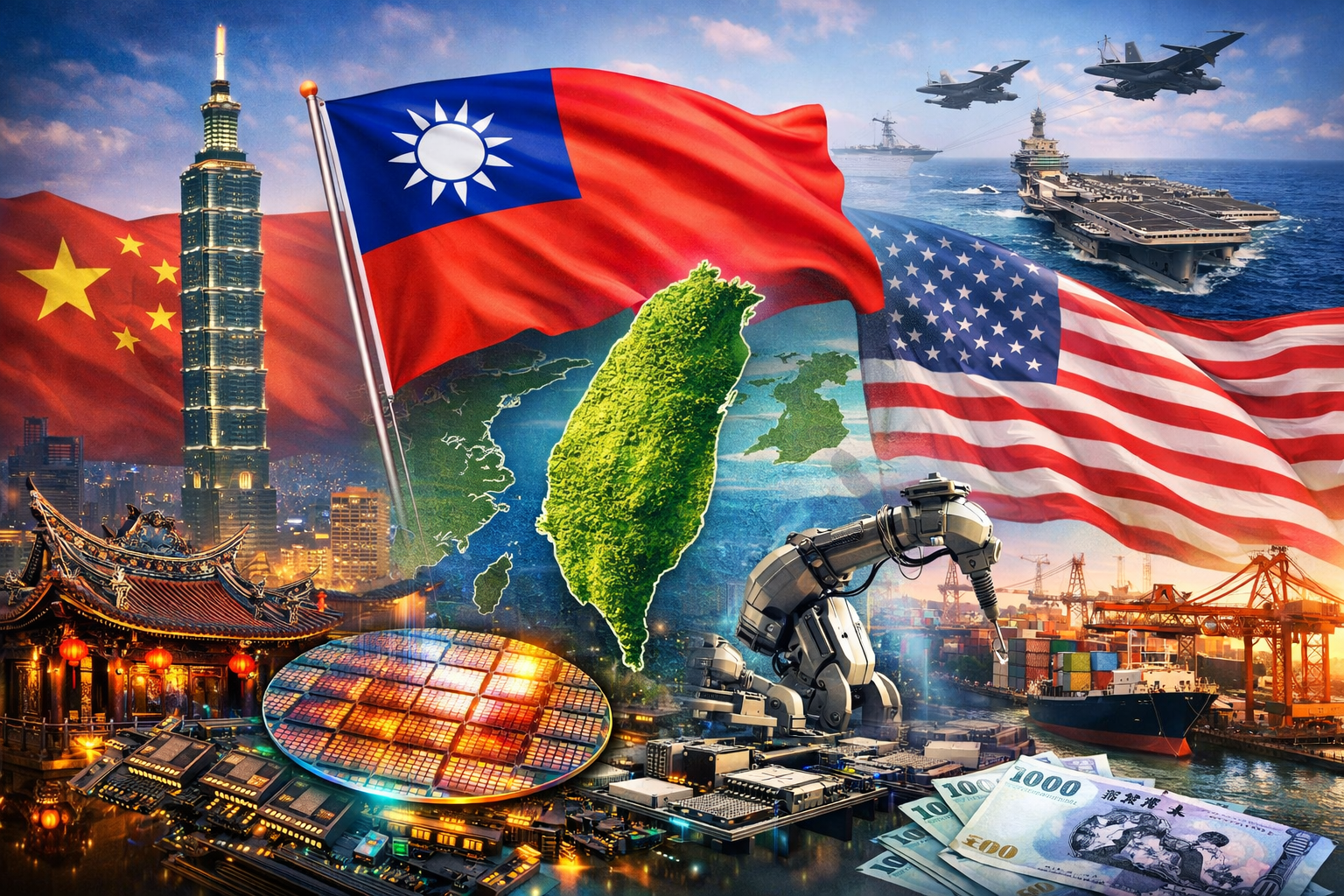
Taiwan, officially known as the Republic of China, is a small island nation in East Asia that has emerged as one of the most strategically important economies in the world. Despite its modest size, Taiwan sits at the heart of global technology supply chains, particularly in semiconductor manufacturing, and plays a crucial role in geopolitical dynamics involving the People’s Republic of China and the United States.
Thank you for reading this post, don’t forget to subscribe!This article explores Taiwan’s journey—from its ancient past to becoming the world’s semiconductor powerhouse—and the geopolitical tensions that define its present.
1. Geography of Taiwan
Taiwan is located in the western Pacific Ocean, about 180 km off the southeastern coast of China. It lies along the “First Island Chain,” a strategic maritime line in East Asia.
Key Features:
- Capital: Taipei
- Terrain: Mountainous (over 60% forested)
- Climate: Subtropical in the north, tropical in the south
- Natural hazards: Earthquakes and typhoons
Its geographic location makes it a critical node for global trade routes and military strategy.
2. Historical Evolution of Taiwan
Ancient & Indigenous Roots
Taiwan was originally inhabited by Austronesian indigenous peoples, with cultural links to Southeast Asia and the Pacific Islands.
Colonial Period
- 17th century: Controlled by Dutch and Spanish settlers
- 1683: Annexed by Qing China
- 1895–1945: Colonized by Japan
Modern Political Formation
After World War II, Taiwan was handed to the Republic of China. In 1949, after the Chinese Civil War:
- The Chiang Kai-shek government fled to Taiwan
- Mainland China became the People’s Republic of China
Thus began the “Two Chinas” issue, still unresolved today.
3. Demography and Ethnicity
Taiwan has a population of around 23–24 million.
Ethnic Composition:
- Han Chinese (≈95%)
- Hoklo (majority)
- Hakka
- Indigenous Austronesian groups (≈2–3%)
Language:
- Mandarin (official)
- Taiwanese Hokkien
- Hakka dialects
- Indigenous languages
Taiwan is one of the most urbanized societies in Asia.
4. Culture and Society
Taiwanese culture is a blend of:
- Traditional Chinese heritage
- Japanese colonial influences
- Modern Western values
Cultural Highlights:
- Festivals: Lunar New Year, Dragon Boat Festival
- Cuisine: Bubble tea (originated here), street food culture
- Religion: Mix of Buddhism, Taoism, folk beliefs
Taiwan is also known for its liberal democracy, freedom of speech, and progressive policies in Asia.
5. Political System
Taiwan is a democratic republic with:
- Directly elected President
- Multi-party system
- Independent judiciary
Major parties:
- Democratic Progressive Party (DPP)
- Kuomintang (KMT)
Taiwan functions as a sovereign state, but its international recognition is limited due to pressure from China.
6. Economic Transformation: From Agriculture to High-Tech
Taiwan’s economic rise is often called an “East Asian Miracle.”
Phases of Growth:
- 1950s–60s: Land reforms and agriculture
- 1970s–80s: Export-oriented industrialization
- 1990s–present: High-tech innovation
Today, Taiwan is a global leader in:
- Electronics
- Information technology
- Semiconductors
7. Taiwan as the World’s Semiconductor Hub
At the heart of Taiwan’s success lies Taiwan Semiconductor Manufacturing Company (TSMC).
Why Taiwan Leads in Chip Manufacturing:
- Produces over 60% of global semiconductors
- Controls over 90% of advanced chips
- TSMC alone holds about 64% of global foundry market share
Key Factors Behind Success:
1. Innovative Business Model
TSMC pioneered the “pure-play foundry model”—manufacturing chips for other companies rather than designing its own
2. Government Support
- Heavy investment in R&D
- Institutions like Industrial Technology Research Institute (ITRI)
3. Skilled Workforce
Strong engineering education and technical expertise
4. Cluster Ecosystem
Close integration of:
- Suppliers
- Designers
- Manufacturers
5. Economies of Scale
Huge investments (billions of dollars per fab) created barriers to entry
8. Raw Materials for Chip Manufacturing
Semiconductor manufacturing relies on:
Key Inputs:
- Silicon wafers (from sand/quartz)
- Rare gases (neon, argon)
- Chemicals (photoresists, acids)
- Ultra-pure water
- Advanced machinery (e.g., EUV lithography)
Taiwan’s Advantage:
Taiwan does not have abundant raw materials, but excels because:
- It imports raw materials efficiently
- Focuses on high-value processing, not extraction
- Maintains strong global supply chains
This shows Taiwan’s success is based on technology, not natural resources.
9. Why Taiwan Became a Global Manufacturing Hub
Taiwan’s rise is not accidental. It is driven by:
Core Drivers:
- Strategic state planning
- Export-oriented policies
- Strong SME ecosystem
- Integration with global markets
- Focus on precision manufacturing
Unlike resource-rich countries, Taiwan built “knowledge capital” instead of natural capital.”
10. Geopolitical Rivalry: Taiwan, China, and the USA
This is one of the most sensitive geopolitical issues today.
China’s Position
- Considers Taiwan a breakaway province
- Seeks reunification (peaceful or forceful)
- Opposes Taiwan’s independence
Taiwan’s Position
- Functions as a sovereign democratic state
- Majority supports maintaining status quo
- Increasing identity separate from China
United States’ Position
- Follows “One China Policy” (recognizes China diplomatically)
- But supports Taiwan militarily and economically
- Provides arms and strategic backing
Why Taiwan Matters Globally
1. Semiconductor Dependence
Global tech giants depend on Taiwan’s chips
2. Strategic Location
Control over Taiwan affects Indo-Pacific security
3. Economic Stability
Any conflict could disrupt global supply chains
What the World Thinks
- Most countries follow “strategic ambiguity”
- Recognize China diplomatically
- Maintain economic ties with Taiwan
Taiwan is thus diplomatically isolated but economically indispensable.
11. The “Silicon Shield” Concept
Taiwan’s semiconductor dominance acts as a deterrent against conflict:
- The world depends on Taiwan’s chips
- Any disruption would hurt all major economies
This is often referred to as Taiwan’s “Silicon Shield.”
12. Challenges Facing Taiwan
- Rising tensions with China
- Overdependence on semiconductor sector
- Aging population
- Global competition (USA, South Korea, China)
Conclusion
Taiwan is a remarkable example of how a small island with limited natural resources can become a global powerhouse through strategic planning, technological innovation, and human capital development.
Its dominance in semiconductor manufacturing has not only shaped the global economy but also elevated its geopolitical importance. However, its future remains closely tied to the evolving power dynamics between China and the United States.
Taiwan today stands at the intersection of technology, economics, and geopolitics—making it one of the most important places in the world to understand in the 21st century.
Leave a Reply