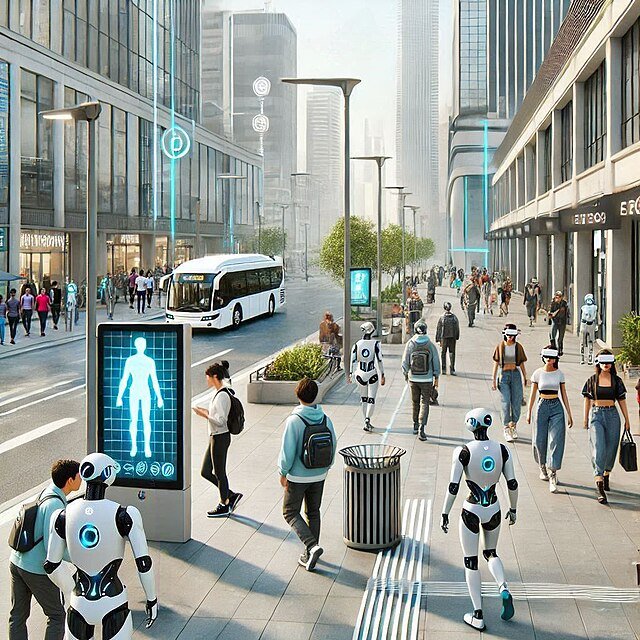
The world today is standing at the edge of a historic transformation — the Artificial Intelligence (AI) Revolution. What began as simple algorithms powering recommendation systems and automation tools has now evolved into generative AI, autonomous decision-making, and human-machine collaboration at an unprecedented scale. By 2050, AI is expected to reshape industries, societies, economies, and even geopolitics. But how will this transformation unfold? Which sectors will lead the way? What will human life look like in 2050, and where will India stand in this new world order? Let’s explore.
Thank you for reading this post, don’t forget to subscribe!The AI Transformation: Key Sectors by 2050
1. Healthcare: From Cure to Prevention
By 2050, healthcare will likely be dominated by AI-driven precision medicine. Instead of treating diseases after they appear, AI will predict illnesses through genetic sequencing, wearable devices, and continuous health monitoring. Robotics will assist in surgeries, while AI-enabled drug discovery will reduce the time and cost of producing new medicines. Life expectancy could see a significant boost, with chronic diseases managed more effectively than ever before.
Impact in 2050: Personalized healthcare as a default, reduced mortality rates, and AI doctors accessible to even rural populations.
2. Education: Hyper-Personalized Learning
The classroom of 2050 will be unrecognizable. AI tutors will provide personalized curricula for every student based on their aptitude, interest, and pace of learning. Virtual reality and immersive simulations will replace textbooks, while skill-based learning will dominate over rote memorization.
Impact in 2050: Education equality across nations, higher global literacy, and a workforce continuously upskilled through lifelong learning powered by AI.
3. Work and Industry: Humans + Machines
The future of work will be less about humans competing with AI and more about collaboration. Routine jobs in accounting, logistics, and customer service will be fully automated, but new jobs in AI ethics, supervision, and creative problem-solving will emerge. Factories will become smart ecosystems, with machines handling operations and humans overseeing innovation.
Impact in 2050: A shift in the definition of employment, with shorter work weeks, gig-based AI-supervised work, and creativity-driven professions.
4. Transportation: The Era of Autonomy
Autonomous vehicles, drones, and AI-controlled traffic systems will dominate. By 2050, manual driving may be as rare as horse-riding is today. Urban air mobility (flying taxis) will become commonplace, reducing congestion and reshaping urban design.
Impact in 2050: Safer roads, faster commutes, and eco-friendly smart cities with AI-regulated transportation networks.
5. Finance and Economy: Algorithmic Powerhouses
Banking, investing, and financial services will be AI-first. From algorithmic trading to blockchain-based smart contracts, financial systems will become faster, safer, and more decentralized. By 2050, physical currency may be obsolete, replaced by digital global currencies regulated by AI.
Impact in 2050: Inclusive financial access, reduced fraud, and globalized economies interconnected by AI-driven systems.
6. Defence and Security: The Double-Edged Sword
Military strategies will be dominated by autonomous weapons, cyber defence, and AI surveillance. Nations with advanced AI capabilities will enjoy unmatched geopolitical strength, but the risks of misuse, cyber warfare, and AI-driven conflicts will be high.
Impact in 2050: A new form of warfare where AI dominance defines global superpowers.
7. Climate and Sustainability: AI for the Planet
By 2050, AI will play a key role in climate monitoring, renewable energy management, and smart agriculture. From predicting natural disasters to optimizing energy grids, AI could be humanity’s strongest ally against climate change.
Impact in 2050: Potential stabilization of climate crises, AI-driven food security, and sustainable urban living.
Human Life in 2050: The Pros and Cons of the AI Future
Pros
- Longer life expectancy through AI-driven healthcare.
- Effortless communication via AI-powered translation and virtual companions.
- Higher productivity with less time spent on repetitive tasks.
- Global connectivity with AI bridging education, finance, and governance gaps.
Cons
- Job Displacement: Millions may lose jobs in traditional industries before reskilling catches up.
- Privacy Erosion: AI surveillance could compromise personal freedoms.
- Inequality Risks: Nations and individuals without AI access may be left far behind.
- Ethical Dilemmas: From autonomous weapons to biased algorithms, ethical questions will dominate policy debates.
India in 2050: The AI-Powered Giant
India’s trajectory is deeply tied to how it harnesses AI. By 2050:
- Economic Status: India is projected to be among the top three global economies, powered by a young, AI-skilled workforce and a thriving digital economy.
- Geopolitical Strength: With AI capabilities in defence, space, and cyber-security, India will emerge as a key global power, balancing the US, China, and other AI superpowers.
- Social Transformation: AI-driven agriculture, healthcare, and education will uplift rural communities, reducing poverty and bridging urban-rural divides.
- Innovation Hub: India will not just consume but also create AI breakthroughs, leading startups and innovations in healthcare, fintech, and green technologies.
India in 2050: A technologically advanced, economically powerful, and geopolitically influential nation, shaping global AI ethics and governance.
Which Sectors Will Emerge Victorious by 2050?
- Healthcare & Biotechnology – AI cures, disease prevention, and longevity science.
- Education & Skill Development – Personalized, lifelong learning ecosystems.
- Clean Energy & Climate Tech – AI-driven sustainable future.
- Finance & Digital Economy – Decentralized, borderless transactions.
- Defence & Cybersecurity – Nations mastering AI in defence will dominate geopolitics.
Conclusion: A Future Shaped by AI
The AI revolution by 2050 is not just about smarter machines but about a redefined human experience. While challenges of inequality, ethics, and security remain, the potential of AI to improve health, sustainability, and knowledge is immense. Human life will be more connected, efficient, and innovative than ever before. For India, this is not just an opportunity but a destiny — to rise as a global AI powerhouse by 2050.
The choices we make today — in AI governance, education, and ethics — will determine whether 2050 is remembered as the age of empowerment or the age of dependency.
Leave a Reply