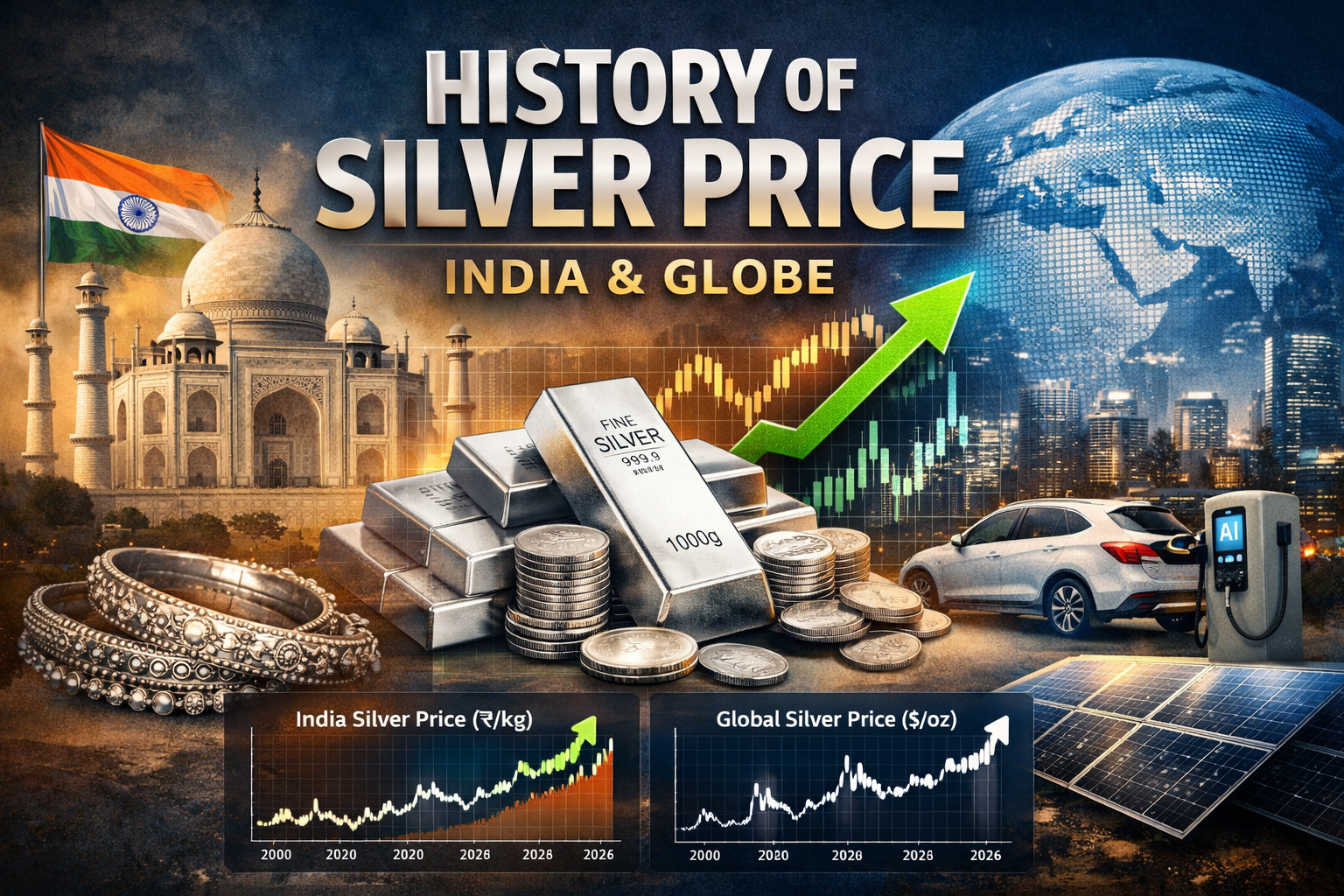
Silver — known as the “white metal” — has fascinated humans for millennia. From ancient coins and royal treasures to modern industrial applications, this metal combines beauty, utility, and investment value.
Thank you for reading this post, don’t forget to subscribe!In this article, we explore:
- Historical silver price trends in India and globally,
- Why silver is considered precious,
- What’s driving today’s price surge,
- Industrial and cultural uses,
- Silver’s relevance in India’s society.
1. Historical Silver Price Chart: India (2000–2026)
Here’s a snapshot of how silver prices moved in India over the last 25+ years (₹ per kg):
| Year | Silver Price (₹/kg) |
| 2000 | 7,900 |
| 2005 | 10,675 |
| 2010 | 27,255 |
| 2015 | 37,825 |
| 2018 | 41,400 |
| 2020 | 63,435 |
| 2022 | 55,100 |
| 2023 | 78,600 |
| 2024 | 95,700 |
| Sep 2025 | 1,30,000 |
| Oct 2025 | 1,95,000 |
| Dec 19, 2025 | 2,09,000 |
| Jan 2026 | ~3,25,000 (spot highs) |
Data reflects official market and spot/MCX price trends in India.
Key Insight: Silver prices have multiplied over 40 times in the past two decades in India, tracing rising global demand, inflation, and investment flows.
2. Global Silver Price Trends (Post-2000)
Silver, traditionally priced in US dollars per ounce, has also seen dramatic cycles:
- Early 2000s: Silver was trading below $5/oz.
- 2011 Peak: After financial crises and monetary easing, silver neared $50/oz.
- Mid-2010s Dip: Prices declined into the $15–20/oz zone.
- 2024–2026 Rally: Recently, silver has surged past $60/oz, and at times above $100/oz in early 2026 in some spot markets, driven by structural demand and supply tightness.
3. Why Silver is Precious
Silver’s precious status is not accidental — it stems from several core properties:
Unique Physical Properties
- High electrical conductivity — best among all metals,
- Excellent thermal conductivity,
- Reflective and antibacterial properties,
- Malleable and ductile.
These qualities make it both aesthetically valuable and technically indispensable.
Dual Role: Precious & Industrial
Unlike gold (primarily a store of value), silver is a hybrid metal — cherished for jewellery and investment, and heavily demanded as an industrial input.
4. Why Silver Prices Surged Recently (2024–2026)
Silver’s market has transformed in the last decade due to structural demand.
A) Industrial Boom
Silver demand today is dominated by industry:
- Solar panels (photovoltaics),
- Electric vehicles (EVs),
- Electronics & semiconductors,
- 5G infrastructure and data centres.
Industrial use accounts for over 50% of total demand, a massive shift from past decades when jewellery and coins drove consumption.
B) Persistent Supply Deficit
Silver mining output is largely a by-product of other metals like copper and zinc. This means miners cannot easily scale up production in response to higher prices, leading to recurring deficits.
C) Investment Demand
With inflation worries and macroeconomic uncertainty, retail and institutional investors have turned to silver as a hedge and investment asset, including silver ETFs and physical holdings.
D) Currency & Macro Factors
For India, a weak rupee makes imported silver pricier, amplifying local price increases.
E) Geopolitics & Monetary Policy
Global economic instability and projected interest rate cuts have supported precious metals markets, boosting silver’s appeal.
5. Industrial Uses of Silver
Silver plays a critical role in modern technology:
Solar Energy
Each solar panel uses silver paste to conduct electricity efficiently. It’s irreplaceable in most photovoltaic cells.
Electronics & EVs
Used in:
- Conductors & connectors,
- Printed circuit boards,
- Battery systems,
- Sensors.
Medical & Hygiene
Silver ions are antimicrobial — widely used in wound dressings, coatings, and medical instruments.
Telecom & AI Data Centres
Silver-based components are key for high-speed, high-efficiency hardware.
This industrial demand distinguishes silver from gold and ensures ongoing relevance across high-growth sectors.
6. How India Is Associated with Silver
Cultural & Religious Importance
In India, silver is deeply tied to:
- Religious pujas and rituals,
- Weddings and gifting traditions,
- Festival purchases (like Dhanteras & Akshaya Tritiya),
- Traditional silverware and utensils.
This cultural demand remains strong year after year.
Investment Habits
Many Indians buy silver coins, bars, and jewellery both as:
- A store of value,
- A hedge against inflation,
- A way to pass wealth across generations.
Trade & Import Dependence
India is one of the largest global consumers of silver, but imports over 80% of its requirement, making prices sensitive to global markets and currency movements.
7. Industrial Relevance & Future Outlook
Silver’s role is shifting:
- From tradition and jewellery to clean technology and electrification,
- Demand tied to solar, EVs, AI, and semiconductors likely to grow further,
- Supply challenges may continue if mining doesn’t catch up.
Some manufacturers are exploring silver substitutes where possible, but its unique properties keep it essential.
Conclusion
Silver’s journey — from ancient coins to modern industrial metal — is one of evolution. Its price history reflects changing global use, linking traditional demand with cutting-edge technology.
Today:
- Industrial demand drives structural growth,
- Supply deficits and investor interest support higher prices,
- India remains a key market both culturally and economically.
Silver’s story is far from over — it is increasingly becoming a cornerstone of the clean energy revolution and electrified economy of the 21st century.
Leave a Reply