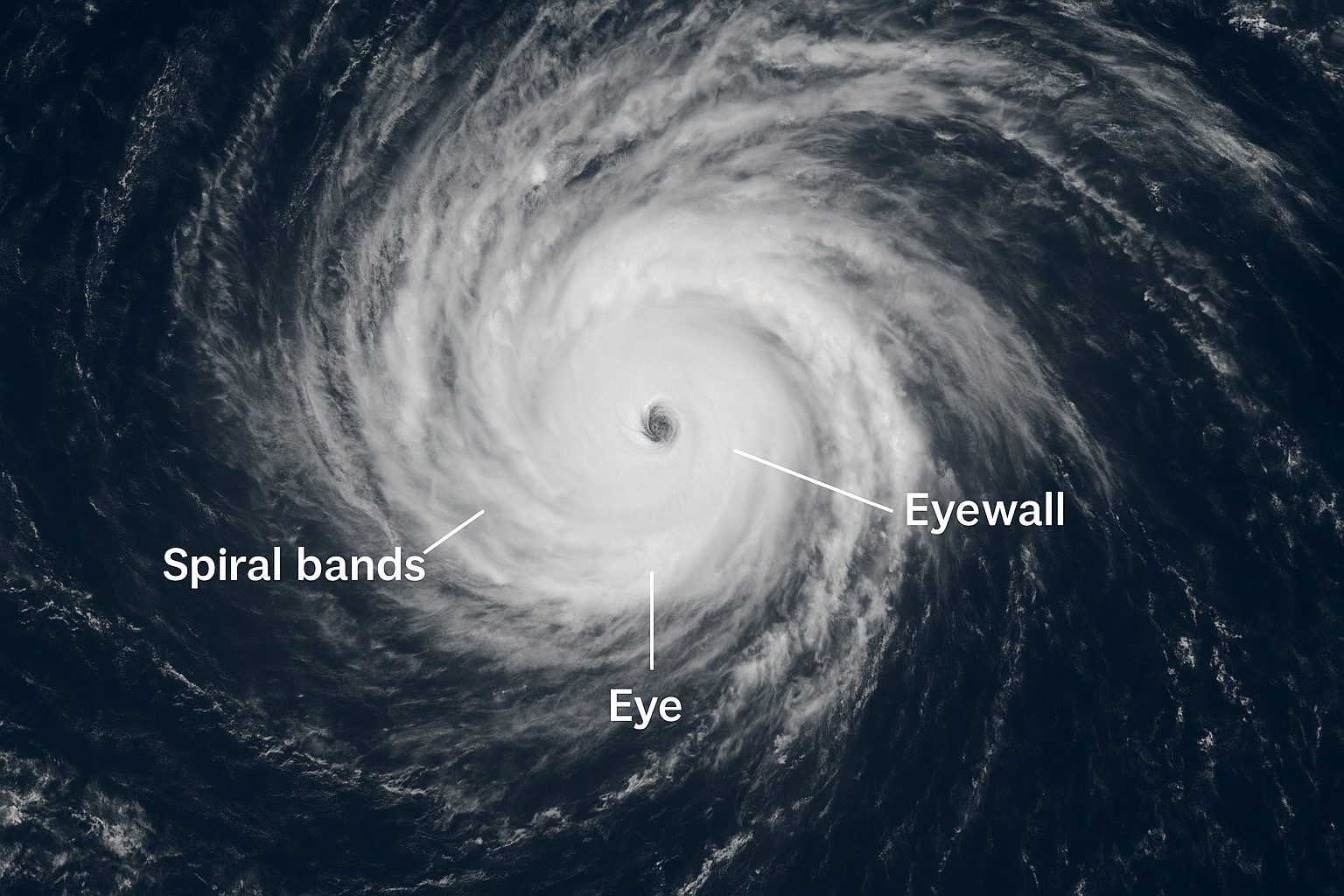
What is a Cyclone?
Thank you for reading this post, don’t forget to subscribe!A cyclone is a large-scale air mass that rotates around a strong centre of low atmospheric pressure. It is a powerful natural phenomenon characterized by spiraling winds, heavy rains, and thunderstorms.
In simple terms, a cyclone is a violent storm system formed over warm ocean waters, where the air spirals inward and upward, creating intense winds and torrential rains.
The word “Cyclone” comes from the Greek word “kyklon” meaning “moving in a circle” or “whirling around.”
How Cyclones Form
Cyclones typically originate over warm tropical oceans near the equator. The process involves:
- Warm Ocean Water (at least 26.5°C): Warm surface water heats the air above it, making it rise.
- Low Pressure Zone: As warm air rises, it leaves behind a low-pressure area.
- Moisture Condensation: The rising moist air cools and condenses, releasing latent heat, which further fuels the system.
- Coriolis Effect: Due to Earth’s rotation, the air begins to spiral, creating a spinning motion around the low-pressure centre.
- Formation of the Eye: As the cyclone strengthens, it develops a calm, clear centre known as the eye of the cyclone.
The Eye of the Cyclone
The eye is the centre of the cyclone — a relatively calm, clear area surrounded by the eye wall, which has the most intense winds and rainfall.
Inside the eye:
- Winds are light and skies may appear clear.
- Pressure is at its lowest.
- The surrounding eyewall contains the most violent winds and thunderstorms.
The size of the eye can range from 10 km to 100 km across, depending on the cyclone’s strength.
Why Cyclones Originate
Cyclones originate mainly due to heat energy from warm ocean waters and moisture-laden air. The essential conditions include:
- Warm Sea Surface Temperature: Above 26.5°C.
- High Humidity: Especially in the lower to middle layers of the atmosphere.
- Coriolis Force: Caused by Earth’s rotation, which helps in spinning the storm.
- Low Vertical Wind Shear: To allow the cyclone to build vertically.
- Pre-existing Low-Pressure Area: Acts as a seed for cyclone formation.
If any of these conditions are missing, cyclone formation becomes difficult.
Types of Cyclones
Cyclones are broadly classified into two main types based on their formation region:
1. Tropical Cyclones
- Form over warm tropical oceans.
- Fuelled by heat and moisture from the ocean surface.
- Very destructive, with strong winds and heavy rains.
- Examples: Hurricanes, Typhoons, Cyclones (in Indian Ocean).
- Wind speed can exceed 119 km/h (74 mph).
Sub-categories of tropical cyclones:
- Tropical Depression (≤ 62 km/h)
- Tropical Storm (63–118 km/h)
- Severe Cyclone or Hurricane (≥ 119 km/h)
2. Extratropical (Temperate) Cyclones
- Form in mid-latitudes (30°–60°) over land or sea.
- Driven by temperature differences between warm and cold air masses.
- Larger in size but less intense than tropical cyclones.
- Common in North America and Europe.
Cyclone Names in Different Parts of the World
Although the term Cyclone is used globally, the same weather phenomenon is known by different names depending on its location:
| Region | Name Used | Example | Special Characteristics |
| North Atlantic Ocean & East Pacific | Hurricane | Hurricane Katrina (2005) | Strong winds & storm surges affecting Americas |
| Northwest Pacific Ocean | Typhoon | Typhoon Haiyan (2013) | Intense rainfall, highly destructive in East Asia |
| South Pacific & Indian Ocean | Cyclone | Cyclone Amphan (2020) | Impacts South Asia, Australia & Indian Ocean islands |
| Southwest Indian Ocean | Tropical Cyclone | Cyclone Idai (2019) | Heavy rainfall, flooding in Africa |
| Australia Region | Willy-Willy (informal) | — | Local term for strong tropical storms |
Despite regional differences in names, their structure, formation process, and impact mechanisms are similar.
How Cyclones Are Named
Naming cyclones helps meteorologists, media, and the public to communicate clearly and avoid confusion during warnings or disasters.
Process of Naming:
- Cyclones are named by regional meteorological organizations such as:
- India Meteorological Department (IMD)
- World Meteorological Organization (WMO)
- Names are pre-decided and arranged in alphabetical lists.
- Each country in a region contributes names.
- Once a name is used, it is retired if the cyclone was exceptionally deadly or costly (e.g., Katrina, Haiyan).
Criteria for Naming:
- Simple, short, and easy to pronounce.
- Should not offend any culture or religion.
- Names alternate between male and female.
- Should reflect cultural and linguistic diversity of the region.
Example:
The name Amphan was given by Thailand; Tauktae by Myanmar; Fani by Bangladesh.
Impacts of Cyclones
Cyclones can cause widespread destruction, including:
- Loss of life and property
- Flooding and storm surges
- Damage to agriculture and infrastructure
- Disruption of communication and transport
- Environmental changes such as coastal erosion
However, cyclones also have natural benefits, such as redistributing heat across the planet and replenishing rainfall in dry regions.
Preparedness and Mitigation
To reduce the impact of cyclones:
- Governments issue early warnings through meteorological centres.
- Communities are encouraged to build cyclone shelters.
- Disaster management plans and evacuation drills are essential.
- Planting mangroves and maintaining coastal buffers can reduce storm surges.
Conclusion
Cyclones are among nature’s most powerful forces — both destructive and awe-inspiring. Understanding their formation, naming, and regional characteristics helps us prepare better and respect the delicate balance of nature. With improved forecasting, global cooperation, and community awareness, we can mitigate their impact and safeguard human lives.
Quick Recap:
- Cyclones = rotating storms around a low-pressure centre.
- Known as Hurricanes (Atlantic), Typhoons (Pacific), Cyclones (Indian Ocean).
- Named regionally for clarity and communication.
- “Eye” is the calm centre; “Eyewall” is the most violent zone.
- Originates from warm ocean water + moisture + Earth’s rotation.
Leave a Reply