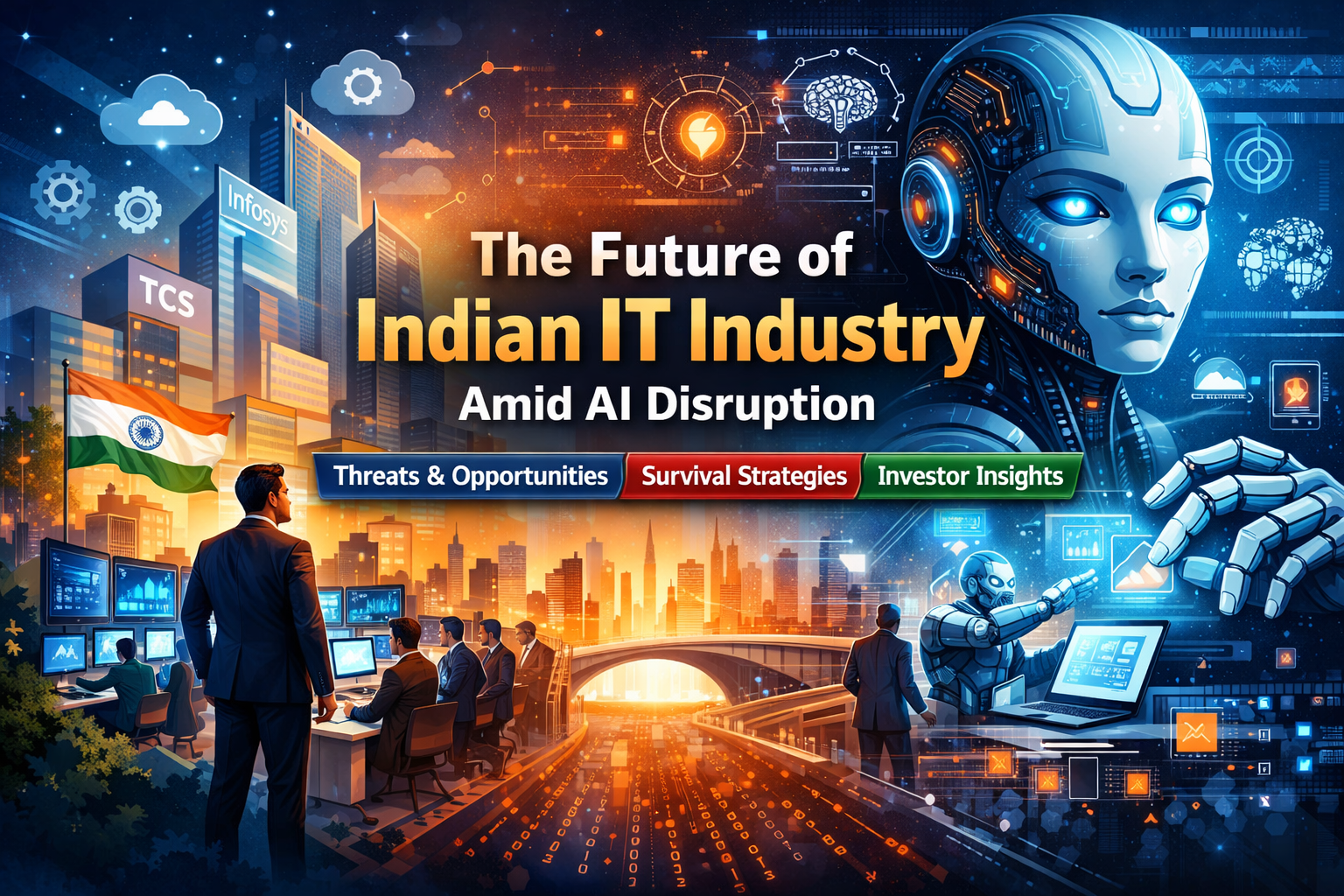
The global technology landscape is undergoing a profound transformation. The rapid advancement of Artificial Intelligence (AI), especially Generative AI, has triggered excitement, anxiety, and sharp market reactions. Companies like Anthropic—known for developing the AI model Claude—have accelerated fears that traditional IT services may face disruption.
Thank you for reading this post, don’t forget to subscribe!But is this the beginning of decline for Indian IT companies? Or is it the start of a new growth cycle?
Let us explore the future of Indian IT industries, survival strategies in the AI revolution, threats and opportunities, and what investors should do in this volatile environment.
1. Understanding the Current AI Disruption
The current wave of AI disruption is led by frontier AI firms such as:
- Anthropic
- OpenAI
- Google DeepMind
- Meta
These firms are building large language models (LLMs) capable of:
- Writing software code
- Automating customer service
- Generating business reports
- Creating digital content
- Enhancing cybersecurity
Earlier, Indian IT companies primarily earned revenue through:
- Application development
- Infrastructure management
- Business process outsourcing (BPO)
- ERP implementation
- Testing and maintenance services
AI now threatens to automate large parts of these repetitive services.
This explains why stock markets sometimes react sharply when new AI models are launched.
However, disruption does not mean destruction.
2. Current Position of Indian IT Industry
India’s IT industry is a global powerhouse with major players such as:
- Tata Consultancy Services
- Infosys
- Wipro
- HCL Tech
- Tech Mahindra
Strengths:
- Strong global client base (US & Europe)
- Large skilled workforce
- Cost competitiveness
- Strong balance sheets
- Experience in digital transformation projects
These companies are not software product startups. They are service integrators and transformation partners.
This distinction is crucial.
3. Threats Facing Indian IT Companies
1. Automation of Coding
AI tools can now generate code quickly, reducing demand for junior developers.
2. Reduced Billing Rates
Clients may demand lower prices since AI improves productivity.
3. Shorter Project Cycles
AI speeds up implementation timelines, potentially reducing revenue duration.
4. Direct AI Platforms
Companies like Anthropic offer AI tools directly to enterprises, bypassing traditional service vendors.
5. Margin Pressure
Higher investment in AI infrastructure and training may compress short-term margins.
4. Opportunities in the AI Revolution
Despite the fears, AI may actually increase long-term IT spending.
1. AI Implementation & Integration
Enterprises cannot directly deploy AI at scale without consulting partners.
Indian IT firms can:
- Customize AI for clients
- Ensure data privacy compliance
- Integrate AI with legacy systems
- Provide AI governance frameworks
2. Cloud & AI Infrastructure
AI workloads require:
- Cloud migration
- Data architecture modernization
- Cybersecurity upgrades
This benefits service providers significantly.
3. AI + Domain Expertise
Indian firms have expertise in:
- Banking
- Healthcare
- Manufacturing
- Telecom
Combining AI with industry knowledge creates high-value solutions.
4. Productivity Gains
If AI reduces manpower needs, companies can:
- Improve margins
- Deliver faster projects
- Compete globally more aggressively
5. India as AI Talent Hub
India produces a large number of engineers annually. Upskilling them into AI specialists can position India as the global AI services capital.
5. Who Will Survive?
Not all companies will benefit equally.
Likely Survivors:
✔ Firms investing aggressively in AI
✔ Companies building proprietary AI platforms
✔ Companies with strong global relationships
✔ Firms focusing on high-value consulting
Vulnerable:
✘ Companies dependent only on low-end coding
✘ Firms resisting automation
✘ Small IT vendors without capital
Large players like Tata Consultancy Services and Infosys have already launched AI-focused platforms and partnerships.
The survival formula is:
Adopt AI faster than your client.
6. Anthropic-Type Disruption: Threat or Catalyst?
Companies like Anthropic are building foundational AI models.
But they are not:
- Managing legacy IT systems
- Handling multi-country compliance
- Running large transformation programs
Indian IT companies can partner with such AI firms instead of competing with them.
Just like:
- Cloud did not destroy IT services
- Automation did not end outsourcing
AI may simply change the nature of work.
7. Way Forward for Indian IT Industry
1. Massive AI Upskilling
Re-skill millions of engineers in:
- Machine Learning
- Prompt Engineering
- AI Governance
- Data Science
2. Build Proprietary AI Platforms
Move from services to IP-led revenue.
3. Focus on Consulting & Advisory
High-value advisory services cannot be easily automated.
4. Strategic Partnerships
Collaborate with:
- Anthropic
- OpenAI
- Google DeepMind
5. Invest in R&D
India must move from execution to innovation.
8. What Should Common Investors Do?
Stock markets often overreact to technological disruption.
1. Avoid Panic Selling
Short-term corrections are common in structural transitions.
2. Focus on Fundamentals
Check:
- Cash reserves
- Order book strength
- AI investments
- Client diversification
3. Long-Term Perspective
AI transformation may increase global IT spending over the next decade.
4. Diversification
Balance IT investments with:
- Banking
- Manufacturing
- Consumption sectors
5. SIP Strategy
Systematic Investment Plans reduce volatility risk.
9. The Bigger Picture: India’s Structural Advantage
India has:
- Demographic dividend
- Strong engineering education base
- Global digital credibility
- Startup ecosystem
If properly aligned, India can become:
“The AI Implementation Capital of the World.”
The AI revolution is not the end of Indian IT. It is the beginning of its second evolution.
Conclusion
The rise of AI platforms like Anthropic represents disruption—but not extinction—for Indian IT companies.
The industry stands at a turning point:
- Low-end coding may shrink
- High-end AI consulting may expand
- Productivity will rise
- Business models will evolve
The winners will be those who:
- Embrace AI
- Invest in talent
- Build intellectual property
- Move up the value chain
For investors and professionals alike, this is not a moment of fear—but a moment of strategic thinking.
India’s IT journey is far from over. It is simply entering its most intelligent phase.
Leave a Reply