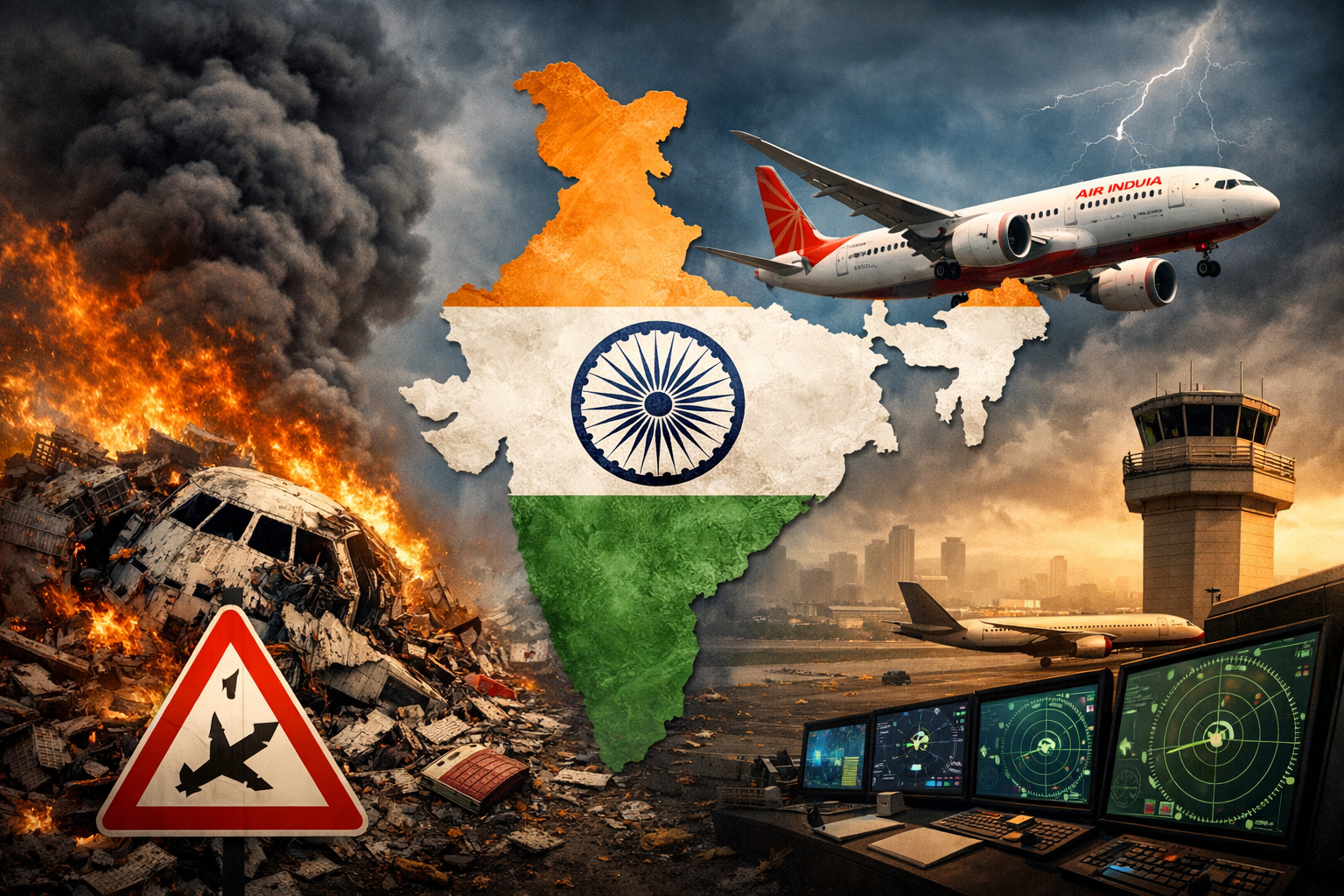
India’s aviation sector has dramatically evolved since independence — from a handful of flights in the 1940s to one of the world’s fastest-growing air travel markets today. However, this journey has been accompanied by tragic air disasters that have shaped safety practices and reforms.
Thank you for reading this post, don’t forget to subscribe!Early Beginnings: First Documented Crash
The earliest documented aircraft tragedy involving an Indian flight occurred on 27 December 1947, when an Air-India Limited DC-3 crashed soon after take-off near Korangi Creek (then in Pakistan), killing all 23 onboard, likely due to instrument failure and poor visibility.
Major Plane Crashes in Indian Aviation History
Below are some significant air disasters that mark India’s aviation record — each prompting improvements in safety practices:
1. Air India Flight 182 – 1985: Mid-air Bombing
- A Boeing 747 (Flight 182) en route from Canada to India exploded over the Atlantic due to a terrorist bombing.
- All 329 people onboard were killed.
- This remains the deadliest aviation disaster linked to Indian aviation.
2. Mid-air Collision at Charkhi Dadri – 1996
- A Saudi Arabian aircraft collided with a Kazakhstan Airlines jet near Delhi, killing 349 people onboard both flights.
- It is one of the deadliest mid-air collisions in the history of global commercial aviation.
3. Air India Flight 855 – 1978
- Shortly after take-off from Mumbai, the Boeing 747 crashed into the Arabian Sea due to instrument failure and loss of spatial orientation.
- All 213 onboard died, highlighting early challenges in cockpit instrumentation and crew coordination.
4. Indian Airlines Flight 113 – 1988
- A Boeing 737 crashed on final approach to Ahmedabad due to pilot and ATC errors under poor visibility.
- 133 of 135 onboard died.
5. Indian Airlines Flight 605 – 1990
- Airbus A320 crashed while landing in Bangalore due to pilot misinterpretation of instruments.
- 92 people lost their lives.
6. Indian Airlines Flight 257 – 1991
- Crashed into hilly terrain near Imphal due to pilot deviation from procedures.
- All 69 onboard died.
7. Air India Express Flight 812 – 2010
- Overshot the runway at Mangalore; 158 passengers and crew perished.
- Runway overrun accidents raise focus on landing dynamics and airport terrain.
8. Air India Express Flight 1344 – 2020
- At Kozhikode, during heavy rain, the aircraft skidded off the runway; 21 people died.
- Stresses the importance of wet-runway landing checks and touchdown zone awareness.
9. Air India Flight 171 – 2025
- A Boeing 787 crashed after take-off from Ahmedabad into a residential area, killing around 260 people including on ground.
- Under investigation but suspected technical issues; weather was stable.
Major Causes Behind These Air Crashes
Across these incidents, the leading causes fall into these categories:
1. Pilot Error & Human Factors
Poor decision making, misinterpretation of instruments, and incorrect responses to warnings frequently contributed to accidents.
2. Weather & Environmental Conditions
Severe rain, low visibility, and runway surface conditions (e.g., wet runway) have played significant roles in crash dynamics.
3. Technical or Mechanical Failure
Instrument failure — particularly attitude indicators — and other mechanical malfunctions have been underlying factors.
4. Air Traffic Control & Procedural Errors
The 1996 mid-air collision highlighted the need for stricter ATC protocols and collision avoidance systems.
5. Terrorism
The bombing of Flight 182 underscored aviation security risks and boosted global anti-terror security measures.
India’s Airports: Operational Numbers & Categories
India has experienced rapid airport growth — a leap from around 74 airports in 2014 to over 150 today.
According to official data (Ministry of Civil Aviation, Jan 2026):
Operational Airports in India
- Total operational airports: 163
- International airports: 33
- Customs airports: 12
- Domestic airports: 118
(Includes state and private airports)
Airport Categories Explained
1. International Airports:
Serve both international and domestic flights with customs and immigration facilities.
2. Domestic Airports:
Handle flights within India.
3. Customs Airports:
Have customs clearance — often for limited international operations.
4. Civil Enclaves:
Military bases that also host civil operations.
Aviation Safety Norms in India
To ensure safer skies, the Indian aviation sector follows rigorous safety standards for both operators and passengers.
Regulator: DGCA
The Directorate General of Civil Aviation (DGCA) is India’s primary aviation safety authority — ensuring compliance with global and ICAO standards.
Key Safety Norms for Operators
- Mandatory safety audits and maintenance checks
- Regular pilot training and simulator sessions
- Strict compliance with aircraft maintenance schedules
- Implementation of Safety Management Systems (SMS)
- Flight data monitoring and incident reporting
Recent DGCA audits identified lapses in training and scheduling, underscoring the need for vigilance.
Safety Norms for Airports
- Functional Instrument Landing Systems (ILS)
- Runway Safety Areas and RESA compliance
- Air Traffic Management (ATM) upgrades
- Emergency response and fire services readiness
Infrastructure gaps at smaller airports are ongoing issues under discussion in policy forums.
Passenger Safety Practices
- Follow seatbelt and safety instructions
- Observe carry-on restrictions
- Report anomalies to staff promptly
- Use official airline apps for alerts
Conclusion — Lessons and the Road Ahead
While air crashes in India remain rare relative to the number of flights worldwide, each tragedy has driven safety reforms — from cockpit training enhancements to better ATC standards and airport infrastructure upgrades.
With India’s aviation market poised to become one of the largest globally, continuous improvements in safety culture, technology, and regulatory oversight are essential to ensure every flight remains as safe as possible in the skies.
Leave a Reply