Introduction
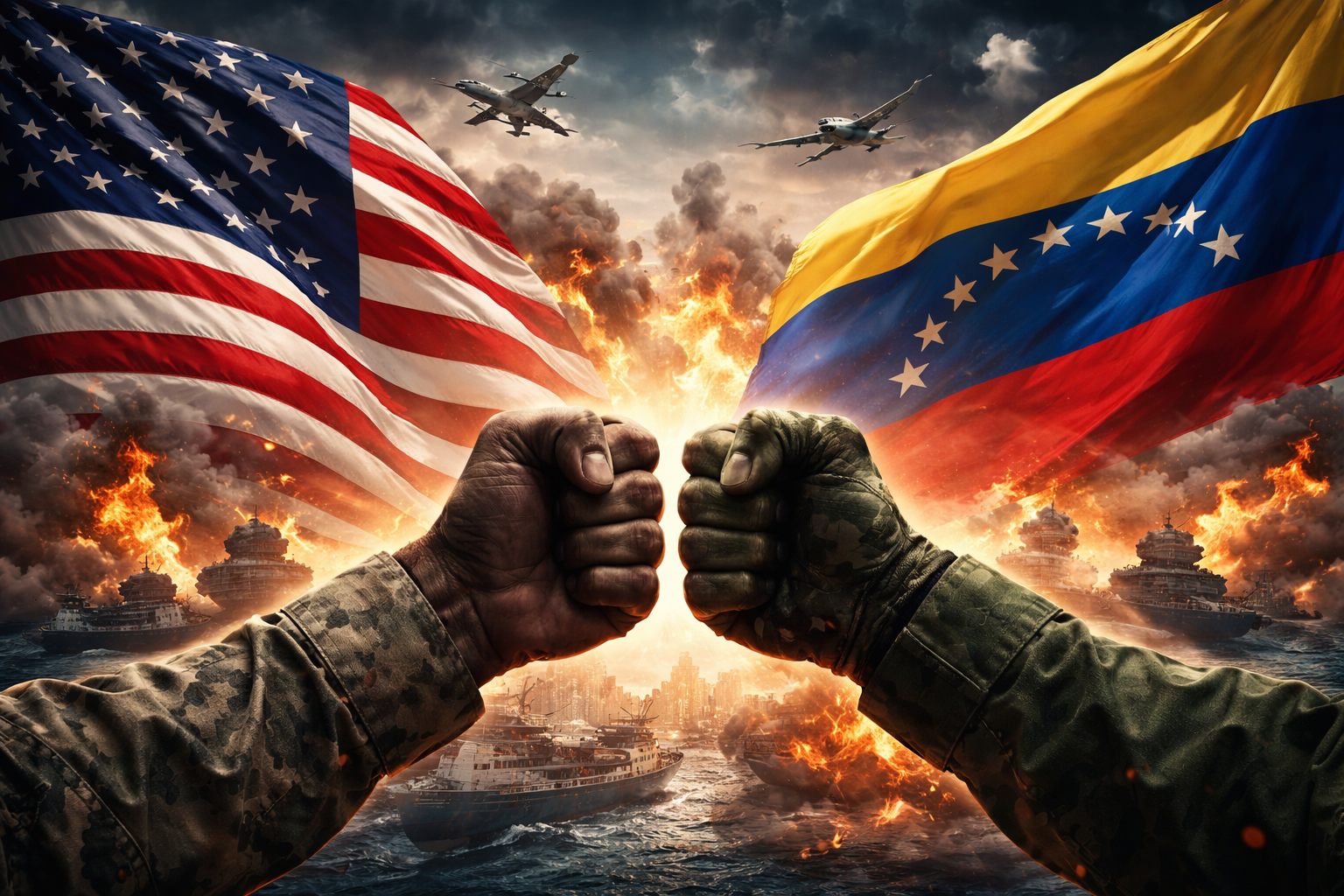
Thank you for reading this post, don’t forget to subscribe!Tensions between the United States and Venezuela — long simmering — have escalated dramatically in late 2025 into early January 2026, with reports of U.S. military strikes in Caracas and claims that Venezuelan President Nicolás Maduro has been captured. This has pushed the two nations to the brink of open confrontation, raising alarm worldwide about regional security, global trade, and geopolitical stability.
1. What’s Happening Now?
In early January 2026, multiple explosions were reported in Caracas and across northern Venezuela. The U.S. launched air and special operations strikes, with President Donald Trump claiming that Nicolás Maduro and his wife were captured. Venezuela denounced the attacks as “illegal military aggression,” declared a national emergency, and warned of intensified resistance.
The situation has triggered:
- Venezuela’s declaration of emergency.
- Strong condemnation from allies like Colombia and Cuba.
- Fears of wider regional escalation.
- Disruption to regional airspace and travel advisory warnings.
2. Root Causes Behind the Conflict
a. Longstanding Political Breakdown
Venezuela has faced years of political turmoil, disputed elections, economic collapse, and mass protests since 2018 — paving the way for unstable governance and legitimacy crises.
b. U.S. Sanctions & Designations
The U.S. has imposed sanctions on Venezuelan officials and institutions, accusing the Maduro regime of corruption, human rights abuses, and narco-terrorism — including designating the “Cartel de los Soles” a terrorist organization.
c. Military Buildup & Caribbean Tensions
From late 2025, the U.S. significantly increased its naval and air presence in the Caribbean — the largest such buildup in decades — framed as counter-drug and regional security operations. Venezuela strongly rebuffed this as an aggressive formation aimed at regime change.
d. Drug Trafficking Claims
The U.S. asserts Venezuelan facilities and gangs play a major role in cocaine distribution to U.S. markets, justifying military and law enforcement pressure. Venezuela denies this and sees it as a pretext for broader intervention.
e. Oil, Resources & Strategic Interests
Venezuela holds the world’s largest proven oil reserves, making it geopolitically critical for global energy markets. U.S. policy aims to influence control over energy exports and limit Russian and Chinese footholds in the region.
f. Global Power Rivalry
Venezuela’s growing ties with China and Russia — economically and militarily — have turned it into a flashpoint in broader U.S.–China–Russia competition, particularly in what Washington considers its strategic hemisphere.
3. Geopolitics: Why It Matters Beyond Bilateral Dispute
a. Monroe Doctrine Legacy
The U.S. historically views Latin America as its sphere of influence. Venezuela’s alliances with rival powers challenge that paradigm.
b. Influence of China & Russia
Beijing has invested massively in Venezuelan oil infrastructure and loans, while Moscow has supplied military aid — transforming a regional standoff into a global geostrategic question.
c. Latin American Regional Stability
Neighbouring countries — including Colombia, Brazil, and Caribbean nations — fear refugee flows, border tensions, and economic disruption if war spreads.
d. Global Energy Market Volatility
Any conflict or sanctions impacting Venezuelan oil affects crude pricing, supply chains, and investments — influencing markets from North America to Asia.
4. Consequences for Regional Security & Global Trade
a. Security Risks
- Increased militarization of the Caribbean.
- Spillover risks into Caribbean and South American nations.
- Heightened refugee and humanitarian crises.
b. Economic Disruption
- Global oil price instability.
- Trade disruptions due to naval blockades or airspace closures.
- Foreign investment pullbacks in Latin America.
c. Business & Investment
Foreign businesses face higher risk premiums, restricted operations, and potential target sanctions or trade blockades as geopolitical tensions sour investor confidence.
5. Why Both Countries Are Locked In
For the USA
- Wants to curb alleged narco-trafficking and terrorism threats.
- Aims to counter Chinese and Russian influence in its hemisphere.
- Sees Venezuela’s political system as destabilizing regionally.
For Venezuela
- Maduro’s government sees U.S. actions as a threat to sovereignty.
- Mobilizes internal political legitimacy through external pressure.
- Depends on alliances with China, Russia, and others for economic survival.
6. Potential Solutions & Negotiations
Although tension has sharply escalated, analytical consensus suggests a combination of:
Diplomacy & Third-Party Mediation
Engaging regional blocs (e.g., OAS, UN, CARICOM) or neutral countries to broker ceasefire and political negotiation.
Incremental De-escalation
Withdrawal of some U.S. military assets, phased easing of sanctions in return for credible reforms, with monitoring by international observers.
Addressing Root Causes
Economic reforms in Venezuela, anti-drug cooperation, assurances on resource governance, and confidence-building measures could reduce incentives for conflict.
Humanitarian Focus
Prioritising migrant support, food and medicine delivery corridors, and refugee assistance to de-politicize the crisis.
Without calibrated diplomacy, the conflict risks becoming protracted and costly for civilians and the region.
7. Impact on Global Geopolitics
If the U.S.–Venezuela standoff turns into prolonged conflict:
- It complicates U.S. strategic focus already strained by Ukraine, Middle East, and China competition.
- It could spur greater cooperation between Russia & China as counterweights.
- Investment and trade flows would shift as markets price in supply disruptions and security risks.
- Regional alliances might realign, affecting future U.S.–Latin America engagement.
Conclusion
The crisis between the United States and Venezuela is not just a bilateral dispute — it is a multidimensional geopolitical standoff rooted in political legitimacy, resource control, anti-drug policy, hemispheric influence, and global power rivalry. Its consequences are far-reaching — from regional stability to global energy markets and investor confidence. While immediate war has not officially been declared, 2026 has begun with one of the most serious escalations in recent U.S.–Latin America relations, making diplomatic solutions urgent not only for these two nations but for global security and economic resilience.
Leave a Reply