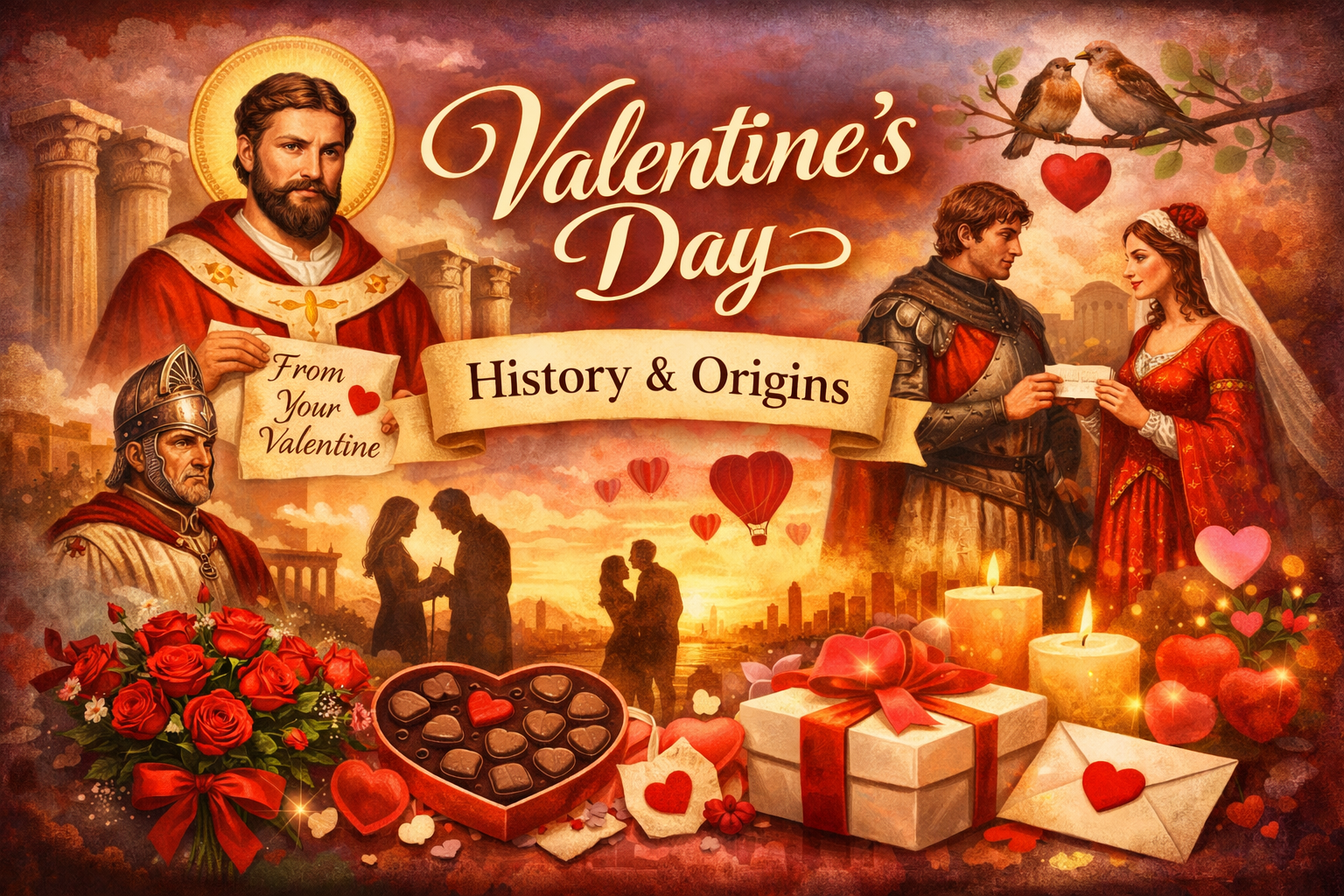
Valentine’s Day is one of the most celebrated days of love across the world. Observed every year on February 14, it is a time when people express affection, gratitude, and romance toward their loved ones through cards, flowers, gifts, and heartfelt gestures. But beyond chocolates and roses lies a rich history that blends ancient traditions, Christian martyrdom, medieval poetry, and modern commercialization.
Thank you for reading this post, don’t forget to subscribe!Let’s explore the fascinating journey of Valentine’s Day—from its ancient origins to its global celebration today.
What Is Valentine’s Day?
Valentine’s Day is an annual celebration dedicated to love, romance, friendship, and affection. While it is most commonly associated with romantic partners, many cultures also use the occasion to celebrate friendships and familial bonds.
It is observed in numerous countries including the United States, Canada, the United Kingdom, India, Australia, and parts of Europe and Asia.
Who Was St. Valentine?
The name “Valentine” refers to one or more early Christian martyrs named Saint Valentine. The most popular legend connects Valentine to Rome during the reign of Claudius II Gothicus in the 3rd century.
The Most Popular Legend
According to tradition:
- Emperor Claudius II believed that unmarried men made better soldiers than married ones.
- He allegedly banned marriages for young men.
- Valentine, a Christian priest, defied the emperor’s order and secretly performed marriages for couples in love.
- When discovered, he was imprisoned and eventually executed on February 14, around 269 AD.
Before his execution, legend says he wrote a note to a young woman signed, “From your Valentine,” a phrase still widely used today.
Though historians debate the accuracy of these stories, Valentine became a symbol of love, faith, and sacrifice.
Ancient Roots: The Festival of Lupercalia
Valentine’s Day may also have roots in an ancient Roman festival called Lupercalia, celebrated in mid-February.
Lupercalia was a pagan fertility festival dedicated to Faunus, the Roman god of agriculture. It involved rituals believed to promote fertility and purification. Some historians suggest that as Christianity spread, the Church replaced pagan festivals like Lupercalia with Christian observances, including St. Valentine’s Day.
When Did Valentine’s Day Become Associated with Romance?
Valentine’s Day became linked with romantic love during the Middle Ages, especially in England and France.
One major influence was the English poet Geoffrey Chaucer, who wrote in the 14th century that February 14 was the day birds chose their mates. His poem helped popularize the idea of Valentine’s Day as a romantic celebration.
By the 15th century, people were exchanging handwritten love notes. By the 18th and 19th centuries, printed Valentine cards became popular in Europe and America.
Evolution of Valentine’s Day Traditions
1. Handmade Love Letters
In early centuries, lovers exchanged handwritten notes expressing devotion.
2. Printed Valentine Cards
With advances in printing technology in the 19th century, mass-produced Valentine cards became common, especially in England and the United States.
3. Flowers and Gifts
Roses—especially red roses symbolizing passion—became associated with the day.
4. Modern Commercial Celebration
Today, Valentine’s Day includes:
- Greeting cards
- Chocolates
- Jewellery
- Romantic dinners
- Social media expressions
Why Is Valentine’s Day Celebrated Across the World?
Valentine’s Day has spread globally due to:
1. Universal Emotion of Love
Love is a universal human emotion that transcends religion, culture, and geography.
2. Cultural Adaptation
Different countries celebrate it in unique ways:
- In Japan, women give chocolates to men.
- In South Korea, multiple love-related days are celebrated.
- In India, it has gained popularity among youth since the 1990s.
3. Globalization & Media
Movies, music, and global brands have popularized romantic culture worldwide.
4. Commercial Influence
Retail industries, restaurants, and gift brands promote it heavily, making it a major economic event.
How Did St. Valentine Spread the Message of Love?
Even if some legends are symbolic, St. Valentine represents:
- Courage to stand for love
- Commitment and loyalty
- Faith and compassion
- Sacrifice for others’ happiness
By secretly uniting couples in marriage, he became a symbol of romantic devotion and moral strength. Over time, his story transformed into a powerful cultural narrative of love conquering authority and fear.
When Did the Celebration Officially Begin?
- 3rd Century: Martyrdom of St. Valentine
- 496 AD: Pope Gelasius I declared February 14 as St. Valentine’s Day
- 14th–15th Century: Linked to romantic love in Europe
- 18th–19th Century: Exchange of Valentine cards became common
- 20th–21st Century: Global commercial and cultural celebration
Why Is Valentine’s Day So Popular Today?
Valentine’s Day remains popular because:
- It provides a dedicated day to express emotions.
- It strengthens relationships.
- It offers emotional connection in a fast-paced world.
- It is widely promoted through media and commerce.
- It appeals to youth and modern relationship culture.
In the digital age, expressions of love have expanded to:
- Social media posts
- Virtual gifts
- Online dating celebrations
Beyond Romance: Modern Interpretation
Today, Valentine’s Day is not limited to romantic couples. Many celebrate:
- Friendship (Galentine’s Day)
- Self-love and self-care
- Family bonds
- Acts of kindness
It has evolved into a broader celebration of human connection.
Conclusion
Valentine’s Day is far more than a commercial event. Rooted in ancient Roman rituals, Christian martyrdom, medieval poetry, and centuries of cultural transformation, it stands today as a global celebration of love in all its forms.
From the courage of Saint Valentine to modern-day expressions through roses, messages, and digital greetings, the essence remains the same—celebrating love, compassion, and connection.
Whether you mark the day with grand gestures or quiet appreciation, Valentine’s Day reminds us of something timeless: love is one of humanity’s most powerful and unifying forces.
Leave a Reply