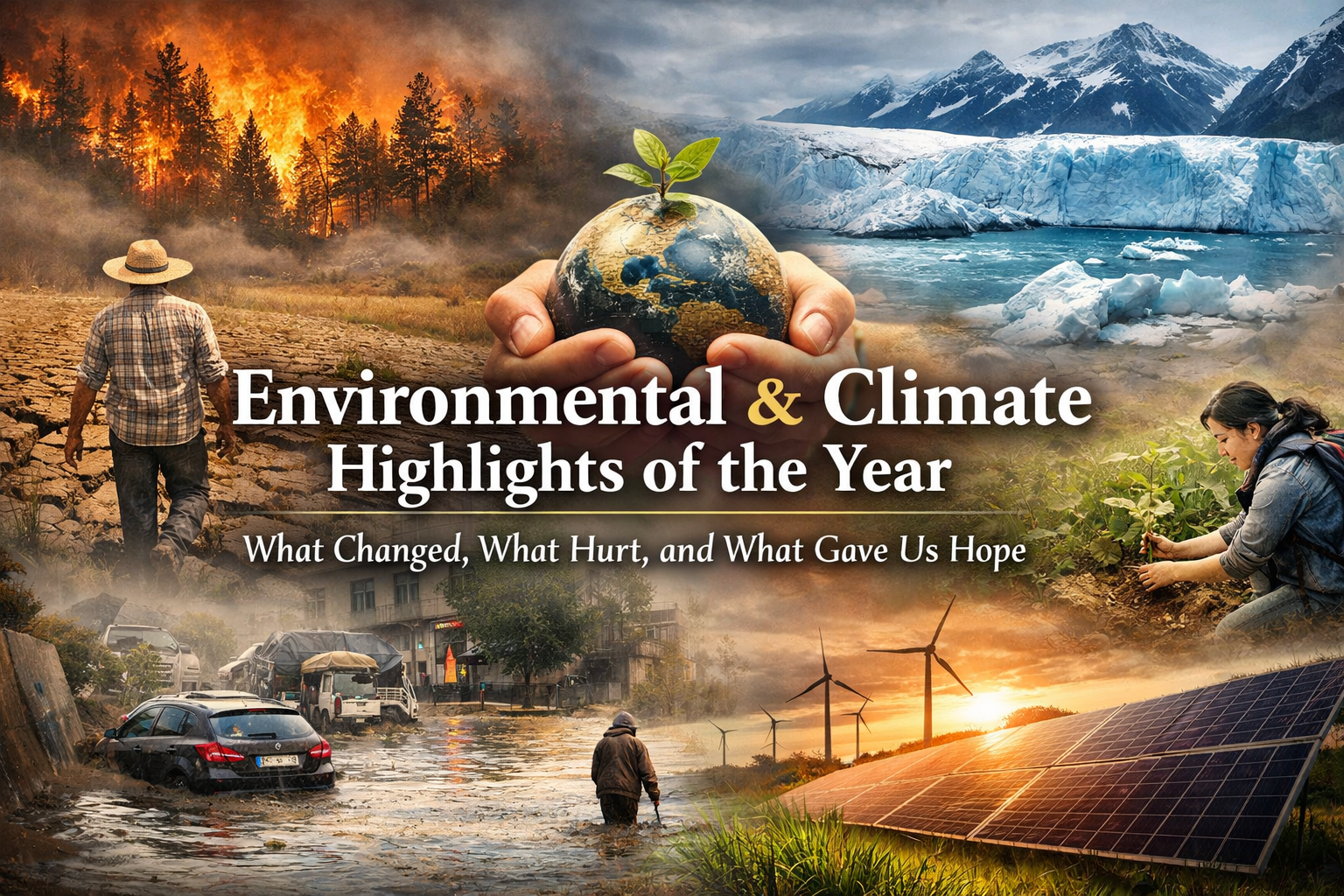
For many of us, this year didn’t begin or end with headlines. It began with sensations.
A summer afternoon that felt heavier than usual. A winter morning that arrived late, or barely at all. Rain that didn’t come for weeks—and then arrived all at once, flooding streets, fields, and homes.
People remember climate change not through charts, but through moments like these. A farmer standing in a cracked field. A city family opening windows at night because the heat refused to leave. A coastal village watching the tide inch closer, season after season. This year, the planet didn’t whisper. It spoke clearly—and sometimes painfully.
What follows is not just a summary of climate events this year, but a reflection on what changed, what hurt, and what quietly reminded us why hope still belongs in the conversation.
Major Climate Events of the Year: When Nature Pushed Back
Record-breaking heat and longer summers
Heat was one of the most widely felt climate events this year. Across continents, temperature records fell again. Heatwaves stretched longer than before, sometimes lingering for weeks. Cities trapped heat between concrete walls, while rural areas struggled with water shortages.
What made this year different wasn’t just how hot it got—but how early the heat arrived and how slow it was to leave. Crops ripened too fast or failed altogether. Outdoor workers faced serious health risks. Wildlife searched for shade and water in unfamiliar places.
This wasn’t abstract global warming impact. It was daily life interrupted.
Floods that arrived without warning
In contrast to drought-stricken regions, other parts of the world saw intense rainfall compressed into short periods. Rivers overflowed. Landslides followed. Entire neighborhoods were submerged overnight.
Floods don’t just damage homes—they erase stability. Schools close. Livelihoods vanish. Recovery takes months or years, especially for communities with limited resources. This year’s floods reminded us how unevenly climate events affect people, even within the same country.
Wildfires and smoky skies
Wildfires once associated with specific seasons and regions now feel almost unpredictable. Forests burned longer and hotter. Smoke traveled hundreds of kilometers, turning skies orange and making air unsafe to breathe far from the flames.
Beyond the immediate destruction of ecosystems, fires left quieter scars—lost wildlife habitats, displaced communities, and landscapes that will take decades to recover.
Melting ice and rising seas
Glaciers continued to retreat, some at alarming rates. For many, melting ice feels distant. But glacier loss affects water supplies for millions who depend on seasonal melt for drinking water and agriculture.
Meanwhile, coastal communities faced stronger storms and slow but steady sea-level rise. The ocean didn’t surge dramatically everywhere—but it kept moving forward, one high tide at a time.
Scientific & Environmental Breakthroughs: Where Progress Found a Way
Amid difficult climate news, this year also delivered moments of genuine sustainability progress.
Renewable energy gained momentum
Solar and wind energy expanded faster than many expected in several regions. Costs continued to drop, making clean energy more accessible not just for governments, but for households and small businesses.
In many places, renewable power wasn’t framed as a climate solution alone—it became an economic one. Jobs, local investment, and energy independence entered the conversation, broadening support.
Nature-based solutions showed promise
Communities restored wetlands to absorb floodwaters naturally. Mangroves were replanted along coastlines, protecting villages from storm surges while reviving marine ecosystems.
These efforts reminded us that sometimes the most effective technology already exists—in forests, soils, and living systems that know how to heal if given space.
Advances in climate science and monitoring
Scientists improved climate models, making extreme weather predictions more accurate and timely. Early-warning systems saved lives by giving communities precious hours or days to prepare for storms and floods.
Better data didn’t erase disasters, but it reduced surprise—and surprise is often what turns a hazard into a tragedy.
Policy shifts and local action
While global climate negotiations moved slowly, local and regional governments made meaningful commitments. Cities invested in public transport, cooling green spaces, and climate-resilient infrastructure. Schools introduced environmental education rooted in real-world observation, not fear.
Change didn’t always come from the top. Often, it started where people lived.
Voices from the Ground: Stories Behind the Statistics
A farmer spoke of planting twice, hoping one crop might survive.
A fisher described how shifting seasons altered fish patterns passed down through generations.
Young climate volunteers organized cleanups, tree planting, and awareness drives—not because they believed they could fix everything, but because doing nothing felt worse.
Indigenous communities shared knowledge about water conservation, fire management, and land care—practices refined over centuries, not decades. Their voices grew louder this year, reminding the world that sustainability isn’t new. It’s often forgotten.
These stories didn’t dominate headlines, but they carried truth. Climate change 2025 wasn’t just measured in degrees—it was measured in adaptation, resilience, and quiet determination.
What the Data Tells Us (Without the Overload)
The numbers confirm what people already sensed:
- Global average temperatures continued to rise.
- Extreme weather events became more frequent and intense.
- Natural ecosystems faced increasing stress.
- Clean energy adoption accelerated, though unevenly.
Put simply, the climate system is changing faster than before—but human response is also evolving. Not fast enough everywhere, but faster than it once did.
Data doesn’t replace lived experience. It supports it. And this year, the two aligned more clearly than ever.
A Moment of Hope & Responsibility: What This Year Left Us With
Hope doesn’t mean pretending things are fine. It means recognizing where progress is possible and choosing to act anyway.
This year taught us that small actions matter when repeated widely—saving water, supporting local food systems, reducing waste, voting thoughtfully, teaching children to observe nature with care. None of these solve everything. Together, they shape culture.
Awareness still has power. Conversation still matters. So does patience, persistence, and honesty about where we are.
Closing: A quiet conversation with the reader
If this year showed us anything, it’s that the environment is not a distant issue—it lives in our routines, our food, our air, our sense of season. We are not separate from it. We never were.
The question moving forward isn’t whether climate change will affect us. It already has. The real question is how gently—or how carelessly—we choose to respond.
There is still room to listen better. To protect what remains. To repair what we can. And to pass on a world that, while changed, is still deeply alive.
That work doesn’t belong to governments alone. It belongs to all of us, in ordinary moments, choosing attention over indifference—again and again.
Leave a Reply