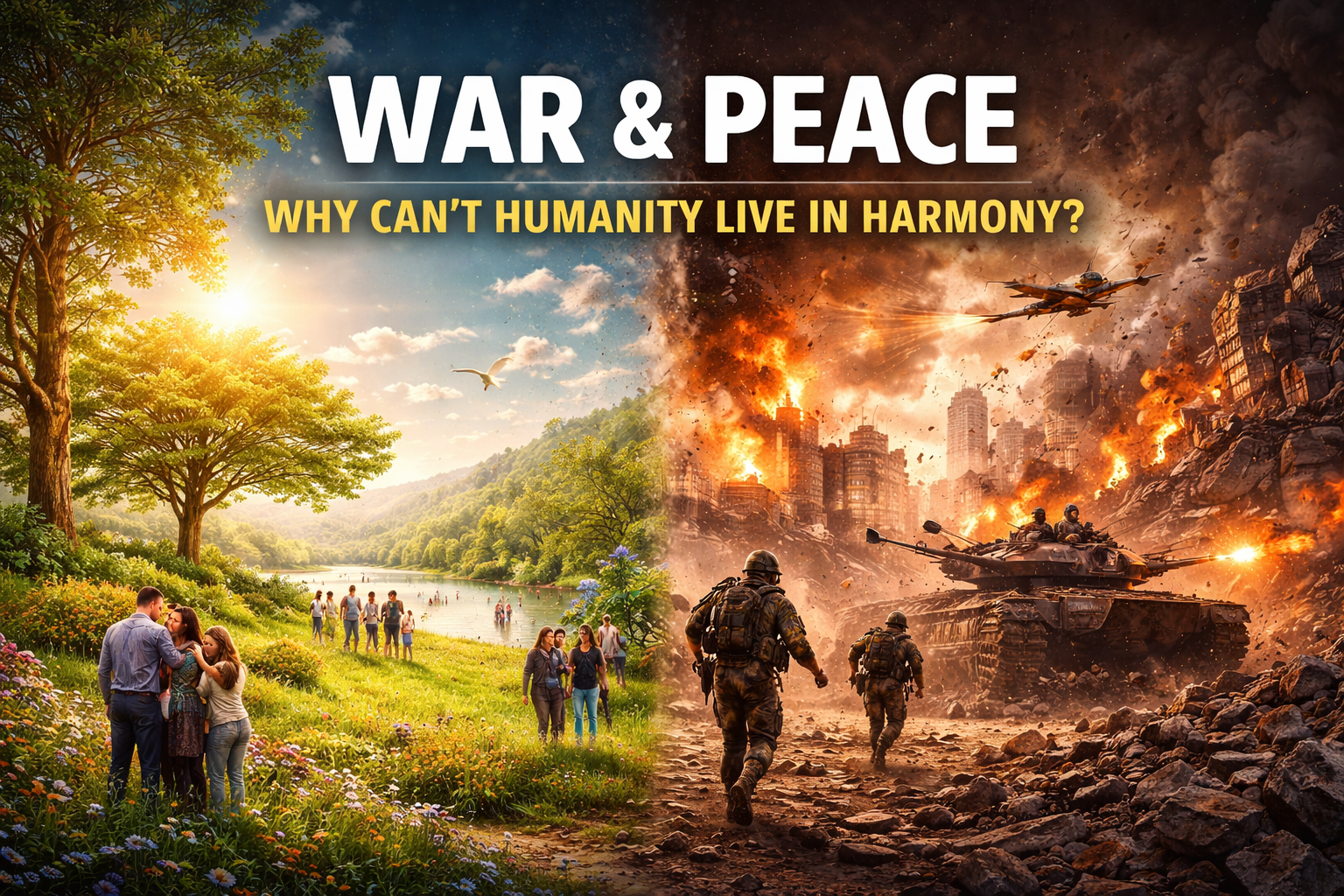
Introduction: The Oldest Question Still Unanswered
Thank you for reading this post, don’t forget to subscribe!War is as old as human memory—and perhaps older than civilization itself. From stone-age skirmishes to nuclear standoffs, humanity has repeatedly chosen destruction over dialogue. Even after witnessing unimaginable suffering—two World Wars, genocides, nuclear devastation—our world today stands once again at the edge of large-scale conflict.
This raises uncomfortable but essential questions:
- What is war, really?
- Why do humans and nations fight?
- Is war ever necessary—or is it a failure of consciousness?
- Why hasn’t humanity learned from history?
- What did enlightened thinkers like Lord Buddha and Osho say about violence?
This article is not just about war—it is about human nature, fear, power, ego, survival, and the unfinished journey of human consciousness.
1. What Is War?
At its simplest, war is organized violence between groups, typically states, aimed at imposing one’s will upon another.
But at a deeper level, war is:
- A collapse of dialogue
- A failure of empathy
- A projection of inner conflicts onto the outer world
Military theorist Carl von Clausewitz famously defined war as “the continuation of politics by other means.”
Yet philosophy tells us something darker: war is the continuation of unresolved human fear, greed, and identity crises—by violent means.
2. The History of War on Planet Earth
2.1 Prehistoric and Tribal Conflicts
War did not begin with nations. Archaeological evidence suggests that:
- Early humans fought over food, territory, mates, and survival
- Tribal warfare was common among hunter-gatherers
- Violence preceded civilization, not the other way around
These conflicts were existential—fight or perish.
2.2 Wars of Civilizations and Empires
As societies grew:
- Wars became organized
- Armies, weapons, and ideologies emerged
- Conflicts expanded from survival to control and dominance
Examples:
- Mesopotamian city-state wars
- Egyptian, Persian, Greek, and Roman conquests
- Chinese dynastic wars
- Mauryan, Gupta, Mughal, and European imperial conflicts
Here, war became about:
- Territory
- Resources
- Prestige
- Civilizational superiority
2.3 Religious and Ideological Wars
Religion and ideology added moral justification to violence:
- Crusades
- Jihads
- Sectarian conflicts
- Later, ideological wars (Capitalism vs Communism)
The paradox: belief systems meant to bring meaning often became tools for mass killing.
2.4 Nation-States and World Wars
The modern era institutionalized war:
- Standing armies
- Military-industrial complexes
- Nationalism
World War I and II marked a turning point:
- Over 100 million deaths
- Holocaust
- Atomic bombs on Hiroshima and Nagasaki
Never before had humanity demonstrated such technological brilliance combined with moral collapse.
3. Why Did War Start? The Core Theories
3.1 Survival Theory
War began as a survival mechanism:
- Scarcity of resources
- Threat from rival groups
But survival no longer explains modern wars.
3.2 Power and Dominance Theory
War is driven by:
- Desire to control
- Fear of losing power
- Imperial ambition
Power creates insecurity:
Those who have power fear losing it; those without power want it.
3.3 Ego and Identity Theory
Much of war is psychological:
- National pride
- Historical grievances
- “Us vs Them” identity
When identity becomes rigid, violence becomes inevitable.
3.4 Economic and Resource Theory
Many wars are fought over:
- Oil
- Minerals
- Trade routes
- Strategic geography
Economic interests often hide behind patriotic narratives.
3.5 Fear and Insecurity Theory
Nations, like individuals, act out of fear:
- Fear of invasion
- Fear of decline
- Fear of irrelevance
Fear is the invisible engine of war.
4. Is War Ever Necessary?
This is one of the hardest questions.
Some argue:
- War is justified in self-defence
- War ended fascism
- War stopped genocide
Others counter:
- War creates more suffering than it resolves
- Violence plants seeds for future violence
- Even “just wars” deform human morality
The uncomfortable truth:
War may sometimes appear unavoidable—but it is never noble.
It is a tragic last resort, not a moral victory.
5. The Psychology of War: Why Humans Fight
5.1 The Human Mind and Violence
Humans are:
- Capable of empathy
- Capable of extreme cruelty
War activates:
- Tribal instincts
- Dehumanization of the “enemy”
- Obedience to authority
Ordinary people commit atrocities not because they are evil—but because systems normalize violence.
5.2 Ego, Masculinity, and Glory
Historically, war has been romanticized:
- Honor
- Sacrifice
- Martyrdom
- Heroism
But glory is a narrative—death is the reality.
6. What Did Lord Buddha Teach About War?
Lord Buddha’s philosophy is rooted in non-violence (Ahimsa) and compassion (Karuna).
Key teachings:
- Hatred cannot be ended by hatred
- Violence arises from ignorance
- Desire and attachment create suffering
Buddha did not ignore conflict—but he addressed its root cause: the untrained mind.
“Victory breeds hatred. The defeated live in pain. Happily the peaceful live, giving up victory and defeat.”
7. Osho on War and Humanity
Osho offered a radical perspective:
- War is a symptom, not the disease
- The disease is unconsciousness
- Nations are collective egos
He argued:
- Politicians need enemies to survive
- Nations are psychological constructs
- Humanity is still primitive emotionally
Osho believed:
Until individuals become aware, war will continue—no matter how advanced technology becomes.
8. Why Do Nations Clash?
Nations clash because:
- They are built on fear-based identities
- Borders divide human consciousness
- Power is centralized and competitive
- History is weaponized
Nations think in terms of interest, not humanity.
9. Why Can’t Humanity Live Together Peacefully?
Because:
- Peace requires inner maturity
- Humanity has advanced technologically faster than morally
- Education trains skills, not wisdom
- Fear is rewarded; compassion is sidelined
We changed tools—but not consciousness.
10. Why Haven’t We Learned from Past Wars?
Because:
- Trauma is inherited but not healed
- Power structures benefit from conflict
- War is profitable
- Memory fades, ego returns
Each generation believes “this time it will be different.”
11. Are We on the Brink of a Third World War?
Current geopolitics show alarming signs:
- Arms race
- Proxy wars
- Nuclear brinkmanship
- Nationalist rhetoric
- Weak global institutions
History warns us:
World wars do not begin suddenly—they are normalized slowly.
Conclusion: The Choice Still Exists
War is not inevitable—it is chosen, consciously or unconsciously.
Humanity stands at a crossroads:
- One path leads to domination, fear, and extinction
- The other leads to empathy, cooperation, and shared survival
The real battle is not between nations—but within human consciousness.
Peace is not the absence of war.
Peace is the presence of understanding.
Leave a Reply