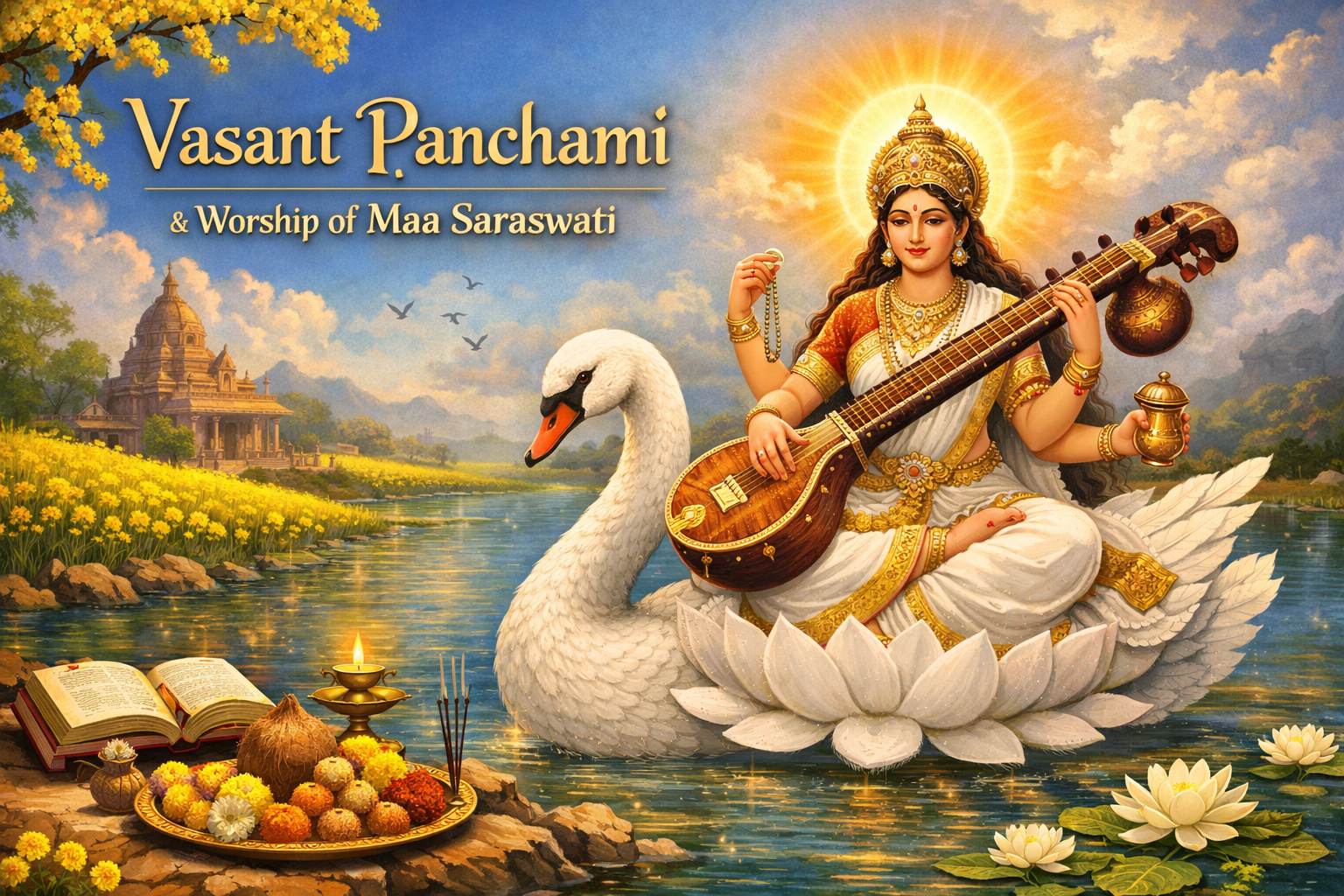
Introduction: What is Vasant Panchami?
Thank you for reading this post, don’t forget to subscribe!Vasant Panchami is one of the most spiritually significant festivals of Sanatan Dharma, celebrated on the fifth day (Panchami) of the bright fortnight (Shukla Paksha) of the Hindu month of Magha. This auspicious day marks the arrival of Vasant Ritu (spring season)—a time symbolizing renewal, creativity, learning, prosperity, and divine harmony.
Vasant Panchami is dedicated to Goddess Maa Saraswati, the eternal source of knowledge (Vidya), wisdom (Buddhi), music (Sangeet), arts (Kala), language (Vani), and consciousness (Chetna). On this day, seekers of knowledge—students, scholars, artists, teachers, and spiritual aspirants—invoke her blessings for clarity, intellect, and enlightenment.
Importance of Vasant Panchami in Sanatan Sanskriti and Indian Culture
In Sanatan Sanskriti, knowledge is not merely information but a sacred path toward Moksha (liberation). Vasant Panchami represents the awakening of divine knowledge in human consciousness.
Cultural and Spiritual Significance
- Marks the beginning of spring, a season of growth and creativity
- Considered highly auspicious for Vidyarambh Sanskar (initiation of education)
- Celebrated in Gurukuls, schools, universities, temples, and homes
- Associated with arts, literature, music, and learning traditions
- Symbolizes balance between material knowledge and spiritual wisdom
The colour yellow dominates the festival, representing:
- Energy of the sun
- Prosperity and fertility
- Intellectual illumination
- Detachment and purity
Why is Vasant Panchami Dedicated to Goddess Maa Saraswati?
According to ancient scriptures, Maa Saraswati manifested on Vasant Panchami to bring order, speech, and wisdom into a chaotic universe. Before her appearance, creation lacked harmony and expression.
She is worshipped on this day because:
- Knowledge flourishes with the onset of spring
- It is believed she blesses devotees with sharp intellect and pure wisdom
- Spiritual vibrations of the day enhance learning and creativity
- It is an ideal time to begin education, arts, and spiritual studies
Who is Maa Saraswati – The Goddess of Learning and Knowledge
Maa Saraswati is revered as the Adi Shakti of knowledge and consciousness.
Scriptural Identity
- Daughter of Lord Brahma (creator of the universe)
- Mentioned extensively in Rigveda, Yajurveda, Upanishads, and Puranas
She is not merely a goddess of books but the divine intelligence that enables understanding, discrimination, creativity, and self-realization.
Why is Maa Saraswati’s Vahana (Carrier) a Swan (Hansh)?
The Hansh (swan) is one of the most profound symbols in Sanatan philosophy.
Spiritual Significance of Hansh
- Symbol of Vivek (discretion)
- Believed to separate milk from water, representing the ability to distinguish truth from illusion
- Represents purity, grace, and transcendence
- Associated with Paramatma and Atma-Gyan
Thus, Maa Saraswati riding a swan teaches humanity to:
“Accept wisdom and discard ignorance.”
Items Held by Maa Saraswati and Their Symbolism
Maa Saraswati is depicted with four arms, each carrying a profound message:
1. Veena (Musical Instrument)
- Represents harmony between mind, body, and soul
- Symbol of art, music, creativity, and cosmic vibration (Nada Brahma)
2. Book (Vedas or Scriptures)
- Represents supreme knowledge and learning
- Emphasizes importance of scriptural wisdom and education
3. Rosary (Akshamala)
- Symbol of meditation, concentration, and spiritual discipline
- Encourages inner reflection and self-control
4. Kamandalu (Water Pot)
- Represents purity, detachment, and spiritual liberation
- Water symbolizes the flow of wisdom
Symbolism of White Attire
Maa Saraswati is always adorned in white, symbolizing:
- Absolute purity
- Knowledge free from material desires
- Sattva Guna (balance and clarity)
Important Vedic Mantras and Shlokas Dedicated to Maa Saraswati
1. Saraswati Vandana (Most Popular)
Sanskrit:
या कुन्देन्दु तुषार हार धवला।
या शुभ्र वस्त्रावृता।
या वीणा वर दण्ड मण्डित करा।
या श्वेत पद्मासना॥
या ब्रह्माच्युत शंकर प्रभृतिभि।
र्देवैः सदा वन्दिता।
सा मां पातु सरस्वती भगवती।
निःशेष जाड्यापहा॥
English Meaning:
Goddess Saraswati, who is as white as jasmine, the moon, and snow,
who wears pure white garments,
who holds the Veena,
who sits on a white lotus,
who is worshipped by Brahma, Vishnu, and Shiva—
may she remove all ignorance from my life.
2. Saraswati Beej Mantra
Sanskrit:
ॐ ऐं सरस्वत्यै नमः॥
Meaning:
Salutations to Goddess Saraswati, the embodiment of divine knowledge.
3. Saraswati Mantra
Sanskrit:
ॐ सरस्वत्यै विद्महे।
ब्रह्मपुत्र्यै धीमहि।
तन्नो देवी प्रचोदयात्॥
English Meaning:
We meditate upon Goddess Saraswati,
the daughter of Brahma,
may she enlighten our intellect.
4. Gayatri Mantra (Vedic Form)
ॐ भूर्भुवः स्वः ।
तत्सवितुर्वरेण्यं
भर्गो देवस्य धीमहि ।
धियो यो नः प्रचोदयात् ॥
Om bhūr bhuvaḥ svaḥ
tat savitur vareṇyaṁ
bhargo devasya dhīmahi
dhiyo yo naḥ pracodayāt
Meaning (Simple English)
We meditate upon the divine light of the Supreme Sun (Savita),
who is worthy of adoration.
May that divine brilliance inspires and illuminate our intellect.
Rituals and Traditions of Vasant Panchami
- Saraswati Puja in homes, schools, temples
- Placement of books, musical instruments near the deity
- Avoidance of reading/writing before puja in some traditions
- Offering of yellow flowers, sweets, and fruits
- Children begin education through Vidyarambh Sanskar
Relevance of Maa Saraswati in Modern Times
In an era of information overload, Maa Saraswati teaches:
- Ethical use of knowledge
- Balance between intellect and wisdom
- Importance of creativity and critical thinking
- Harmony between science, art, and spirituality
Conclusion: Eternal Relevance of Vasant Panchami
Vasant Panchami is not merely a festival—it is a spiritual reminder that knowledge is sacred, wisdom is divine, and learning is a lifelong journey. Worship of Maa Saraswati inspires humanity to rise above ignorance and walk the path of truth, creativity, and enlightenment.
Leave a Reply