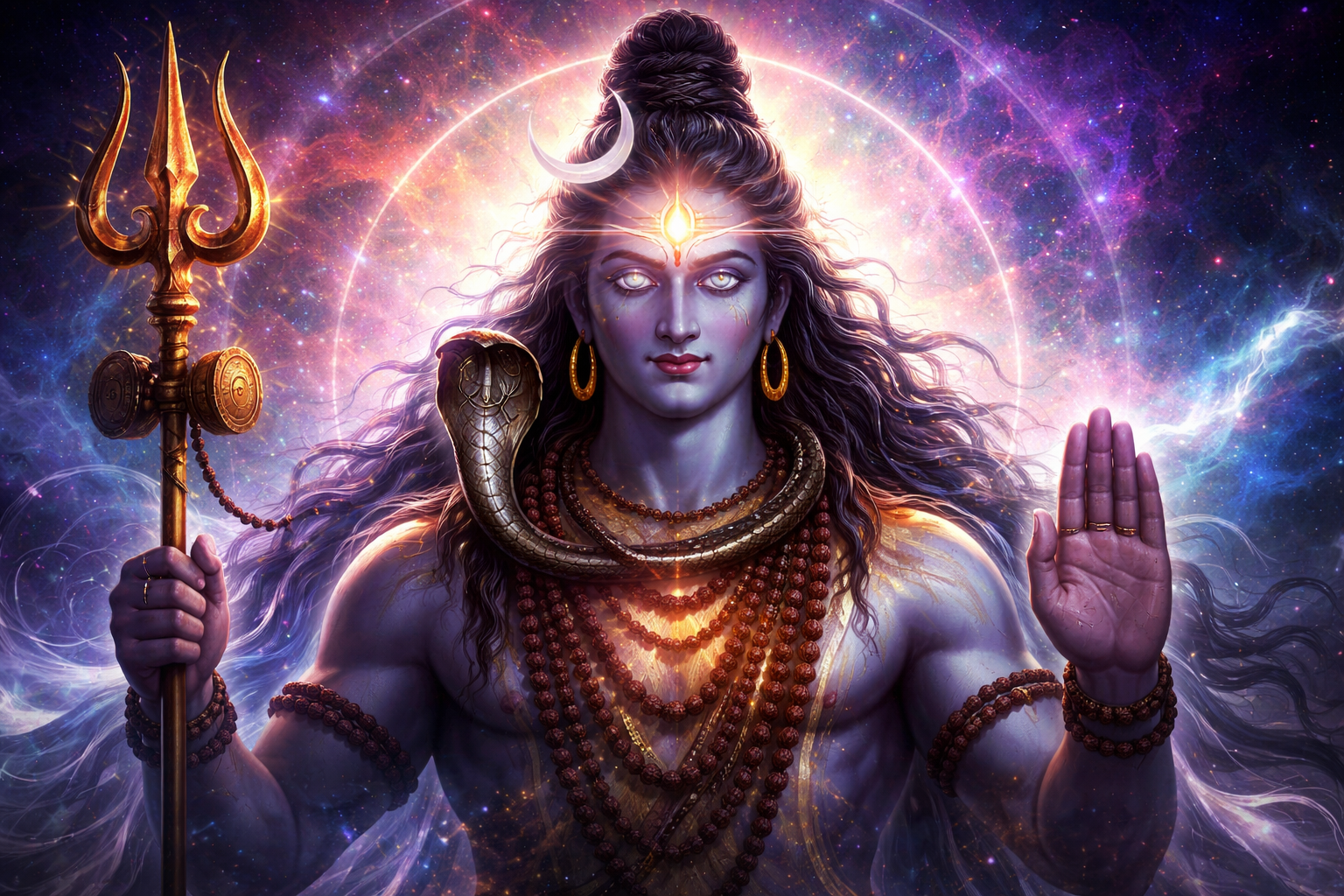
In Sanatan Dharma, Shiva—also known as Mahadev, Bholenath, and Shankar—is one of the most profound and complex deities. Among his many symbolic features, the third eye (Trinetra) is perhaps the most mysterious and powerful. It represents not destruction alone, but divine wisdom, higher consciousness, and cosmic balance.
Thank you for reading this post, don’t forget to subscribe!This blog explores the story behind Shiva’s third eye, what happens when it opens, its scientific and spiritual interpretation, and the broader importance of Lord Shiva in Hindu philosophy.
Who is Lord Shiva?
Shiva is part of the Trimurti—the divine trinity consisting of:
- Brahma – The Creator
- Vishnu – The Preserver
- Shiva – The Destroyer and Transformer
However, “destroyer” does not mean evil. In Sanatan philosophy, destruction is necessary for renewal and transformation. Shiva dissolves ignorance, ego, and illusion (Maya) to pave the way for truth.
What is the Third Eye of Shiva?
The third eye, located on Shiva’s forehead between the eyebrows, is called “Divya Chakshu” or “Jnana Netra” (Eye of Wisdom).
Symbolic Meaning:
- Higher consciousness
- Spiritual awakening
- Inner vision beyond physical sight
- Destruction of ignorance
- Power of divine perception
It represents the ability to see past, present, and future simultaneously.
Why Does Shiva Have a Third Eye?
The third eye symbolizes supreme awareness. While normal eyes see the material world, the third eye sees ultimate truth (Satya).
In yogic philosophy, it corresponds to the Ajna Chakra (Brow Chakra)—the centre of intuition and perception beyond ordinary reality.
When Shiva opens this eye, it releases cosmic fire (Agni) capable of destroying illusion and evil forces.
The Story Behind Shiva’s Third Eye
The most famous legend involves Kamadeva, the god of love.
According to the Shiva Purana:
When Goddess Parvati was trying to win Shiva’s affection, the gods wanted Shiva to marry her so that their son could defeat the demon Tarakasura. To awaken Shiva from deep meditation, they sent Kamadeva.
Kamadeva shot his arrow of love at Shiva. Disturbed from meditation, Shiva became furious and opened his third eye. The fire from it burned Kamadeva to ashes instantly.
Later, upon Parvati’s request, Shiva revived Kamadeva in a formless state (Ananga), symbolizing that desire exists but must be controlled.
Spiritual Meaning of the Story:
- Meditation is supreme
- Desire (Kama) must be regulated
- Ego and distraction are destroyed by higher awareness
What Happens When Shiva Opens His Third Eye?
When the third eye opens:
- Illusion (Maya) is destroyed
- Evil and negativity are annihilated
- Cosmic transformation begins
- Ignorance turns into wisdom
It is not merely physical destruction—it is spiritual purification.
In some traditions, Shiva’s third eye is also linked with Pralaya (cosmic dissolution) at the end of a cycle of creation.
Scientific Interpretation of the Third Eye
Many scholars connect Shiva’s third eye with the Pineal Gland in the human brain.
The Pineal Gland:
- Located in the centre of the brain
- Regulates sleep cycles (melatonin)
- Associated with intuition and higher awareness
In yogic science, the Ajna Chakra is located near this region. Ancient sages believed activating this centre enhances:
- Intuition
- Awareness
- Self-realization
- Emotional balance
Modern neuroscience does not confirm mystical fire power, but meditation has been proven to:
- Reduce stress
- Improve brain function
- Increase emotional regulation
- Enhance clarity of thought
Thus, Shiva’s third eye can be interpreted as a metaphor for awakened consciousness.
Importance of Shiva in Sanatan Dharma
Shiva is not just a deity; he represents:
1. Supreme Yogi
He is called Adi Yogi, the first yogi who transmitted yoga knowledge to humanity.
2. Symbol of Equality
Shiva accepts everyone—gods, demons, humans, animals. He lives in cremation grounds, showing detachment from social status.
3. Balance of Creation
As part of the Trimurti, Shiva ensures cosmic equilibrium.
4. Symbol of Simplicity
Unlike other gods adorned with gold, Shiva wears:
- Ash (Bhasma)
- Tiger skin
- Serpent around his neck
- Crescent moon
- Ganga flowing from his hair
Each element carries symbolic meaning.
Symbolism of Shiva’s Appearance (Bearing)
Trishul (Trident)
Represents:
- Creation, Preservation, Destruction
- Past, Present, Future
- Body, Mind, Soul
Crescent Moon
Symbol of time cycle and calmness.
Serpent (Vasuki)
Represents control over fear and death.
Third Eye
Symbol of spiritual awakening.
Ash (Bhasma)
Everything material turns into ash—reminder of impermanence.
Damru (Drum)
Symbolizes cosmic sound vibration from which creation begins.
What is Abhay Mudra?
Abhay Mudra means “gesture of fearlessness.”
In this hand posture:
- Palm faces outward
- Fingers point upward
- Right hand is raised
It signifies:
- Protection
- Courage
- Blessing
- Assurance of safety
When Shiva shows Abhay Mudra, it means:
“Do not fear. I am with you.”
Spiritually, it encourages devotees to overcome fear, ignorance, and attachment.
Shiva and Modern Relevance
In today’s fast-paced world, Shiva’s philosophy teaches:
- Detachment from material obsession
- Meditation for mental health
- Balance between destruction and renewal
- Control over desires
- Fearlessness in adversity
The third eye metaphor reminds us to look beyond surface reality and develop inner clarity.
Religious and Philosophical Significance
In Advaita Vedanta, Shiva represents pure consciousness (Brahman).
In Shaivism traditions, he is:
- The Supreme Reality
- The cosmic dancer (Nataraja)
- The origin of spiritual knowledge
He embodies paradox:
- Ascetic yet householder
- Destroyer yet compassionate
- Fierce yet benevolent
Conclusion
The third eye of Shiva is not just a mythological feature. It symbolizes:
- Awakening of higher awareness
- Destruction of ignorance
- Transformation through wisdom
- Control over desires
- Spiritual evolution
In Sanatan Dharma, Shiva represents the eternal cycle of life—creation, preservation, and dissolution. His third eye reminds humanity that true vision lies within.
Leave a Reply