The global technology market witnessed a dramatic development on 23 November 2026 as shares of NVIDIA Corporation (NASDAQ: NVDA) surged sharply following an extraordinary leadership announcement. The company’s co-founder, Jensen Huang, returned as its President and Chief Executive Officer after stepping down less than two weeks earlier amid a controversy involving alleged foreign intelligence connections, personal relationships and investigations into possible violations of US chip-export restrictions.
Thank you for reading this post, don’t forget to subscribe!The announcement triggered a spectacular rally in NVIDIA shares, with the stock rising approximately 33–34% during the trading session. The company’s market value potentially increased by around $900 billion in a single day.
But NVIDIA is much more than a semiconductor manufacturer. It has become one of the most influential companies in the global artificial intelligence revolution.
What exactly does NVIDIA do? Why is its technology so important? What happened to Jensen Huang? Is the company’s spectacular valuation justified? And, most importantly, does NVIDIA still offer an attractive investment opportunity?
Let’s explore the company, its financial performance, controversies, future growth opportunities and investment potential.
1. What is NVIDIA and what does it do?
NVIDIA Corporation is an American technology company specialising in graphics processing units (GPUs), artificial intelligence computing, semiconductor technologies, networking systems and advanced computing software.
It was established in April 1993 by three engineers:
- Jensen Huang
- Chris Malachowsky
- Curtis Priem
Its headquarters is located in Santa Clara, California, USA.
Initially, NVIDIA focused on developing graphics chips for personal computers and video gaming. However, its strategic decision to develop programmable GPUs transformed the company into a central player in artificial intelligence.
In 1999, NVIDIA introduced the GeForce 256, which it described as the world’s first GPU.
Its most important technological innovation was not simply making faster graphics chips. It developed an ecosystem that enabled GPUs to perform complex mathematical calculations simultaneously, making them exceptionally useful for AI training and scientific computing.
What are NVIDIA’s major businesses?
| Business | What it does |
| Data Centre | GPUs, AI computing infrastructure and supercomputing systems |
| Gaming | GeForce graphics cards and gaming technologies |
| Professional Visualisation | Advanced graphics, simulation and 3D design |
| Automotive | AI-powered autonomous driving technologies |
| Robotics | Computing platforms for intelligent robots |
| AI Software | CUDA, AI development tools and enterprise platforms |
Its CUDA software platform is particularly important because it allows developers to build applications using NVIDIA GPUs.
In simple terms, NVIDIA does not merely sell computer chips. It provides much of the computing infrastructure required to develop, train and operate modern artificial intelligence systems.
2. Why is NVIDIA so important in the AI revolution?
Imagine artificial intelligence as a massive industrial factory.
The AI models are the products, data is the raw material, and computing power is the machinery required to manufacture those products.
NVIDIA supplies much of that machinery.
Companies such as Microsoft, Google, Amazon, Meta and OpenAI require enormous computing resources to develop and operate advanced AI systems.
NVIDIA provides GPUs, networking equipment, complete computing systems and software that support these operations.
Its Blackwell and newer Vera Rubin computing platforms are designed for increasingly demanding AI workloads.
The significance of NVIDIA lies in three major advantages:
- Advanced hardware: Its GPUs are designed for highly parallel computing.
- Software ecosystem: CUDA creates a strong developer ecosystem and makes switching platforms more difficult.
- Integrated infrastructure: It combines processors, networking, software and computing systems into integrated solutions.
This combination gives NVIDIA a competitive advantage that is considerably more difficult to replicate than manufacturing an individual semiconductor chip.
3. Why did NVIDIA shares rise sharply on 23 November 2026?
Major market development
The immediate trigger was the extraordinary announcement that Jensen Huang had been reinstated as NVIDIA’s President and CEO.
On 12 November 2026, Huang had resigned following a controversy involving reported personal relationships, a woman allegedly suspected of having connections with Chinese intelligence, and questions surrounding a Singapore-based business partner.
The company’s board had initially accepted his resignation and appointed CFO Colette Kress as interim CEO.
However, on 23 November, NVIDIA officially announced that its board had unanimously reinstated Huang following discussions and consultations with senior US government officials.
Four reasons behind the dramatic rally
1. Jensen Huang’s return
Huang is not an ordinary corporate executive. He is the company’s co-founder, public face and principal strategic leader.
Investors were concerned that his departure could disrupt NVIDIA’s leadership, innovation strategy and relationships with major technology companies.
His return reduced an important source of uncertainty.
2. Strong financial performance
NVIDIA had already announced exceptionally strong quarterly results on 17 November.
| Financial indicator | Q3 FY2027 |
| Total revenue | $115.8 billion |
| Data Centre revenue | $107.6 billion |
| Year-on-year revenue growth | 103% |
| Net income (GAAP) | $65.3 billion |
| GAAP gross margin | 74.8% |
The company’s revenue more than doubled compared with the corresponding quarter of the previous year.
3. Confidence in future AI demand
The company’s latest results reinforced the belief that demand for AI computing infrastructure remains strong.
Its management also indicated that its next-generation Vera Rubin platform was progressing.
4. Recovery in the broader stock market
The rally was not limited to NVIDIA. US markets also recovered following a difficult period for technology stocks.
According to Associated Press, the Nasdaq gained approximately 6.9%, while NVIDIA advanced 34.4% during Monday’s trading session.
The dramatic rise therefore reflected a combination of leadership relief, strong financial performance and a broader market recovery.
4. What is the controversy surrounding Jensen Huang?
This is perhaps the most unusual corporate development in NVIDIA’s recent history.
In November 2026, reports emerged concerning Huang’s personal relationships and an alleged connection involving Alice Huang, a former executive associated with Singapore-based technology company Megaspeed.
US authorities reportedly suspected that the woman had links to Chinese intelligence. These allegations have not been established as proven facts.
The controversy became more serious because Megaspeed was reportedly under investigation over the possible diversion of advanced NVIDIA chips to Chinese companies, potentially circumventing US export restrictions.
The United States maintains strict controls on exports of certain advanced AI chips to China because of national security concerns.
The developments raised three important questions:
- Whether advanced NVIDIA chips were illegally diverted to restricted destinations.
- Whether foreign intelligence operations targeted individuals associated with the company.
- Whether NVIDIA’s leadership and compliance arrangements adequately addressed national security risks.
Huang’s resignation on 12 November intensified market uncertainty.
His reinstatement on 23 November has not, however, brought all investigations to an end. NVIDIA has stated that its independent investigation into the reported foreign intelligence effort will continue. Its board has also established a national security and export-control oversight structure.
The important distinction: Allegations, investigations and established corporate misconduct are not interchangeable. Investors should avoid treating unproven allegations as confirmed findings.
5. How has NVIDIA’s wealth and market valuation increased over time?
NVIDIA’s transformation from a gaming graphics company into a multi-trillion-dollar technology giant is one of the most remarkable corporate growth stories in modern economic history.
The following table illustrates its historical market capitalisation at selected year-ends.
| Year | Approx. market capitalisation |
| 2015 | $17.7 billion |
| 2016 | $57.6 billion |
| 2017 | $117.2 billion |
| 2018 | $81.4 billion |
| 2019 | $144 billion |
| 2020 | $323.2 billion |
| 2021 | $735.3 billion |
| 2022 | $359.5 billion |
| 2023 | $1.22 trillion |
| 2024 | $3.29 trillion |
| 2025 | $4.53 trillion |
Source: Historical year-end market capitalisation data, InvestmentVisual. Figures are approximate and reflect historical market values, not company revenue.
Investment Visual
NVIDIA’s market capitalisation growth
Approximate year-end market capitalisation, 2015–2025, in US dollars.
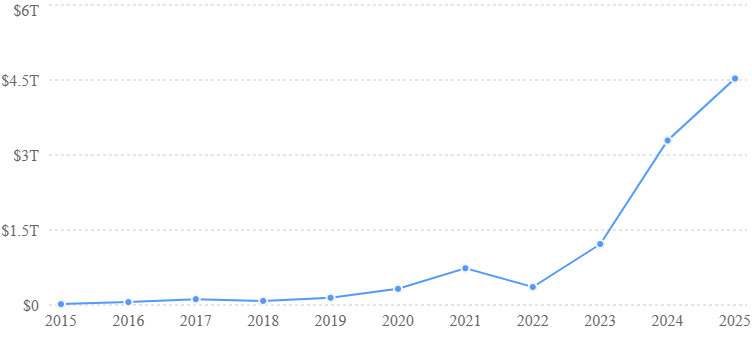
The most remarkable acceleration occurred after 2022, when generative AI became commercially significant.
The launch of ChatGPT in November 2022 helped trigger a global race among technology companies to develop increasingly powerful AI models and computing infrastructure.
NVIDIA became one of the biggest beneficiaries of this transformation.
Its FY2026 annual revenue reached $215.9 billion, representing 65% growth over the previous financial year. Its Q3 FY2027 revenue subsequently reached $115.8 billion.
The November 23, 2026, rally potentially added another $900 billion to its market value, although this should be understood as an intraday estimate rather than a verified closing valuation.
6. What is NVIDIA’s intrinsic value? Is the stock overvalued?
This is arguably the most important question for long-term investors.
Market capitalisation tells us what investors are currently willing to pay for a company. Intrinsic value attempts to estimate what the business is actually worth based on its future ability to generate cash.
A company can be excellent while its shares are expensive.
Similarly, a rapidly rising share price does not automatically mean that the stock is a good investment.
How can NVIDIA’s intrinsic value be calculated?
One widely used approach is the Discounted Cash Flow (DCF) method.
It estimates the present value of future cash flows using assumptions about:
- Future revenue growth.
- Operating profit margins.
- Free cash flow generation.
- Cost of capital.
- Long-term growth rate.
A DCF valuation model published by Trefis on 18 November 2026 estimated NVIDIA’s value at approximately $238.06 per share.
The model used a 9% discount rate and 3% terminal growth assumption. This is one independent model estimate, not an official company valuation or a universally accepted fair price.
Trefis estimate $238.06
What could make NVIDIA’s intrinsic value rise?
- Continued expansion of AI infrastructure.
- Increasing demand for AI inference and agentic AI.
- Successful commercialisation of new GPU architectures.
- Continued dominance of CUDA and its software ecosystem.
- Growth in robotics, autonomous vehicles and industrial AI.
- Strong free cash flow and sustainable profit margins.
What could reduce its intrinsic value?
- Competition from AMD and custom AI chips developed by major cloud companies.
- US-China geopolitical tensions and export restrictions.
- A slowdown in hyperscaler investment in AI infrastructure.
- Declining GPU prices and shrinking profit margins.
- Excessive valuations and investor expectations.
- Increasing electricity, cooling and data-centre infrastructure costs.
An investor should therefore evaluate NVIDIA’s expected future cash flows rather than simply extrapolate its historical share-price growth.
7. What is the future business potential of NVIDIA?
NVIDIA’s future is closely linked to the future of artificial intelligence.
The AI revolution is expanding beyond chatbots and image generation. It is entering manufacturing, healthcare, education, finance, transportation, defence, agriculture and scientific research.
Some of its most promising opportunities include:
A. Artificial intelligence and data centres
This is currently NVIDIA’s biggest growth engine. Companies are investing billions of dollars in AI infrastructure, creating demand for high-performance processors, networking and complete computing systems.
B. Robotics and physical AI
Robots capable of understanding their surroundings, learning tasks and interacting with physical environments could create a major new market for NVIDIA.
Its Isaac robotics platform and related technologies are positioned in this emerging industry.
C. Autonomous vehicles
NVIDIA DRIVE provides computing and software platforms for advanced automotive applications, including autonomous driving.
D. Digital twins and industrial simulation
NVIDIA Omniverse enables companies to create virtual representations of factories, infrastructure and industrial environments.
Such technologies could transform manufacturing, logistics, urban planning and infrastructure management.
E. Healthcare and scientific research
Advanced computing can support drug discovery, medical imaging, genomics and scientific simulation.
The opportunities are substantial, although commercial adoption and profitability will take time.
8. Who are NVIDIA’s biggest competitors?
NVIDIA enjoys a strong competitive position, but it does not operate without competition.
| Competitor | Major area of competition |
| AMD | AI accelerators and GPUs |
| Intel | CPUs and AI computing |
| TPU-based AI infrastructure | |
| Amazon | Trainium and Inferentia AI chips |
| Broadcom | Custom AI accelerators and networking |
| Huawei | Domestic Chinese AI processors |
One particularly important challenge comes from NVIDIA’s own customers.
Large cloud companies are increasingly developing their own specialised processors to reduce dependence on external suppliers and control their computing costs.
Nevertheless, NVIDIA’s combination of hardware, software and networking remains a significant competitive advantage.
9. Is NVIDIA worth investing in?
An investor’s perspective
I’m not a financial advisor, but NVIDIA is an interesting example of the difference between investing in a great business and buying its shares at an attractive price.
Its long-term business prospects are supported by several powerful trends:
- The global expansion of artificial intelligence.
- Increasing demand for high-performance computing.
- Strong financial growth and profitability.
- Its established CUDA ecosystem.
- Expansion into robotics, automotive and industrial computing.
However, investors should also consider the following risks:
| Opportunity | Risk |
| Growing AI infrastructure demand | AI investment slowdown |
| Strong market position | Competition from custom chips |
| High profitability | Possible margin compression |
| Global customer base | US-China geopolitical tensions |
| New product architectures | Technology disruption |
| Strong leadership following Huang’s return | Corporate governance concerns |
Assessment
For a long-term investor, NVIDIA deserves serious consideration because it occupies an important position in the global AI supply chain.
However, its extraordinary growth has already created exceptionally high market expectations.
Buying after a sudden 30% or greater rally simply because the stock is rising can be risky.
A more disciplined approach would be to:
- Examine valuation against projected earnings and free cash flow.
- Compare its forward P/E ratio with historical levels and competitors.
- Monitor quarterly data-centre revenue and customer spending.
- Track developments in China-related export restrictions.
- Consider gradual investment rather than committing a large amount at one price.
- Maintain diversification rather than concentrating an entire portfolio in one technology company.
The key question is not whether AI will grow. It almost certainly will. The more important question is whether NVIDIA can continue growing fast enough to justify the price investors are paying today.
10. What does NVIDIA’s story mean for the global economy?
NVIDIA’s rise illustrates a major transformation in the global economic structure.
During the industrial revolution, economic power was associated with control over coal, steel, oil and manufacturing capacity.
In the digital age, data, semiconductors, computing infrastructure and artificial intelligence are becoming equally strategic resources.
NVIDIA is positioned at the intersection of these developments.
Its technology influences:
- Global technology investment and stock markets.
- US-China strategic competition.
- Semiconductor manufacturing in Taiwan and South Korea.
- Energy demand from AI data centres.
- Employment patterns and the future of automation.
- Productivity and competitiveness across industries.
Its influence is particularly significant because a slowdown in NVIDIA’s business could affect the wider AI investment ecosystem, including cloud providers, semiconductor manufacturers and data-centre operators.
For India, NVIDIA’s growth is also relevant. India’s ambitions in semiconductor manufacturing, AI infrastructure, digital public infrastructure and indigenous AI development will require access to advanced computing technologies.
The expansion of AI could create opportunities for Indian IT companies, startups, universities, research institutions and manufacturing industries. At the same time, dependence on imported advanced processors remains a strategic challenge.
11. Conclusion: Is NVIDIA the company of the AI century?
NVIDIA’s journey from a small semiconductor startup in 1993 to one of the world’s most valuable technology companies demonstrates how technological innovation can reshape global economic power.
Its extraordinary growth is not simply the result of a rising stock market. It reflects the emergence of a new computing era in which artificial intelligence is becoming an essential component of economic activity.
Jensen Huang’s dramatic return on 23 November 2026 has restored an important degree of leadership confidence, but the controversies surrounding export controls, corporate governance and national security remain relevant.
The company’s long-term prospects are promising, particularly in AI infrastructure, robotics, autonomous systems and industrial computing.
Nevertheless, even the strongest companies can become poor investments when purchased at excessive valuations.
NVIDIA may well remain one of the defining companies of the AI revolution. But its future stock-market performance will depend not only on how big the AI economy becomes, but also on how much of that economic value NVIDIA can capture and how much investors have already priced into its shares.
That is the real lesson for investors: never confuse a revolutionary business with an automatically attractive stock price.
Leave a Reply