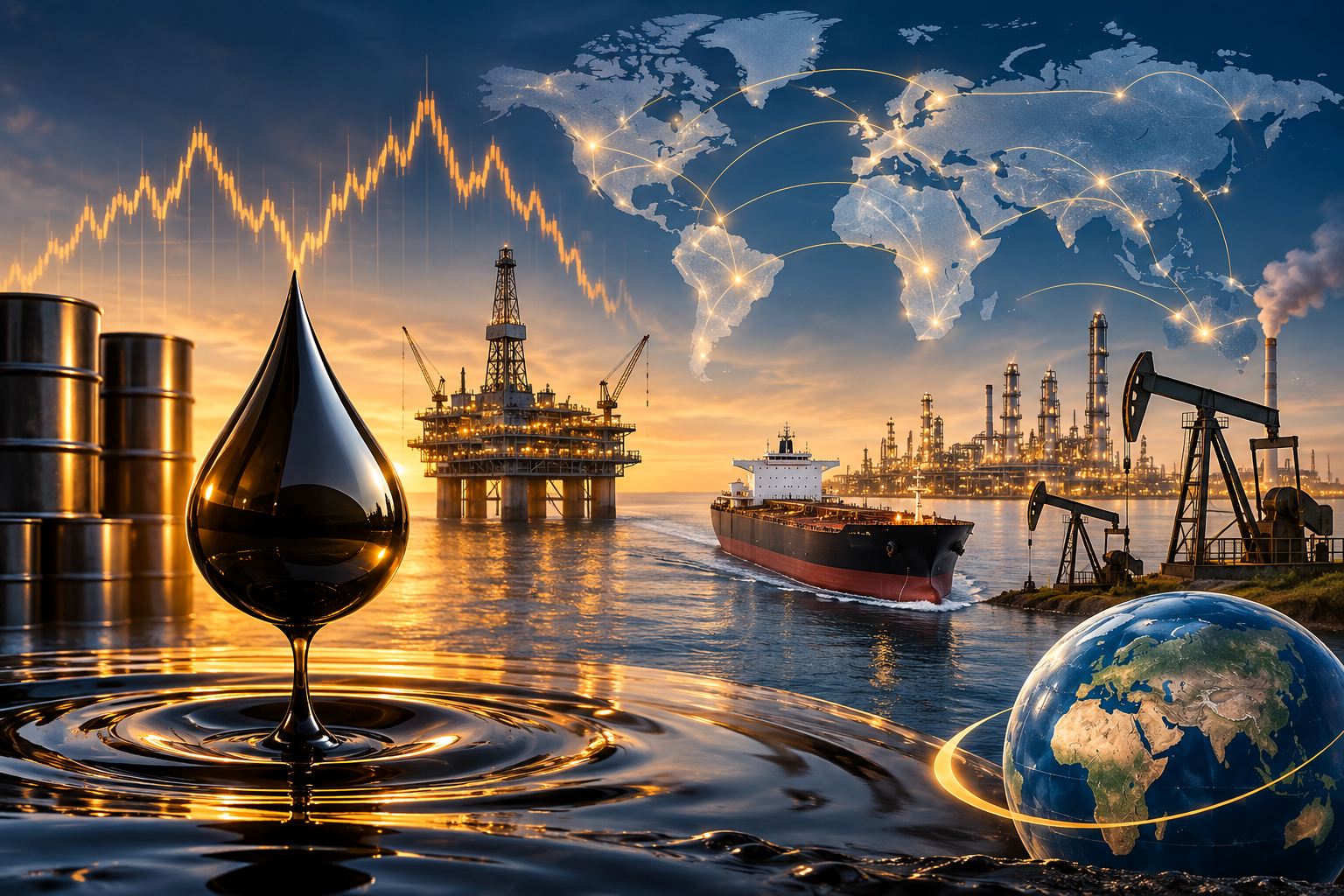
Crude oil is much more than a source of fuel. It is a strategic economic resource, a powerful instrument of international diplomacy, a major determinant of inflation and a significant factor influencing the political and economic relationships among nations. From the petrol consumed by an ordinary commuter to the transportation of goods across continents, crude oil remains deeply embedded in the functioning of modern civilisation.
Thank you for reading this post, don’t forget to subscribe!Often described as Black Gold or Liquid Gold, crude oil has influenced wars, shaped international alliances, created extraordinary wealth and transformed the economic fortunes of several countries. Even as the world moves towards renewable energy, electric mobility and a low-carbon economy, petroleum continues to occupy a central position in global energy security.
But who produces the most crude oil? Which countries possess the largest reserves? Why do oil prices fluctuate? How does the oil trade influence international geopolitics? And, particularly, why is crude oil so important for India’s economy?
Let’s explore the world of crude oil, from its geological origins to its economic and geopolitical significance.
1. What is crude oil?
Crude oil is a naturally occurring liquid fossil fuel found beneath the Earth’s surface, both on land and beneath the seabed. It is formed over millions of years through the decomposition and transformation of ancient marine organisms, including microscopic plants and animals, under conditions of heat and pressure.
It is primarily a mixture of hydrocarbons, which are compounds made up of hydrogen and carbon. Depending on its geological origin, crude oil varies in colour, density, viscosity and chemical composition.
Crude oil is extracted through drilling operations and transported to refineries, where it is processed into different petroleum products.
Some of its most important products include:
- Petrol (gasoline) – used primarily in cars and motorcycles.
- Diesel – used in trucks, buses, agricultural machinery and industrial equipment.
- Aviation Turbine Fuel (ATF) – used in aircraft.
- LPG – used for cooking and industrial applications.
- Naphtha – used in petrochemical manufacturing.
- Bitumen – used in road construction.
- Lubricants – used in vehicles and industrial machinery.
- Petrochemical feedstocks – used to manufacture plastics, synthetic fibres, paints, detergents, fertilisers and numerous other products.
Thus, crude oil is not merely a fuel. It is a fundamental raw material for modern industrial production and everyday consumer goods.
How is crude oil measured?
The international petroleum industry generally measures crude oil in barrels.
One standard petroleum barrel equals:

Oil production is generally expressed in barrels per day (bpd), while large-scale national and international production is measured in million barrels per day (mb/d).
One important distinction is that crude oil, petroleum liquids and refined petroleum products are not identical statistical categories. Therefore, production rankings can vary depending on what is included.
2. Top 10 crude oil-producing countries in the world
The United States, Russia and Saudi Arabia are among the world’s largest crude oil producers. Their production capacity, export infrastructure and influence over global supply make them important players in international energy markets.
According to the US Energy Information Administration (EIA), the latest available 2025 country-level ranking of crude oil production, including lease condensate, is as follows.
Table 1. Top 10 crude oil producers, 2025 annual average
| Rank | Country | Production (million barrels/day) |
| 1 | United States | 13.586 |
| 2 | Russia | 9.885 |
| 3 | Saudi Arabia | 9.556 |
| 4 | Canada | 4.964 |
| 5 | Iraq | 4.388 |
| 6 | China | 4.325 |
| 7 | Iran | 4.051 |
| 8 | United Arab Emirates | 3.771 |
| 9 | Brazil | 3.769 |
| 10 | Kuwait | 2.584 |
Source: US Energy Information Administration (EIA), International Energy Statistics, 2025. Figures are annual average production in thousand barrels per day converted into million barrels per day. Includes crude oil and lease condensate.
U.S. Energy Information Administration (EIA)
What makes these countries important?
1. United States: The US has emerged as the world’s largest oil producer, supported by technological developments in hydraulic fracturing (fracking) and horizontal drilling, particularly in the Permian Basin.
2. Russia: Russia is a major energy exporter. Its oil industry is strategically important for its government revenues, foreign trade and geopolitical relations, particularly with Asian markets.
3. Saudi Arabia: Saudi Arabia is a central player in global oil markets. Its relatively low production costs, substantial reserves and ability to adjust production make it particularly influential.
4. Canada: Canada’s oil production is significantly supported by its oil sands resources, particularly in Alberta.
5. Iraq: Iraq possesses enormous petroleum resources and remains an important supplier to international markets.
6. China: Although China is one of the world’s largest oil producers, its consumption is considerably greater than domestic production, making it a major oil importer.
7. Iran: Iran possesses substantial petroleum resources and has historically been an important producer. International sanctions and geopolitical developments influence its export capacity.
8. UAE: The United Arab Emirates is a major petroleum producer and exporter, with Abu Dhabi accounting for most of its oil resources.
9. Brazil: Offshore oil discoveries, particularly in deepwater and pre-salt formations, have strengthened Brazil’s position.
10. Kuwait: Kuwait is one of the most important petroleum-producing countries in the Middle East, with a large share of its economy dependent on oil revenues.
An important observation: High production does not necessarily mean high reserves. The United States leads global production, whereas Venezuela possesses the world’s largest proven crude oil reserves.
3. Top 10 countries with the largest crude oil reserves
Oil reserves refer to the estimated quantities of petroleum that can be recovered commercially from known reservoirs under existing economic, geological, technological and regulatory conditions.
A country may have enormous geological oil resources but comparatively limited proven reserves because of extraction costs, infrastructure constraints, technology or political circumstances.
According to OPEC’s Annual Statistical Bulletin 2025, the following are the leading countries in proven crude oil reserves at the end of 2024.
Table 2. Top 10 countries by proven crude oil reserves, end-2024
| Rank | Country | Proven reserves (billion barrels) |
| 1 | Venezuela | 303.22 |
| 2 | Saudi Arabia | 267.20 |
| 3 | Iran | 208.60 |
| 4 | Canada | 163.44 |
| 5 | Iraq | 145.02 |
| 6 | United Arab Emirates | 113.00 |
| 7 | Kuwait | 101.50 |
| 8 | Russia | 80.00 |
| 9 | Libya | 48.36 |
| 10 | United States | 45.01 |
Source: OPEC, Annual Statistical Bulletin 2025, World Proven Crude Oil Reserves, Table 3.1. Values are rounded and expressed in billion barrels.
Interesting facts about global oil reserves
- Venezuela leads the world in proven crude oil reserves, but it is not among the top ten producers in the EIA’s 2025 ranking.
- Saudi Arabia combines enormous reserves with substantial production capacity.
- Canada possesses significant oil sands resources, which require different extraction and processing techniques compared with conventional oil.
- The Middle East has a particularly large concentration of global oil reserves.
- India is a relatively small reserve holder compared with the leading petroleum nations.
The geographical distribution of oil reserves explains why the Middle East continues to have enormous strategic importance in international affairs.
4. Why is crude oil called Black Gold or Liquid Gold?
Crude oil is frequently described as Black Gold because of its dark appearance and extraordinary economic value. The expression Liquid Gold highlights its importance as a highly valuable, versatile and commercially traded natural resource.
There are several reasons behind this description.
First, its economic value: Petroleum exports generate enormous foreign exchange earnings for oil-producing countries. For countries such as Saudi Arabia, Iraq, Kuwait and the UAE, petroleum revenues have historically been central to government finances and economic development.
Second, its industrial importance: Oil is used to produce much more than petrol and diesel. It provides raw materials for plastics, chemicals, synthetic textiles, pharmaceuticals, paints, fertilisers and numerous industrial products.
Third, its strategic significance: Countries with substantial oil reserves and export capacity possess considerable influence in international economic and diplomatic relations.
Fourth, its limited natural availability: Conventional crude oil is a finite fossil fuel formed over geological timescales. Its extraction requires substantial investment, specialised technology and infrastructure.
Consequently, crude oil has become one of the most strategically important commodities in the world economy.
5. How are crude oil prices determined?
One of the most interesting aspects of the petroleum industry is that crude oil prices are not fixed by any single country, company or international organisation.
They are determined through a combination of global supply and demand, international benchmarks, physical trading, futures markets, geopolitical developments and expectations about future economic conditions.
The fundamental principle is simple:
When global demand exceeds available supply, oil prices generally increase. When supply exceeds demand, prices generally decline.
However, the actual price mechanism is considerably more complex.
A. International oil benchmarks
Three important pricing benchmarks are widely used in international petroleum markets.
1. Brent Crude
Brent is the principal international benchmark for a large proportion of globally traded crude oil, particularly oil from Europe, Africa and the Middle East.
2. West Texas Intermediate (WTI)
WTI is a major US crude oil benchmark. It is associated with oil traded and delivered at Cushing, Oklahoma.
3. Dubai/Oman Crude
Dubai and Oman benchmark prices are particularly important for pricing Middle Eastern crude oil exported to Asian markets.
These benchmarks provide reference prices, while the actual price of a particular crude cargo depends on its quality, location, transportation costs and market conditions.
B. Major factors influencing crude oil prices
1. Global demand and supply
Economic expansion increases demand for transportation, industrial production and energy. Conversely, an economic slowdown can reduce petroleum consumption.
2. OPEC and OPEC+ production decisions
The Organization of the Petroleum Exporting Countries (OPEC), along with participating non-OPEC producers under the OPEC+ framework, coordinates production policies.
When major producers collectively reduce output, the available supply may decline, potentially pushing prices upwards. Increasing production can have the opposite effect.
3. Geopolitical tensions and wars
Conflicts involving major oil-producing countries can create fears of supply disruptions. Even when physical supplies remain unaffected, uncertainty can increase prices through a geopolitical risk premium.
4. Currency fluctuations
Crude oil is predominantly traded in US dollars. When the dollar strengthens, oil can become more expensive for countries whose currencies have depreciated against it.
5. Oil inventories
Commercial inventories and strategic petroleum reserves influence market expectations. Rising inventories can indicate excess supply, while falling inventories may signal tightening market conditions.
6. Financial markets and speculation
Oil futures contracts are traded on exchanges such as the Intercontinental Exchange (ICE) and the New York Mercantile Exchange (NYMEX). Traders and investors buy and sell contracts based on their expectations of future prices.
These transactions contribute to price discovery and can amplify short-term market volatility.
7. Natural disasters and production disruptions
Hurricanes, earthquakes, fires and damage to offshore platforms, refineries or pipelines can temporarily disrupt production and transportation.
The US Energy Information Administration identifies supply, demand, inventories and financial market developments among the major factors influencing crude oil prices.
C. Why do oil prices sometimes increase suddenly?
Consider a hypothetical situation.
Suppose a major conflict threatens petroleum exports from the Persian Gulf. International traders fear that oil tankers may be unable to transport crude oil through the Strait of Hormuz.
Even before an actual shortage occurs, traders may anticipate a disruption and bid up crude oil prices.
This is known as a geopolitical risk premium.
Therefore, oil prices are influenced not only by the quantity of oil available today but also by expectations about what may happen tomorrow.
6. The geopolitics of crude oil: How petroleum shapes international relations
Crude oil is one of the most important instruments of economic and geopolitical influence in the modern world.
The global petroleum industry involves producing countries, importing countries, international oil companies, shipping companies, financial institutions, commodity traders and multilateral organisations.
The struggle to secure reliable energy supplies has influenced international alliances, military strategies, sanctions and diplomatic negotiations.
A. OPEC: The organisation that influences global oil markets
The Organization of the Petroleum Exporting Countries (OPEC) was established on 14 September 1960 in Baghdad, Iraq.
Its founding members were:
- Iran
- Iraq
- Kuwait
- Saudi Arabia
- Venezuela
Its headquarters is located in Vienna, Austria.
OPEC’s principal objective is to coordinate and unify petroleum policies among its member countries and help stabilise international oil markets.
OPEC’s decisions regarding production targets can influence the availability of crude oil in international markets.
B. What is OPEC+?
OPEC+ refers to OPEC members and participating non-OPEC oil-producing countries that cooperate through the Declaration of Cooperation.
Russia is particularly important within this arrangement.
The broader cooperation enables major producers to coordinate production adjustments and respond to changes in global demand and supply.
However, OPEC and OPEC+ do not exercise complete control over global oil prices. Production decisions by the United States, Canada, Brazil and other non-participating producers, together with market demand, also play significant roles.
C. The United States and its energy strategy
The United States has transformed its petroleum industry through technological innovations, particularly shale oil extraction.
Its position as the world’s largest producer gives it substantial influence over global energy markets.
At the same time, US foreign policy frequently intersects with petroleum trade through economic sanctions, export restrictions, diplomatic negotiations and strategic relationships with oil-producing countries.
D. Russia, sanctions and energy diplomacy
Russia is one of the world’s major oil producers and exporters.
Following the Russia-Ukraine conflict in 2022, Western sanctions and restrictions on Russian petroleum trade reshaped international energy flows.
Russia redirected a significant portion of its oil exports towards Asian markets, particularly India and China.
This demonstrated how geopolitical developments can change the direction of international petroleum trade without necessarily eliminating the underlying supply.
E. China and the competition for energy security
China is one of the world’s largest oil consumers and importers.
Its rapidly expanding industrial base, manufacturing sector and transportation requirements make access to reliable petroleum supplies an important national priority.
China has developed extensive energy partnerships with Russia, Middle Eastern countries and African producers.
It has also invested in overseas energy infrastructure and strategic petroleum storage.
F. The Strait of Hormuz: The world’s most important oil chokepoint
The Strait of Hormuz is a narrow maritime passage between Iran and Oman that connects the Persian Gulf with the Gulf of Oman and the Arabian Sea.
It is one of the most strategically important waterways in the world.
According to the US EIA, approximately 20.9 million barrels of oil per day passed through the Strait of Hormuz during the first half of 2025, equivalent to around 20% of global petroleum liquids consumption.
Approximately 89% of the crude oil and condensate passing through the strait during that period was destined for Asian markets.
China, India, Japan and South Korea are particularly exposed to disruptions along this route.
Other important petroleum transportation routes include:
- Strait of Malacca – a major shipping passage connecting the Indian and Pacific Oceans.
- Suez Canal – connects the Mediterranean Sea with the Red Sea.
- Bab el-Mandeb – connects the Red Sea with the Gulf of Aden.
- Turkish Straits – an important route for oil shipments from the Black Sea region.
A disruption in any of these important routes can increase transportation costs, insurance premiums and delivery times, ultimately affecting the price of crude oil.
G. Oil as a geopolitical weapon
Oil can also become an instrument of political and economic pressure.
Countries may impose sanctions on petroleum exports, restrict access to energy technology or limit financial transactions involving oil-producing nations.
Similarly, producers can adjust exports or production to influence market conditions.
The 1973 Arab oil embargo demonstrated how petroleum supply restrictions could have far-reaching consequences for industrialised economies.
The broader lesson is that energy security is not simply an economic issue; it is also a national security and foreign policy concern.
7. How crude oil price fluctuations influence the world economy
Crude oil is an essential input in global economic activity. Its price movements affect production costs, transportation, international trade, inflation and government finances.
The impact differs between oil-importing and oil-exporting countries.
When crude oil prices increase
Higher crude oil prices
Higher petroleum import costs
Increased transportation and production costs
Higher prices of goods and services
Inflationary pressure and potential slowdown in economic growth
Major economic consequences
1. Inflation
Higher crude oil prices increase the cost of petrol, diesel, aviation fuel and other petroleum products. This can increase the prices of food, manufactured goods and services through higher transportation and production costs.
2. International trade deficit
Oil-importing countries must spend more foreign currency to purchase the same quantity of crude oil. This can widen their trade deficits and put pressure on their balance of payments.
3. Currency depreciation
Higher oil import bills can increase demand for US dollars. In countries already facing external-sector vulnerabilities, this may contribute to depreciation of the domestic currency.
4. Industrial production
Industries such as aviation, transportation, chemicals, cement, fertilisers and manufacturing are particularly sensitive to energy costs.
5. Government finances
Governments may face difficult choices between increasing retail fuel prices, reducing taxes, providing subsidies or allowing oil marketing companies to absorb part of the cost.
6. Financial markets
Higher energy prices can reduce corporate profitability, increase inflation expectations and influence central bank interest-rate decisions.
What happens when crude oil prices fall?
Lower oil prices can benefit oil-importing countries by reducing their import bills and inflationary pressures.
However, oil-exporting economies may experience reduced export earnings, lower government revenues and pressure on their public spending.
Therefore, a fall in crude oil prices is not universally beneficial to every country.
8. India’s economy and its association with crude oil
India is one of the world’s largest consumers and importers of crude oil. Petroleum is central to its transportation system, manufacturing sector, agricultural operations, petrochemical industries and overall economic growth.
Despite having domestic oil production, India remains heavily dependent on imported crude oil.
A. India’s dependence on imported crude oil
According to the Ministry of Petroleum and Natural Gas, based on data published by the Petroleum Planning and Analysis Cell (PPAC), India’s crude oil import dependence has remained approximately 88% in recent financial years.
A written reply in the Rajya Sabha on 30 March 2026 confirmed that import dependence, measured on the basis of petroleum, oil and lubricants (POL) consumption, remained broadly around 88% during FY 2023–24, FY 2024–25 and FY 2025–26.
The same reply highlighted the following domestic production figures:
| Indicator | Production |
| FY 2014–15 | 37.461 million tonnes |
| FY 2024–25 | 28.704 million tonnes |
This indicates a significant decline in domestic crude oil production over the decade.
The government attributed the decline partly to the natural depletion of mature oilfields, geological complexities and operational challenges.
B. Why does India import so much crude oil?
There are several reasons:
1. Rising energy demand: Economic expansion, urbanisation and increasing household incomes have increased petroleum consumption.
2. Limited domestic production: India’s domestic crude oil production is insufficient to meet its growing requirements.
3. Industrial development: Manufacturing, petrochemicals, transportation and infrastructure development require substantial petroleum inputs.
4. Growing vehicle ownership: Increasing numbers of cars, motorcycles, buses and commercial vehicles contribute to petroleum demand.
5. Agricultural dependence: Diesel is extensively used in tractors, irrigation pumps and agricultural transportation.
Consequently, India must rely on international markets to meet a substantial proportion of its crude oil requirements.
C. How does rising crude oil prices affect India?
The effects can be understood through several economic channels.
1. Higher import expenditure
When international crude oil prices increase, India’s petroleum import bill generally rises, assuming other factors remain unchanged.
This increases the demand for foreign exchange and can put pressure on the current account balance.
2. Inflationary pressure
Higher crude prices can increase the cost of diesel, petrol, transportation, logistics and industrial inputs.
These costs may eventually be reflected in the prices of food, manufactured goods and services.
3. Pressure on the Indian rupee
An increased petroleum import bill can raise demand for US dollars. If this is not offset by other foreign currency inflows, it may contribute to depreciation pressure on the rupee.
4. Fiscal implications
The government may face pressure to adjust excise duties, provide relief to consumers or manage the financial position of public-sector oil marketing companies.
5. Impact on economic growth
Higher energy costs can reduce household purchasing power and increase operating expenses for businesses, potentially affecting consumption and investment.
D. India’s crude oil suppliers
India purchases crude oil from a diverse range of countries to strengthen supply security and obtain competitive prices.
Its major suppliers include:
- Russia
- Iraq
- Saudi Arabia
- United Arab Emirates
- United States
- Kuwait
- Other African and West Asian producers
The importance of individual suppliers changes according to international prices, discounts, sanctions, shipping costs and geopolitical developments.
For example, a Reuters report dated 19 November 2026 noted that Russia remained India’s largest oil supplier in October 2026, while Saudi Arabia overtook the UAE to become the second-largest supplier. Russia supplied approximately 1.85 million barrels per day during that month.
This illustrates India’s evolving petroleum procurement strategy and its willingness to diversify sourcing based on market conditions.
E. Why is the Strait of Hormuz important for India?
India’s geographical position makes maritime energy security particularly important.
A substantial volume of petroleum from the Persian Gulf travels through the Strait of Hormuz before reaching Indian ports.
Any prolonged disruption in the strait could increase:
- Crude oil procurement costs.
- Shipping and insurance expenses.
- Delivery delays.
- Refinery supply uncertainties.
- Overall import expenditure.
The EIA’s 2025 data identifies India among the principal Asian destinations for petroleum passing through the Strait of Hormuz.
F. India’s domestic refining capacity: A strategic advantage
Although India imports much of its crude oil, it has developed a substantial petroleum refining industry.
Indian refineries process imported and domestically produced crude oil into petrol, diesel, aviation turbine fuel, LPG, naphtha and other petroleum products.
India is also an important exporter of refined petroleum products.
This creates a significant distinction: India is a major importer of crude oil but also a major exporter of refined petroleum products.
Its refining industry generates economic value through processing, manufacturing, employment, logistics and international trade.
9. How can India reduce its dependence on imported crude oil?
Reducing excessive dependence on imported petroleum is important for India’s long-term economic and strategic security.
Several measures can contribute to this objective.
1. Expanding domestic exploration and production
Investment in new exploration technologies, offshore resources, enhanced oil recovery and improved management of mature oilfields can help increase domestic production.
2. Promoting electric mobility
Electric vehicles can gradually reduce petroleum consumption in road transportation, particularly in two-wheelers, three-wheelers, buses and urban mobility.
3. Strengthening public transportation
Metro rail, electric buses, suburban rail and efficient public transportation systems can reduce individual dependence on petrol and diesel vehicles.
4. Expanding renewable energy
Solar, wind and other renewable energy sources can reduce dependence on imported fossil fuels, particularly as electricity replaces petroleum in transport and industry.
5. Promoting biofuels
Ethanol blending, biodiesel and other sustainable biofuel initiatives can partially substitute conventional petroleum fuels.
6. Developing strategic petroleum reserves
India has developed strategic petroleum storage facilities to provide a buffer against supply disruptions and emergencies.
7. Diversifying import sources
Maintaining relationships with multiple oil-producing countries can reduce dependence on a limited number of suppliers and improve India’s negotiating position.
8. Improving energy efficiency
Fuel-efficient vehicles, industrial energy conservation, better logistics and efficient freight transportation can reduce petroleum consumption per unit of economic output.
These measures are also relevant to India’s broader commitments towards energy security, sustainable development and climate action.
10. The future of crude oil in a changing world
The global energy landscape is undergoing a major transformation.
Countries are investing in renewable energy, electric mobility, green hydrogen, energy storage and other alternatives to fossil fuels.
However, the transition away from petroleum will not happen overnight.
Crude oil will continue to play an important role in several sectors, particularly aviation, shipping, petrochemicals, heavy industry and certain transportation activities.
The future of the petroleum industry will depend on several developments:
- Growth in electric vehicle adoption.
- Technological developments in renewable energy.
- Changes in global transportation patterns.
- Economic growth in emerging economies.
- Government policies on carbon emissions.
- Investment in oil exploration and production.
- Geopolitical stability in major oil-producing regions.
An important consideration is that the energy transition itself may create new geopolitical relationships. Countries possessing lithium, cobalt, copper, rare earth elements and advanced battery technologies may become increasingly influential in the emerging energy economy.
Thus, the world may gradually move from competition over petroleum resources towards competition over a wider range of critical minerals, energy technologies and supply chains.
11. Conclusion: Will crude oil remain the world’s most strategic commodity?
Crude oil has played a defining role in shaping the modern global economy. It has fuelled industrial revolutions, supported international trade, generated enormous national wealth and influenced the geopolitical relationships between powerful nations.
Despite the growing importance of renewable energy, petroleum remains indispensable to the functioning of many economies. Its significance extends beyond energy consumption to manufacturing, transportation, agriculture, international trade and national security.
For India, crude oil represents both an economic necessity and a strategic vulnerability. Its high import dependence exposes the country to international price fluctuations, currency movements and geopolitical disruptions.
India’s long-term economic resilience will therefore depend on its ability to diversify energy sources, strengthen domestic production, improve energy efficiency and accelerate the transition towards cleaner alternatives.
Ultimately, crude oil may not remain the dominant energy resource forever, but its influence on global economic and political affairs will continue for years to come.
The world may be moving towards a new energy era, but the geopolitics of oil will remain an important part of understanding international relations and the global economy.
Leave a Reply