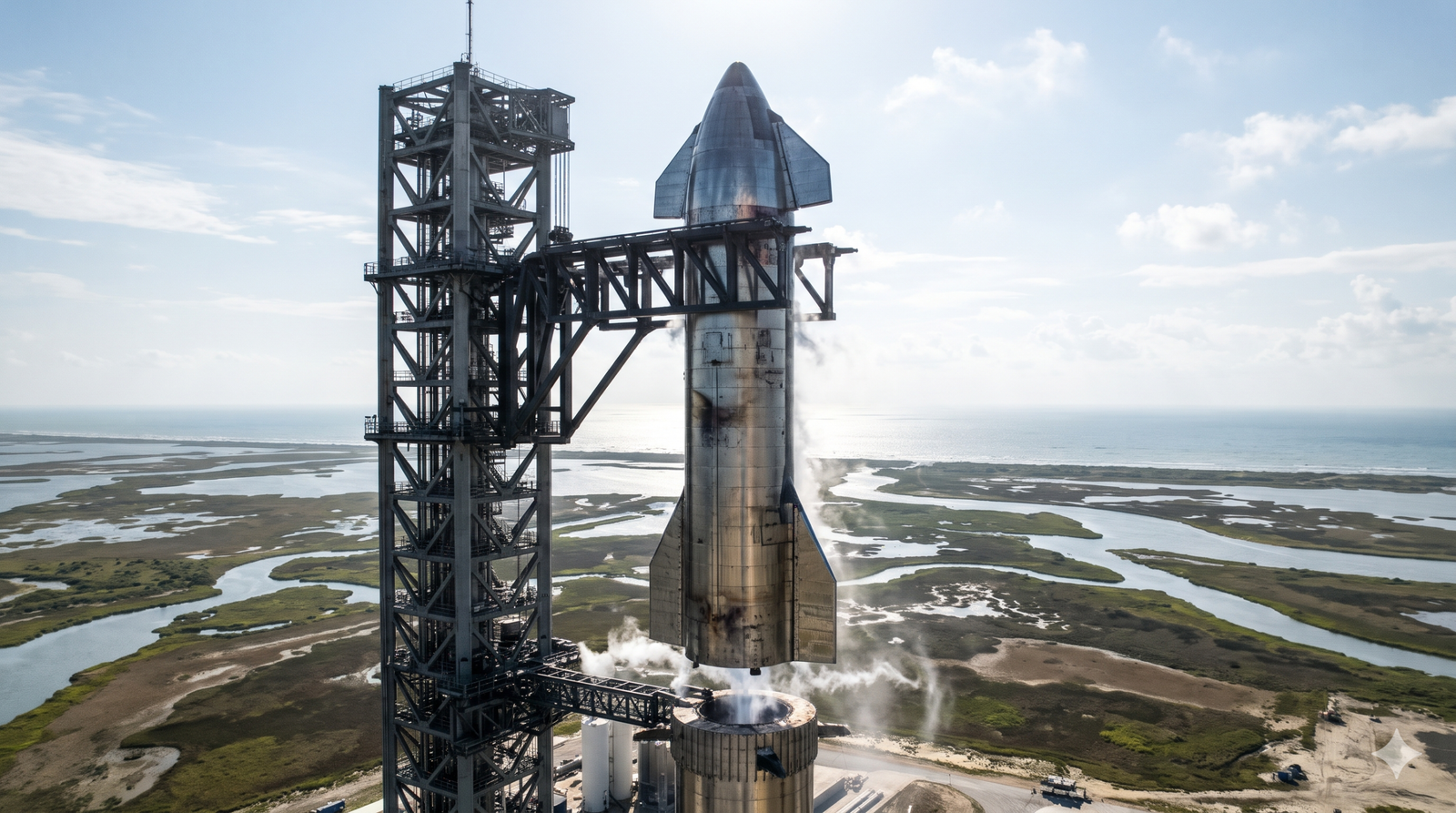
Imagine a rocket taller than a 30-storey building launching into the sky. Instead of being thrown away after its mission, it returns to Earth, slows down, and is caught by two giant mechanical arms attached to a launch tower.
Thank you for reading this post, don’t forget to subscribe!It sounds like science fiction. But this is exactly the kind of engineering challenge SpaceX has been working to achieve with its revolutionary Starship system.
The idea is simple but extraordinary: build a rocket that can launch, return, and fly again — making space travel more like travelling by aircraft than using a disposable vehicle.
A rocket caught in mid-air!
On November 14, 2026, something remarkable happened at SpaceX’s Starbase facility in Texas. A spacecraft that had travelled into space, circled Earth, and survived the scorching heat of re-entry returned to its launch site — where a giant tower caught it in mid-air.
This was not a small rocket or a simple experiment. It was the upper stage of Starship, one of the most ambitious space vehicles ever developed.
For the first time, SpaceX successfully caught the Starship spacecraft itself using the enormous mechanical arms of its launch tower. The achievement marked a major step towards making spaceflight more affordable and reusable.
But how can a rocket be caught without landing legs? How does it know where to go? And why would anyone want to catch a rocket instead of simply letting it land?
Let’s explore the science behind this incredible feat.
What exactly is Starship?
Starship is a gigantic rocket system developed by SpaceX. It is designed to carry people, cargo, satellites and eventually astronauts to destinations such as the Moon and Mars.
The complete Starship vehicle has two major parts:
- Super Heavy Booster: The powerful first stage that lifts the vehicle away from Earth.
- Starship (Ship): The upper spacecraft that continues the journey after separating from the booster.
Think of it like a two-stage journey. The booster provides the enormous initial push, while the spacecraft takes over for the trip into space.
The entire vehicle stands roughly 120 metres tall — comparable to a very tall building — and is powered by SpaceX’s Raptor engines.
The problem with traditional rockets
For decades, rockets were mostly treated as disposable vehicles.
A rocket would launch, deliver its payload, and then its stages would fall back to Earth or burn up in the atmosphere. Building a new rocket for every mission made space travel extremely expensive.
Imagine buying a new aeroplane every time you wanted to fly from Delhi to Mumbai. That would make air travel ridiculously costly!
SpaceX began changing this approach with its Falcon 9 rockets, which can return their first-stage boosters to Earth and fly again.
Starship takes the idea much further. The ultimate goal is to recover and reuse both the booster and the spacecraft, reducing the need to manufacture a completely new vehicle for every launch.
Meet Mechazilla — the giant rocket catcher
The launch tower at Starbase has a nickname: Mechazilla.
It is equipped with two enormous mechanical arms that SpaceX calls chopsticks. These arms can move, open and close to capture a returning rocket stage.
The system is designed to do something extraordinary:
Instead of allowing the rocket to land on the ground, the tower catches it while it is still in the air.
Why use such a complicated method?
Because a rocket that does not need landing legs may be lighter, and a vehicle caught directly at the launch tower could potentially be inspected, prepared and reused more quickly.
The arms grip specially designed structural points near the top of the returning vehicle. They must be positioned with extraordinary precision, because even a small error could damage the rocket or the tower.
This is not simply a giant pair of pincers. It is a carefully coordinated system involving sensors, computers, guidance software, engines and mechanical structures.
How does a rocket return from space and get caught?
The process involves several remarkable stages.
Step 1: Launch into space
Super Heavy’s powerful engines lift the complete Starship vehicle from the launch pad. Once the spacecraft reaches the required altitude, the booster and upper stage separate.
Step 2: The spacecraft completes its mission
The upper stage continues its journey. During Flight 15, Starship deployed 26 next-generation Starlink satellites and completed approximately 14 orbits of Earth.
Step 3: Returning to Earth
The spacecraft begins its return journey. It must carefully control its trajectory and speed as it enters Earth’s atmosphere.
The atmosphere acts like a giant brake, but it also creates intense heat. Starship uses a heat shield made of protective tiles to help withstand the extreme temperatures of re-entry.
Step 4: The dramatic landing manoeuvre
As the spacecraft approaches its landing area, it performs a controlled manoeuvre to bring itself into the correct orientation.
The vehicle must slow down, stabilise and align itself with the launch tower.
Step 5: The catch!
At the final moment, the spacecraft uses its engines to control its descent and position.
The mechanical arms of the tower move into place and catch the vehicle at specially designed structural points.
And just like that, a spacecraft that has travelled through space is held securely by a tower on Earth!
The catch of Ship 42 on November 14, 2026, took place approximately 22.5 hours after its launch.
Why was catching Starship such a big deal?
SpaceX had already demonstrated the tower-catch technique with the Super Heavy booster.
The first successful booster catch took place during Starship Flight 5 in October 2024. Further booster catches followed during Flights 7 and 8.
However, catching the upper spacecraft was a much more difficult challenge.
The spacecraft travels farther, reaches orbital speeds, and must survive the much harsher conditions of atmospheric re-entry.
Flight 15 changed that.
For the first time, the Starship upper stage returned from space and was successfully caught by the launch tower.
It demonstrated that the tower-catch concept could work not only for a returning booster but also for a spacecraft that had completed a journey around Earth.
Was the entire Starship caught?
Historic milestone — with one important detail
SpaceX had hoped to catch both stages during Flight 15.
The Super Heavy booster was supposed to return to the launch tower shortly after launch. However, a low-fuel warning and an automated safety decision caused it to divert to a splashdown in the Gulf of Mexico.
The upper stage, Ship 42, completed its return successfully and was caught by the tower the following day.
So, the mission achieved a major milestone, but it was not a successful catch of both stages on the same flight.
This is an important lesson in engineering: a mission can achieve something historic while still leaving challenges to solve.
What happens to the rocket after it is caught?
The catch is only the beginning of the next phase.
Engineers must inspect the vehicle carefully to understand how it performed during launch, spaceflight and re-entry.
They examine:
- The heat shield and thermal protection tiles
- Engines and propulsion systems
- Structural components
- Sensors and flight-control systems
- Any signs of damage or unusual wear
The purpose is to determine whether the vehicle can be refurbished and flown again, or whether further modifications are needed.
A successful catch does not automatically mean that the spacecraft is ready for another launch. Reusability requires reliable inspection, maintenance and testing.
That is why every test flight provides valuable information.
How could this change the future of space travel?
If Starship becomes fully reusable and can be operated reliably, it could transform the way humanity explores space.
More affordable launches: Reusing expensive rocket hardware could reduce the cost of sending payloads into space.
More frequent missions: A reusable vehicle could support a faster launch schedule, provided it can be inspected and prepared efficiently.
Moon exploration: Starship is being developed as part of NASA’s Artemis programme to support future lunar missions.
Mars exploration: Its large payload capacity and reusable design make it a potential vehicle for transporting cargo and, eventually, people to Mars.
A future space economy: Lower launch costs could help expand satellite networks, scientific research, space stations and other activities beyond Earth.
Of course, these possibilities depend on many more successful tests, improvements in reliability and the development of supporting technologies such as orbital refuelling.
But the vision is exciting: a future in which travelling to space becomes more routine, rather than an extraordinary event that happens only occasionally.
The science behind the catch: precision, physics and teamwork
The Starship catch is a wonderful example of several scientific and engineering fields working together.
The catch is not magic. It is the result of thousands of calculations, countless simulations, careful design and repeated testing.
And perhaps the most interesting part is that engineers are learning by doing. Every flight reveals something new.
Conclusion: When science fiction becomes engineering
The story of SpaceX catching its own Starship is more than a spectacular rocket landing.
It represents a new way of thinking about space travel.
For generations, rockets were built to fly once and disappear. Now engineers are working towards a future where enormous spacecraft can return, be recovered and fly again.
The successful catch of Ship 42 during Flight 15 showed that a spacecraft returning from orbit could be captured by its launch tower — a remarkable step towards full Starship reusability.
The journey is far from complete. There are still challenges involving reliability, refurbishment, safety and repeated flights.
But one thing is clear: the future of space exploration is being shaped not only by how we reach space, but also by how cleverly we return.
And the next time you see a rocket launch, remember this incredible possibility:
One day, the rocket that carries us into space may come back, get caught by a giant robot-like tower, and prepare for its next journey.
That is the beauty of science — turning an impossible idea into a real engineering challenge.
Leave a Reply