Most of us begin our mornings without thinking about science.
Thank you for reading this post, don’t forget to subscribe!We tap our phones to check messages. We switch on a light. We trust that clean water will flow from the tap. Even the simple act of brewing tea relies on centuries of accumulated knowledge — heat transfer, material science, chemistry — quietly working in the background. Science rarely announces itself. It simply makes life possible.
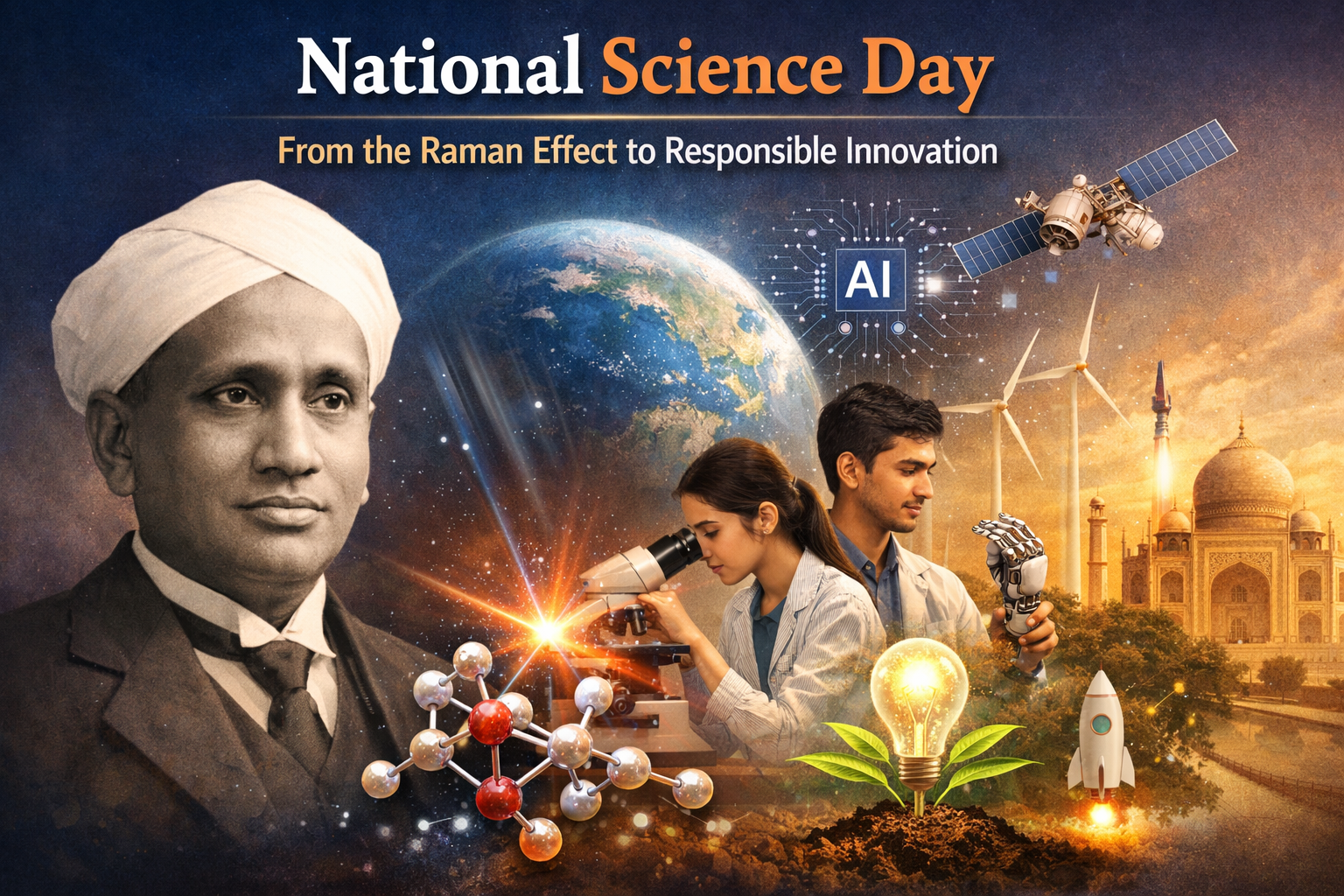
Perhaps that is why 28th February, celebrated in India as National Science Day, feels less like a grand festival and more like a moment of reflection. It marks the day when C. V. Raman announced his discovery of the Raman Effect in 1928.
In simple terms, Raman showed that when light passes through a substance, a tiny fraction of it changes in a subtle way. That change carries information about the material itself. It was a quiet but powerful insight: light could be used not just to see things, but to understand what they are made of. That idea now underpins tools used in chemistry labs, pharmaceutical research, materials science, and even medical diagnostics.
But National Science Day is not just about looking back at one breakthrough. It invites us to think about what scientific thinking really means today.
We are living in a time when ideas move faster than ever. Artificial intelligence is reshaping industries. Climate change is forcing us to rethink energy, agriculture, and urban planning. Healthcare innovation is accelerating, yet access remains uneven. Research is no longer confined to isolated laboratories; it sits at the intersection of biology, data science, engineering, policy, and entrepreneurship.
In this landscape, discovery alone is not enough.
We often celebrate publications, impact factors, and citations. These matter. But the real question is: how do ideas travel beyond journals? How do they become technologies, solutions, startups, policies, or affordable products that reach people?
This is where innovation and research translation enter the conversation. A promising molecule in a lab notebook is just the beginning. Turning it into a therapeutic product requires regulatory pathways, clinical validation, funding, intellectual property strategy, and industry collaboration. A clever algorithm is only valuable if it solves a real problem in a scalable way. A sustainability model must align with economic realities to be adopted.
Patents, often misunderstood as mere legal tools, are actually bridges. They help protect ideas long enough for them to mature. They signal seriousness to investors and industry partners. They encourage researchers to think not only about novelty, but about application.
Interdisciplinary work has become equally essential. A climate solution may require ecologists, data scientists, material engineers, and policy experts working together. An AI-driven healthcare tool needs both coders and clinicians. The era of working in silos is quietly fading.
At its heart, science is not about memorizing formulas. It is about asking better questions.
For young researchers and PhD scholars, this may be the most important takeaway: cultivate curiosity, but also cultivate context. Understand the ecosystem around your work. Who could use your findings? What problem are you actually solving? Is there a gap between theory and practice that your research can bridge?
The ability to identify meaningful gaps — not just publishable ones — is becoming a defining skill.
Scientific thinking also extends beyond laboratories. It shapes how we evaluate information in an age of misinformation. It influences how we approach public health decisions. It informs how we design policies and assess risks. It demands evidence, but also humility — the willingness to revise conclusions when new data emerges.
In many ways, that mindset is what India needs as it aspires to strengthen its position in global research and innovation. Investments in deep tech, space missions, biotechnology, clean energy, and digital infrastructure are growing. Startups are emerging from campuses. Industry-academia collaborations are expanding. The ambition is visible.
Yet ambition must be matched with a culture of rigorous thinking, ethical responsibility, and long-term vision.
When Raman pursued his experiments with scattered light, he was not chasing a trending topic. He was driven by curiosity and disciplined inquiry. That combination remains timeless.
National Science Day is therefore not only a tribute to a discovery made nearly a century ago. It is a reminder that progress begins with careful observation, patient experimentation, and the courage to question assumptions.
As we move forward, the role of science in shaping India’s future will depend not just on funding or infrastructure, but on mindset. On whether we encourage young minds to explore boldly. On whether we create pathways for research to translate into impact. On whether we treat failure as part of the process rather than a verdict.
Science may work quietly in the background of our daily routines. But the choices we make — as researchers, educators, entrepreneurs, policymakers, and citizens — determine how powerfully it shapes the years ahead.
On this 28th February, perhaps the most meaningful celebration is not a ceremony or a slogan, but a renewed commitment to think clearly, question deeply, and build responsibly. That is how scientific thinking becomes more than a subject. It becomes a way of shaping the future.
Leave a Reply