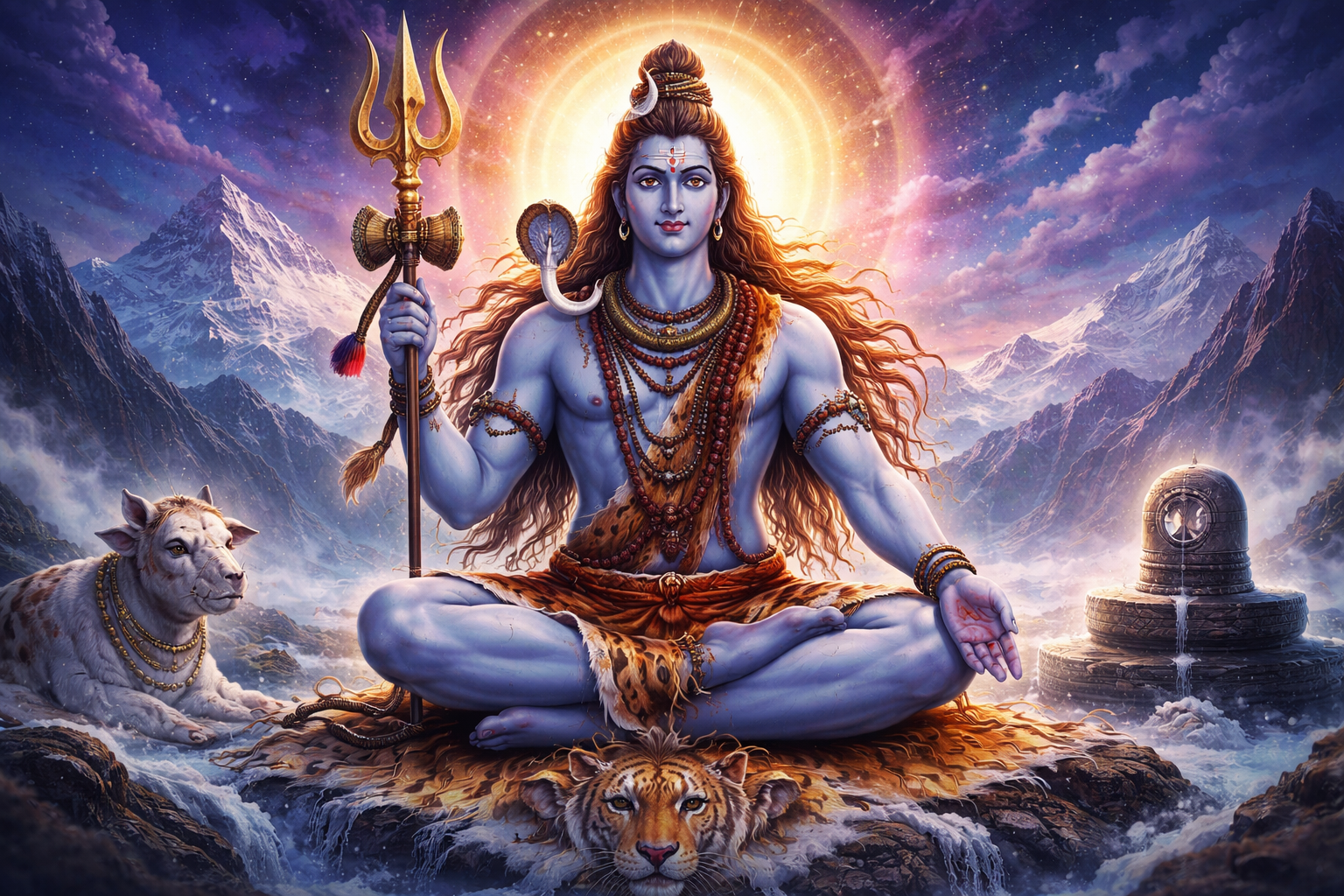
Bhagwan Shiva – The Supreme Consciousness of the Universe
Thank you for reading this post, don’t forget to subscribe!In the vast spiritual tradition of Sanatan Dharma, Shiva stands as the embodiment of supreme consciousness, transformation, destruction, meditation, and eternal truth. Known as the most mysterious and compassionate among the deities, Shiva is worshipped not merely as a god, but as the ultimate reality — the cosmic force that creates, sustains, and dissolves the universe.
He is not confined to palaces or ornaments; instead, he dwells in the silence of the Himalayas, smeared in ash, adorned with serpents, holding a trident, and immersed in meditation. His simplicity reflects the highest spiritual truth — detachment from material illusions.
Historical and Scriptural Origins of Lord Shiva
The roots of Shiva worship trace back to ancient times. References to a proto-Shiva figure are often associated with the Indus Valley Civilization’s “Pashupati Seal.” In the Vedic literature, especially the Rigveda, the deity Rudra is mentioned — a fierce yet benevolent god. Over time, Rudra evolved into Shiva, the auspicious one.
Major scriptures that describe Shiva include:
- Shiva Purana
- Linga Purana
- Skanda Purana
- Mahabharata
These texts elaborate on his cosmic roles, divine marriage to Parvati, fatherhood of Ganesha and Kartikeya, and his role in maintaining universal balance.
Why Is Shiva Called Mahadev?
The name Mahadev means “The Greatest God” (Maha = great, Dev = God). Shiva is called Mahadev because:
- He is supreme among the Trimurti — Brahma (creator), Vishnu (preserver), and Shiva (destroyer).
- Even other gods worship him for blessings.
- He represents the ultimate reality beyond birth and death.
- In many legends, he grants boons even to demons, showing impartial compassion.
In the famous story of Samudra Manthan, when poison (Halahala) emerged threatening the universe, Shiva consumed it to save creation, earning the name Neelkanth (the blue-throated one). This sacrifice elevated him as Mahadev — protector of all beings.
Why Is Shiva Called Adidev?
The term Adidev means “The First God” (Adi = first, Dev = God).
According to Puranic traditions:
- Shiva existed before creation.
- He is self-manifested (Swayambhu).
- The Shiva Linga symbolizes infinite cosmic energy without beginning or end.
One famous legend describes a dispute between Brahma and Vishnu regarding supremacy. Suddenly, an endless pillar of light appeared — the Jyotirlinga. Neither could find its beginning or end. That infinite light was Shiva — the Adidev, beyond time and space.
Various Names of Lord Shiva and Their Meanings
Shiva is known by 108 names, each representing a divine quality.
1. Shankar – The giver of auspiciousness
2. Mahadev – The greatest god
3. Adidev – The primordial deity
4. Neelkanth – The blue-throated one
5. Pashupati – Lord of all living beings
6. Nataraja – The cosmic dancer
7. Bholenath – The innocent and kind-hearted lord
8. Rudra – The fierce form
9. Ardhanarishvara – Half male, half female form
10. Mahakaal – The lord of time
The form of Nataraja symbolizes the cosmic cycle of creation and destruction through divine dance.
The form of Ardhanarishvara represents the perfect balance of masculine and feminine energies in the universe.
Symbolism of Lord Shiva
Shiva’s appearance carries deep philosophical meaning:
- Third Eye – Wisdom beyond physical sight
- Trishul (Trident) – Control over past, present, and future
- Damru (Drum) – Sound of cosmic creation
- Crescent Moon – Control over time
- River Ganga in hair – Flow of divine knowledge
- Snake around neck – Mastery over fear and death
- Ash-covered body – Impermanence of material life
Powerful Sanskrit Mantras and Shlokas Dedicated to Lord Shiva
1. Maha Mrityunjaya Mantra
ॐ त्र्यम्बकं यजामहे सुगन्धिं पुष्टिवर्धनम्।
उर्वारुकमिव बन्धनान् मृत्योर्मुक्षीय मामृतात्॥
Meaning: We worship the three-eyed Lord Shiva who nourishes and sustains all beings. May he liberate us from death and grant immortality.
2. Panchakshari Mantra
ॐ नमः शिवाय॥
Meaning: I bow to Lord Shiva.
This is the most powerful and widely chanted mantra in Shaivism.
3. Shiva Tandava Stotram (Excerpt)
जटाटवीगलज्जलप्रवाहपावितस्थले
गलेऽवलम्ब्य लम्बितां भुजंगतुंगमालिकाम्॥
This powerful hymn describes Shiva’s cosmic dance and divine grandeur.
Shiva in Festivals and Devotion
The grand festival of Maha Shivaratri is dedicated to Lord Shiva. Devotees fast, chant mantras, and perform night-long worship seeking spiritual awakening.
In India, the sacred twelve Jyotirlingas represent Shiva’s divine presence across the land.
Philosophical Significance of Shiva
Shiva is not merely a deity but a philosophy:
- He represents detachment amidst chaos.
- He teaches that destruction is necessary for renewal.
- He symbolizes meditation and inner awakening.
- He accepts all beings — gods, humans, animals, even demons.
Shiva’s life teaches simplicity, equality, compassion, and transcendence beyond ego.
Why Lord Shiva Is Universally Loved
Unlike other deities associated with royal grandeur, Shiva appears as a simple ascetic. His accessibility to common people, his compassion, and his readiness to grant blessings without discrimination make him “Bholenath” — the innocent Lord.
He is the god of yogis, dancers, warriors, householders, and seekers alike.
Conclusion: Shiva – The Infinite Within Us
Bhagwan Shiva is not just worshipped in temples; he resides in the consciousness of devotees. As Mahadev, he is the greatest; as Adidev, he is the origin; as Shankar, he is the auspicious; as Mahakaal, he is time itself.
To worship Shiva is to embrace truth, simplicity, courage, and inner awakening.
Let us conclude with the sacred chant:
हर हर महादेव!
May the blessings of Mahadev guide humanity toward peace, wisdom, and spiritual liberation.
Leave a Reply