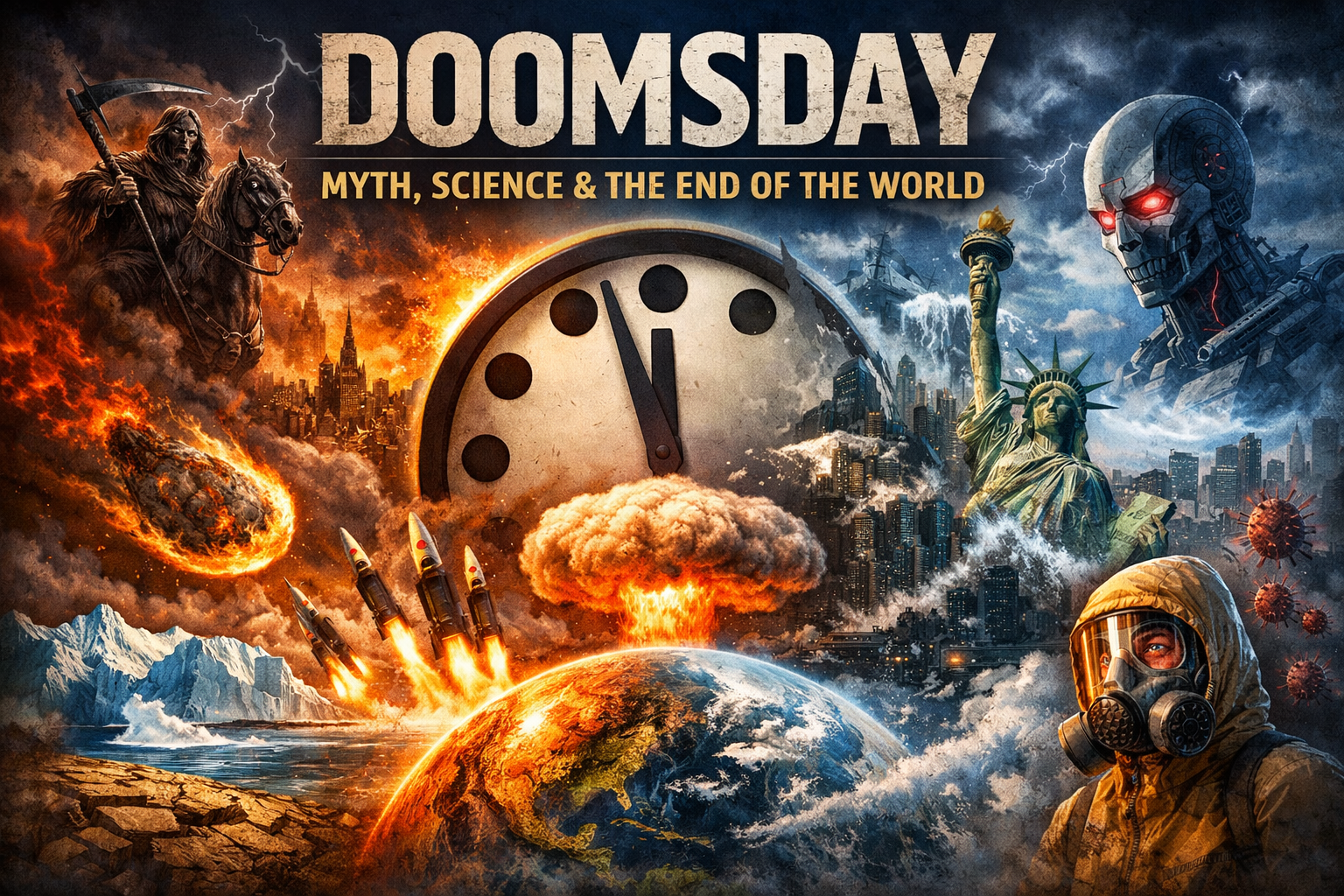
Introduction: Why Are We So Fascinated by Doomsday?
Thank you for reading this post, don’t forget to subscribe!From ancient scriptures to modern nuclear clocks, the idea of Doomsday—the ultimate end of human civilization—has haunted human imagination for thousands of years. Whether portrayed as divine judgment, cosmic catastrophe, or human-made disaster, Doomsday reflects our deepest fears, moral anxieties, and survival instincts.
But what exactly is Doomsday? Is it a religious prophecy, a scientific possibility, or a psychological construct shaped by uncertainty and fear?
This blog explores all dimensions of Doomsday—its origins, meanings, importance, modern interpretations, and why it continues to dominate global discourse.
What Is Doomsday?
Doomsday refers to a hypothetical or foretold moment when the world—or human civilization—faces complete destruction, irreversible collapse, or final judgment.
Broadly, Doomsday can mean:
- The end of humanity
- The collapse of civilization
- Divine judgment day
- An existential catastrophe
The term combines:
- “Doom” (fate, judgment, destruction)
- “Day” (a decisive moment)
The Story Behind Doomsday: Historical & Religious Origins
1. Doomsday in Ancient Religions
Christianity
- Known as Judgment Day
- Christ returns to judge the living and the dead
- Souls are sent to Heaven or Hell
- Mentioned in the Book of Revelation
Islam
- Called Qiyamah
- The universe collapses
- Resurrection and divine judgment follow
- Signs include moral decay, wars, natural disasters
Hinduism
- Linked to the end of Kali Yuga
- Moral collapse leads to destruction
- Lord Kalki restores dharma
- Universe goes through cycles, not permanent end
Buddhism
- No final apocalypse
- World undergoes continuous cycles of creation and destruction
2. Doomsday in Mythology & Ancient Cultures
- Norse Mythology: Ragnarök—battle of gods, fire, floods
- Mayan Civilization: Misinterpreted 2012 calendar “end”
- Zoroastrianism: Cosmic battle between good and evil
These stories often served as moral warnings, not literal predictions.
Scientific Interpretations of Doomsday
Unlike religious narratives, science discusses Doomsday as existential risk.
Major Scientific Doomsday Scenarios
1. Asteroid Impact
- Similar to the dinosaur extinction
- NASA actively tracks Near-Earth Objects (NEOs)
2. Nuclear War
- Global annihilation within hours
- Nuclear winter could destroy agriculture
3. Climate Collapse
- Extreme heat, sea-level rise
- Mass extinction and food crises
4. Artificial Intelligence
- Uncontrolled superintelligence
- Loss of human control systems
5. Pandemics
- Engineered or natural super-viruses
- Lessons from COVID-19 remain relevant
The Doomsday Clock: A Modern Symbol
The Doomsday Clock, created in 1947 by the Bulletin of the Atomic Scientists, symbolizes how close humanity is to self-destruction.
- Midnight = global catastrophe
- Factors include:
- Nuclear weapons
- Climate change
- AI risks
- Geopolitical instability
The closer the clock is to midnight, the greater the risk.
Why Is Doomsday Important?
1. Moral Warning
- Encourages ethical behaviour
- Reminds humanity of consequences
2. Policy & Governance
- Influences climate policy
- Nuclear arms control treaties
3. Scientific Preparedness
- Disaster management
- Space defence programs
4. Psychological Reflection
- Human fear of mortality
- Collective anxiety during crises
Doomsday in Popular Culture
Movies, books, and series amplify Doomsday fears:
- 2012
- Don’t Look Up
- Mad Max
- The Day After Tomorrow
- Interstellar
These stories:
- Reflect current anxieties
- Critique political inaction
- Highlight human resilience
Doomsday in Modern Discourse
Today, Doomsday is no longer just religious—it is scientific, political, and social.
In Media
- Climate headlines
- Nuclear war warnings
- AI takeover fears
In Politics
- Used to justify emergency powers
- Drives international negotiations
In Society
- Rise of “prepper” culture
- Survivalism and bunkers
- Mental health impacts
Is Doomsday Inevitable?
Most scientists agree:
Doomsday is possible—but not inevitable.
Human actions determine outcomes.
- Cooperation can delay catastrophe
- Innovation can reduce risks
- Awareness can drive responsibility
Doomsday narratives exist not to predict the end—but to prevent it.
Conclusion: Doomsday as a Mirror of Humanity
Doomsday is less about the end of the world and more about how we live before it.
It reflects:
- Our fears
- Our failures
- Our hope for redemption
Whether myth or science, Doomsday urges humanity to act wisely—because the future is still in our hands.
Leave a Reply