Blog

  • The Complete Guide to Vitamins: Deficiency Diseases, Symptoms & Natural Sources

    The Complete Guide to Vitamins: Deficiency Diseases, Symptoms & Natural Sources

    In the world of health and wellness, vitamins play the role of invisible superheroes. Though required in small amounts, they are essential for immunity, growth, energy production, mental health, and overall well-being. Unfortunately, vitamin deficiencies are more common than we think and can lead to serious health issues if ignored.

    This blog explores each essential vitamin, the deficiency diseases, symptoms, and natural remedies/sources—all in a practical way for modern readers.

    What are Vitamins?

    Vitamins are organic compounds that our body cannot produce sufficiently on its own. They regulate biochemical reactions, maintain immunity, and help prevent chronic diseases.

    They are classified into two groups:

    • Fat-soluble vitamins (A, D, E, K): Stored in the liver and fatty tissues.
    • Water-soluble vitamins (B-complex & C): Not stored for long; need daily intake.

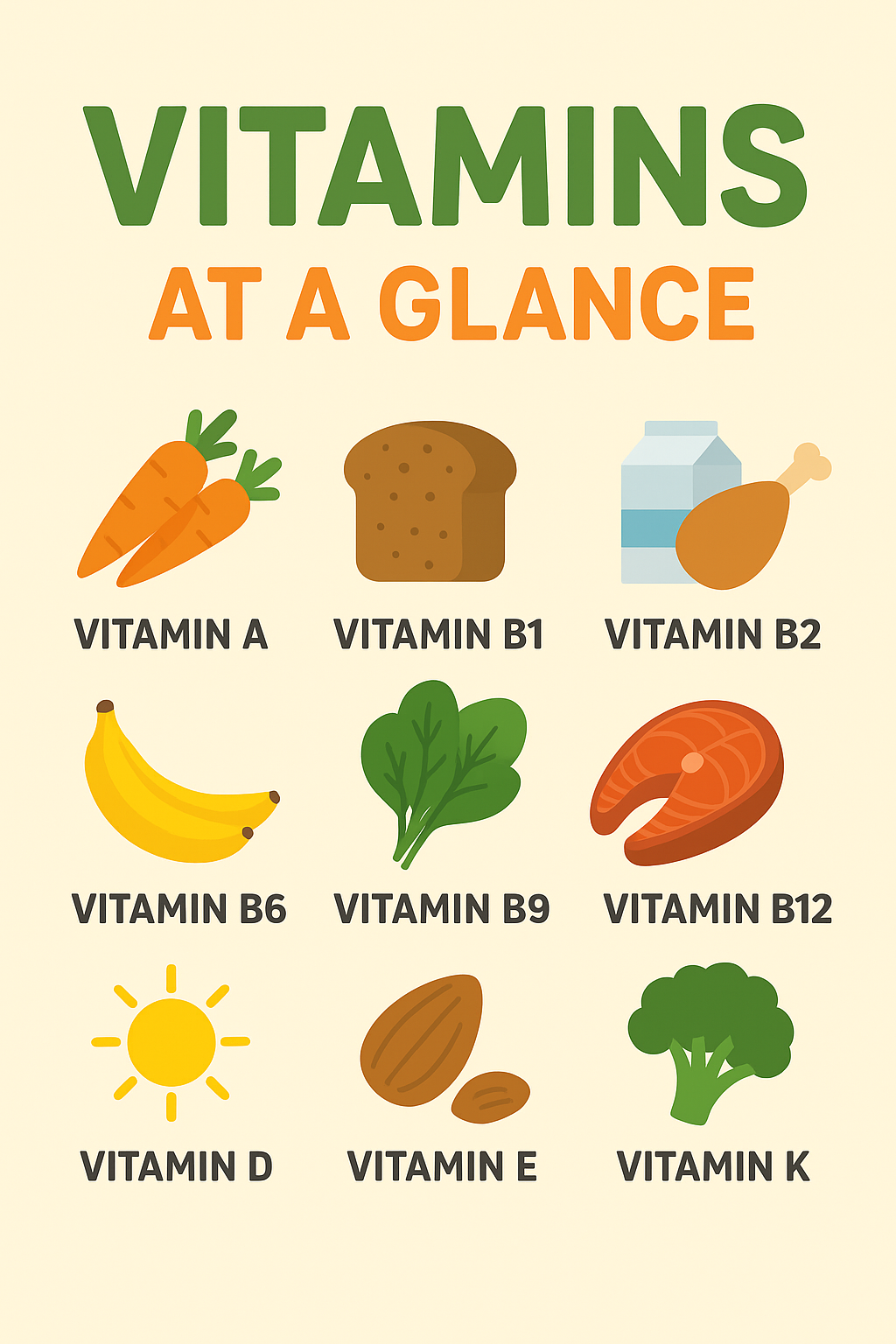
    List of Vitamins, Deficiency Diseases, Symptoms & Sources

    1. Vitamin A (Retinol)

    • Functions: Healthy vision, immune system, skin health.
    • Deficiency Disease: Night blindness, xerophthalmia.
    • Symptoms: Poor vision in dim light, dry eyes, skin issues.
    • Sources: Carrots, spinach, sweet potatoes, papaya, fish liver oil, dairy.

    2. Vitamin B1 (Thiamine)

    • Functions: Converts food into energy, supports nerves & muscles.
    • Deficiency Disease: Beriberi, Wernicke-Korsakoff syndrome.
    • Symptoms: Fatigue, irritability, muscle weakness, nerve damage.
    • Sources: Whole grains, nuts, pork, sunflower seeds, legumes.

    3. Vitamin B2 (Riboflavin)

    • Functions: Energy production, skin and eye health.
    • Deficiency Disease: Ariboflavinosis.
    • Symptoms: Cracks at mouth corners, sore throat, skin inflammation.
    • Sources: Milk, eggs, almonds, green leafy vegetables, mushrooms.

    4. Vitamin B3 (Niacin)

    • Functions: Metabolism, DNA repair, skin health.
    • Deficiency Disease: Pellagra.
    • Symptoms: Diarrhea, dermatitis, dementia (3 Ds).
    • Sources: Chicken, peanuts, fish, mushrooms, whole grains.

    5. Vitamin B5 (Pantothenic Acid)

    • Functions: Hormone and energy production.
    • Deficiency: Rare but may cause fatigue, irritability, numbness.
    • Sources: Avocado, eggs, broccoli, chicken, sunflower seeds.

    6. Vitamin B6 (Pyridoxine)

    • Functions: Brain function, haemoglobin formation.
    • Deficiency Disease: Anaemia, seizures (in severe cases).
    • Symptoms: Depression, confusion, skin rashes.
    • Sources: Bananas, chickpeas, salmon, potatoes, poultry.

    7. Vitamin B7 (Biotin)

    • Functions: Hair, skin, nail health, energy metabolism.
    • Deficiency Disease: Dermatitis, brittle nails, hair loss.
    • Symptoms: Fatigue, thinning hair, skin rashes.
    • Sources: Eggs, almonds, walnuts, cauliflower, soybeans.

    8. Vitamin B9 (Folic Acid/Folate)

    • Functions: DNA synthesis, cell growth, prevents birth defects.
    • Deficiency Disease: Megaloblastic anaemia, neural tube defects in babies.
    • Symptoms: Weakness, fatigue, poor memory, birth complications.
    • Sources: Spinach, lentils, oranges, asparagus, fortified cereals.

    9. Vitamin B12 (Cobalamin)

    • Functions: Nerve health, red blood cell formation.
    • Deficiency Disease: Pernicious anaemia.
    • Symptoms: Fatigue, memory issues, tingling in hands/feet.
    • Sources: Meat, fish, eggs, dairy (vegans may need supplements).

    10. Vitamin C (Ascorbic Acid)

    • Functions: Immunity, collagen formation, iron absorption.
    • Deficiency Disease: Scurvy.
    • Symptoms: Bleeding gums, weak immunity, joint pain.
    • Sources: Oranges, lemon, guava, kiwi, bell peppers, strawberries.

    11. Vitamin D (Calciferol)

    • Functions: Strong bones, calcium absorption, immunity.
    • Deficiency Disease: Rickets (children), Osteomalacia (adults).
    • Symptoms: Weak bones, frequent fractures, fatigue.
    • Sources: Sunlight, fortified milk, mushrooms, fatty fish, egg yolk.

    12. Vitamin E (Tocopherol)

    • Functions: Antioxidant, skin & heart health.
    • Deficiency Disease: Rare, but may cause nerve and muscle damage.
    • Symptoms: Weak immunity, muscle weakness, vision problems.
    • Sources: Almonds, sunflower seeds, olive oil, spinach.

    13. Vitamin K

    • Functions: Blood clotting, bone health.
    • Deficiency Disease: Excessive bleeding disorders.
    • Symptoms: Easy bruising, heavy bleeding from wounds.
    • Sources: Green leafy vegetables, broccoli, soybean oil, cabbage.

    Quick Reference Table of Vitamin Deficiencies

    VitaminDeficiency DiseaseMajor SymptomsKey Sources
    ANight BlindnessPoor vision, dry eyesCarrots, fish oil
    B1BeriberiWeakness, nerve damageWhole grains
    B2AriboflavinosisMouth cracks, sore throatMilk, eggs
    B3PellagraDiarrhea, dermatitis, dementiaChicken, peanuts
    B6AnaemiaDepression, skin rashesBananas, salmon
    B9Megaloblastic AnaemiaFatigue, birth defectsSpinach, lentils
    B12Pernicious AnaemiaTingling, memory lossMeat, dairy
    CScurvyBleeding gums, weak immunityCitrus fruits
    DRickets/OsteomalaciaWeak bonesSunlight, fish
    ENeuromuscular issuesWeakness, vision problemsAlmonds, oils
    KBleeding disordersEasy bruisingGreen veggies

    How to Prevent Vitamin Deficiency?

    1. Eat a balanced diet: Include colourful fruits, vegetables, grains, dairy, and protein.
    2. Rely on natural sunlight: 15–20 mins/day for Vitamin D.
    3. Choose fortified foods: Cereals, milk, and bread enriched with vitamins.
    4. Avoid crash diets: They often lead to hidden deficiencies.
    5. Consult a doctor before supplements: Overdose of fat-soluble vitamins (A, D, E, K) can be harmful.

    Final Thoughts

    In today’s fast-paced lifestyle, micronutrient deficiencies are silently growing. Being aware of vitamin needs, early deficiency symptoms, and natural remedies is the first step toward long-term wellness. Remember, vitamins are not optional—they are life essentials.

    If you often feel tired, weak, or face unusual symptoms, don’t ignore them. Your body might be calling for its vital nutrients. A balanced diet, a healthy routine, and timely check-ups can keep you vitamin-rich and disease-free.

  • Assets vs Liabilities: The Wealth Creation Mindset Everyone Needs

    Assets vs Liabilities: The Wealth Creation Mindset Everyone Needs

    “The rich buy assets. The poor only have expenses. The middle class buys liabilities they think are assets.”

    — Robert Kiyosaki

    When it comes to money, most people work harder but don’t necessarily get richer. Why? Because wealth isn’t built just by earning more — it’s built by understanding how money works, especially the difference between assets and liabilities.

    This blog will walk you through the real meaning of assets and liabilities, how they shape your financial life, and the ultimate strategy to create lasting wealth. Whether you’re a student, a salaried professional, or a budding entrepreneur, this could be your roadmap to financial freedom.

    Understanding Assets and Liabilities

    What Are Assets?

    Assets are things that put money into your pocket — now or in the future.

    They can be:

    • Cash-generating investments (stocks, bonds, mutual funds)
    • Rental properties
    • Digital assets (websites, eBooks, online courses)
    • Businesses
    • Intellectual property (patents, trademarks)

    Even skills and education can be intangible assets, as they increase your earning potential over time.

    What Are Liabilities?

    Liabilities are things that take money out of your pocket, even if they look good on the outside.

    Examples include:

    • Car loans
    • Credit card debt
    • EMI-heavy homes that don’t generate rental income
    • Luxury purchases bought on borrowed money

    The biggest trap? Many liabilities are disguised as assets — like a fancy car or a huge house that bleeds money for maintenance and interest payments.

    Key Difference: It’s About Cash Flow, Not Appearance

    AspectAssetLiability
    Cash FlowBrings money inTakes money out
    Financial OutcomeBuilds wealth over timeReduces net worth
    Common ExamplesInvestments, rental propertyLoans, credit card debt
    Wealth CreationYESNO (unless managed carefully)

    Why Most People Stay Broke (Financial Trap Alert)

    Most people fall into the consumer mindset, not the investor mindset.

    They earn money → spend on lifestyle upgrades → get into debt → work harder to repay → repeat.

    This paycheck-to-paycheck cycle continues endlessly. The real shift happens when you start using your money to buy assets first and let those assets pay for your lifestyle.

    How to Create Wealth: 7 Actionable Steps

    1. Track Your Personal Balance Sheet

    “You can’t improve what you don’t measure.”

    Make a list of all your assets and liabilities. Net worth = Total Assets – Total Liabilities. This is your starting point.

    2. Increase Your Financial IQ

    Read books like:

    • Rich Dad Poor Dad by Robert Kiyosaki
    • The Intelligent Investor by Benjamin Graham
    • Your Money or Your Life by Vicki Robin

    Understanding how money works is more powerful than chasing a promotion.

    3. Start Investing Early

    • Use SIPs (Systematic Investment Plans)
    • Buy Index Funds or ETFs
    • Invest in real estate if feasible
    • Explore peer-to-peer lending or REITs

    Even small investments snowball over time with compounding.

    4. Create Passive Income Streams

    Passive income is the real game-changer. Some ideas:

    • Write an eBook
    • Start a YouTube channel or blog
    • Build a dropshipping store
    • Rent out unused space
    • Monetize a skill via courses

    5. Limit Bad Debt

    Not all debt is bad. If you’re borrowing to build a cash-generating asset (like a business or rental property), that can be considered “good debt.” But avoid debt for consumption — it’s the fastest way to stay poor.

    6. Automate Savings & Investments

    Make your wealth-building process automatic:

    • Auto-debit for SIPs
    • Set reminders for financial reviews
    • Use budgeting apps (like YNAB, PocketGuard, or Walnut)

    7. Reinvest Profits, Not Just Spend

    Every time your asset generates income, reinvest it to buy more assets. That’s how the rich get richer — they don’t just earn, they multiply.

    Real-Life Case Study: From Liability to Asset

    Meet Ramesh, a 30-year-old salaried employee.

    • Bought a car on loan = Liability
    • Took a 3BHK on EMI = Liability (no rental income)
    • No investments = No assets

    3 years later, after learning about assets:

    • He rented out a part of his flat = turns into an asset
    • Bought index funds worth ₹5,000/month = asset
    • Created a YouTube channel on tech reviews = growing passive income

    His financial graph is now upward.

    Common Myths to Avoid

    • My house is my biggest asset — Not unless it earns you money or appreciates beyond inflation.
    • High income means wealth — No, high income with high expenses is still broke.
    • Debt is always bad — Strategic debt can be wealth-building.
    • Investing is risky — Not investing is riskier due to inflation.

    The Wealth Creation Mindset

    It’s not about how much you earn, but what you do with what you earn.

    The Rich:

    • Buy assets first
    • Spend on needs, not wants
    • Focus on long-term value, not instant gratification

    The Poor/Middle Class:

    • Buy liabilities thinking they’re assets
    • Spend first, invest later (if at all)
    • Seek security, not growth

    Change your mindset, and you change your life.

    Final Words: Start Small, Think Big, Stay Consistent

    You don’t need to be born rich to build wealth. You just need to understand the game, start small, and stay consistent. Track your cash flow. Prioritize assets. Cut down on liabilities. And most importantly, invest in yourself.

    “Your money should work for you, not the other way around.”

    Let today be the day you move from being a spender to an investor. The journey to financial freedom starts with your next money decision.

  • Robotics and Robots in 2025 and Beyond

    Robotics and Robots in 2025 and Beyond

    Introduction

    What are Robots and Robotics?

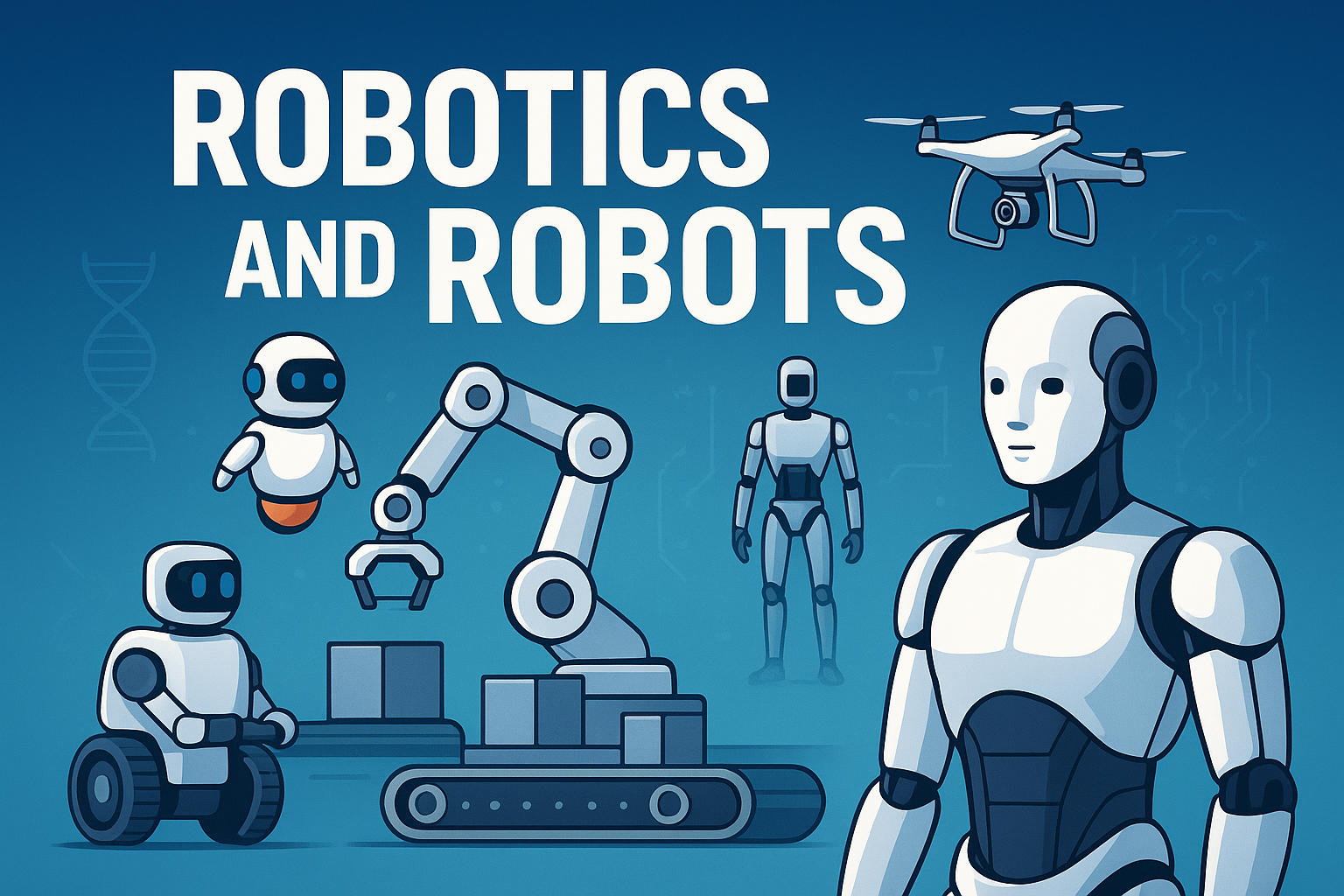
    Robotics is an interdisciplinary branch of science and engineering focused on the design, construction, operation, and use of robots. A robot is a programmable machine capable of carrying out a series of actions autonomously or semi-autonomously.

    From industrial automation to AI-driven humanoids, robotics has evolved into a transformative force across nearly every industry in 2025.

    Types of Robots in 2025

    1. Industrial Robots – Used in manufacturing for tasks like welding, painting, assembly (e.g., ABB, FANUC).
    2. Service Robots – Assist in tasks like cleaning, delivery, and security (e.g., Roomba, Knightscope).
    3. Medical Robots – Used in surgery, rehabilitation, and diagnostics (e.g., Da Vinci Surgical System).
    4. Humanoid Robots – Designed to look and act like humans (e.g., Tesla Optimus, Sophia by Hanson Robotics).
    5. Military & Defense Robots – Used for surveillance, bomb disposal, and combat (e.g., Ghost Robotics).
    6. Agricultural Robots (AgriBots) – Automate planting, irrigation, and harvesting (e.g., Agrobot).
    7. Autonomous Vehicles & Drones – Self-driving cars and delivery drones (e.g., Waymo, Zipline).

    Applications of Robotics in 2025

    SectorRobotic Application
    HealthcareSurgical assistance, elderly care, rehabilitation
    ManufacturingPrecision assembly, quality control, welding
    Retail & DeliveryInventory management, autonomous deliveries
    AgriculturePrecision farming, soil analysis, crop harvesting
    Military & DefenceSurveillance, mine clearance, weapon handling
    EducationRobot-assisted learning, AI tutors
    HospitalityAutomated room service, customer interaction
    Home AutomationCleaning robots, personal assistants

    The Future of Robotics: 2025 and Beyond

    Key Trends Shaping the Future:

    1. AI-Powered Robots

    Robots integrated with generative AI and machine learning will improve real-time decision-making and natural language communication.

    1. Humanoid Robots for Everyday Use

    Tesla’s Optimus robot aims to become a household assistant by 2026, capable of performing tasks like cooking, cleaning, and companionship.

    1. Swarm Robotics

    Inspired by ant colonies, swarm robots are being used in search and rescue, surveillance, and disaster response.

    1. Robots with Emotion and Empathy

    Emotional AI will allow robots to recognize and respond to human feelings — advancing elder care and mental health applications.

    1. Flexible, Soft, and Bio-Inspired Robotics

    Robots made of soft materials can navigate complex environments and work alongside humans more safely.

    1. Human-Robot Collaboration (Cobots)

    Collaborative robots will dominate industries where safety and precision matter, such as healthcare and logistics.

    Top Robotics Companies Leading in 2025

    Here are the leading robotics companies innovating across industries:

    CompanySpecialization
    Boston DynamicsHumanoid & quadruped robots like Atlas & Spot
    TeslaOptimus humanoid robot for general-purpose tasks
    NVIDIAAI chips & robotics simulation platforms
    ABB RoboticsIndustrial automation & robotics
    FANUCFactory robots and CNC systems
    KUKA RoboticsAdvanced industrial robots
    Hanson RoboticsSocial robots like Sophia
    iRobot (by Amazon)Home cleaning robots like Roomba
    UBTECH RoboticsEducational and humanoid robots
    DJIDrones and aerial robotics
    AgrobotAgricultural automation robots
    OpenAI + 1X RoboticsAI-powered robotics (neo-humanoid project)

    Robotics in India: Growing Tech Landscape

    India is rapidly becoming a robotics innovation hub in 2025, with initiatives under Make in India, Startup India, and PLI schemes promoting robotics startups like:

    • Asimov Robotics
    • GreyOrange
    • Addverb Technologies
    • Gridbots

    Skills & Careers in Robotics

    In 2025, robotics offers lucrative careers across:

    • Robotics Engineering
    • AI and Machine Learning
    • Mechatronics
    • Embedded Systems
    • Human-Robot Interaction (HRI)
    • Ethical and Regulatory Tech Law

    Global Market Forecast for Robotics

    • By 2030, the global robotics market is projected to exceed $250 billion.
    • Demand for robotics engineers and AI specialists will grow by 35–40% globally by 2030 (World Economic Forum 2024).

    Ethical & Regulatory Challenges

    • Job Displacement – How will robots impact employment?
    • AI Control – Can we trust autonomous decision-making?
    • Data Privacy – Who owns the data robots collect?
    • Regulation – Global standards for safety, ethics, and liability are still evolving.

    Conclusion

    Robots Are the Future

    From smart assistants at home to advanced machines in industries, robots are transforming the world. As AI integration, mobility, and empathy in robots increase, we’re entering a future where humans and robots will co-exist and collaborate.

    Whether you’re a tech enthusiast, investor, or student — robotics is the future you can’t ignore.

    FAQs on Robotics (2025)

    Q1. What are the top 3 robotics companies in 2025?

    Tesla, Boston Dynamics, and ABB Robotics lead the field with innovations in humanoid and industrial robots.

    Q2. Are robots replacing human jobs?

    They are automating repetitive tasks, but also creating new jobs in tech, programming, and robot maintenance.

    Q3. What is the future of humanoid robots?

    Humanoid robots like Tesla Optimus are expected to become common in homes, healthcare, and public spaces by 2030.

    Q4. Is robotics a good career in 2025?

    Absolutely. Robotics is among the fastest-growing fields with opportunities in AI, engineering, design, and research.

  • Causes of disintegration of the USSR

    Causes of disintegration of the USSR

    Introduction

    The collapse of the Union of Soviet Socialist Republics (USSR) in 1991 marked one of the most significant turning points in modern world history. It not only ended the Cold War era but also led to the birth of 15 independent countries and the formation of the Commonwealth of Independent States (CIS). The causes of the Soviet Union’s disintegration were deep-rooted and multifaceted, spanning political, economic, ideological, and international dimensions.

    Background: What Was the USSR?

    The USSR, or the Soviet Union, was officially formed in 1922, after the Bolshevik Revolution of 1917. It was a union of multiple Soviet republics, governed by a single-party communist system under the control of the Communist Party of the Soviet Union (CPSU). Stretching across Europe and Asia, it became a global superpower after World War II and was the main ideological and political rival of the United States during the Cold War.

    Major Causes of USSR Disintegration

    1. Economic Stagnation

    • The Soviet economy was highly centralized and planned, which led to inefficiencies and a lack of innovation.
    • Agricultural and industrial productivity declined.
    • Chronic shortages of consumer goods and poor living standards were widespread.
    • Heavy military spending during the Cold War drained economic resources.

    2. Political Rigidity and Corruption

    • The Communist Party’s monopoly on power led to authoritarian rule, lack of transparency, and resistance to reform.
    • Corruption was rampant within the party ranks.
    • Leadership transitions (e.g., from Brezhnev to Andropov to Chernenko) brought little change until Mikhail Gorbachev came to power in 1985.

    3. Gorbachev’s Reforms (Perestroika & Glasnost)

    • Perestroika (restructuring): Introduced limited market mechanisms into the economy but created confusion and disruption instead of revival.
    • Glasnost (openness): Encouraged freedom of speech and criticism of the government, which unleashed a flood of suppressed discontent.

    4. Rise of Nationalism and Ethnic Conflicts

    • The USSR consisted of over 100 ethnic groups and 15 republics.
    • Glasnost allowed these suppressed ethnic tensions and nationalist movements to surface.
    • Republics like Lithuania, Latvia, Estonia, Ukraine, and Georgia began demanding independence.

    5. Loss of Ideological Legitimacy

    • Marxist-Leninist ideology lost its appeal, especially among youth and intellectuals.
    • Comparisons with Western prosperity made people question the Soviet model.

    6. Afghan War (1979–1989)

    • The USSR’s prolonged war in Afghanistan drained its military and financial resources.
    • It became known as “Russia’s Vietnam”, demoralizing both the army and public.

    7. External Pressures from the Cold War

    • The US, under Ronald Reagan, adopted an aggressive policy of military buildup and strategic defence.
    • Economic competition with the West, trade embargoes, and a technological gap weakened Soviet influence.

    The Cold War and Its Role in the Disintegration

    The Cold War (1947–1991) was a geopolitical and ideological struggle between the United States and the USSR. Though it never led to direct military conflict, it caused:

    • Arms race and space race, putting immense economic pressure on the USSR.
    • Global proxy wars in Korea, Vietnam, Afghanistan, and Africa.
    • Formation of NATO and Warsaw Pact, dividing the world into two ideological blocs.

    By the 1980s, the Soviet economy could not keep pace with Western capitalism. Internal dissatisfaction, external isolation, and the burden of military overreach led to the Soviet Union’s weakening position globally.

    Immediate Events Leading to Disintegration

    • In March 1991, a referendum showed most citizens wanted to preserve the USSR in a reformed form.
    • However, in August 1991, hardliners staged a failed coup against Gorbachev, accelerating the collapse.
    • Republics began declaring independence one after another.

    Official Dissolution

    • On December 25, 1991, Mikhail Gorbachev resigned as President of the USSR.
    • On December 26, 1991, the Supreme Soviet formally dissolved the Soviet Union.

    Formation of the Commonwealth of Independent States (CIS)

    What is the CIS?

    The Commonwealth of Independent States (CIS) was formed as a successor alliance to the USSR.

    • On December 8, 1991, the leaders of Russia, Ukraine, and Belarus signed the Belavezha Accords, declaring the USSR dissolved and forming the CIS.
    • Later, 12 former Soviet republics joined the CIS as members (excluding the Baltic states).

    Members (Original & Current)

    • Original members: Russia, Ukraine, Belarus, Kazakhstan, Kyrgyzstan, Armenia, Azerbaijan, Moldova, Uzbekistan, Turkmenistan, Tajikistan, Georgia (later withdrew).
    • The Baltic StatesEstonia, Latvia, and Lithuania—never joined.

    Purpose of CIS

    • To facilitate peaceful cooperation and transition.
    • Maintain economic ties.
    • Avoid chaos during the transition from a centralized Soviet structure to independent nations.

    However, the CIS has remained largely symbolic and fragmented, lacking real power or unity. Many member states later pursued closer ties with the West or China.

    Aftermath: Impact on the World Order

    • The USA emerged as the sole superpower, marking the beginning of the Unipolar World.
    • Former USSR states underwent political and economic transitions with varying success.
    • Russia struggled in the 1990s but later reasserted itself under Vladimir Putin.
    • New regional conflicts emerged (e.g., Chechnya, Nagorno-Karabakh, Donbas).
    • NATO and EU expanded eastward, increasing tensions with Russia.

    Conclusion

    The disintegration of the USSR was not the result of a single event but the culmination of decades of systemic failure, economic crisis, leadership challenges, and global pressures. The Cold War’s long ideological and military confrontation pushed the Soviet Union to the brink. The formation of the CIS was an attempt to manage this historic rupture peacefully, but it could not replace the unifying ideology and power structure of the USSR.

    The collapse of the USSR reshaped global geopolitics, ending the bipolar world and triggering a cascade of reforms, conflicts, and alliances that continue to influence world affairs to this day.

  • Understanding the Indian Monsoon: Rainfall,& the Science of Cloudbursts

    Understanding the Indian Monsoon: Rainfall,& the Science of Cloudbursts

    Introduction

    Why Indian Monsoon Matters

    The Indian monsoon is not merely a weather event—it’s the heartbeat of the subcontinent. From replenishing water bodies to sustaining crops, it impacts 70% of agriculture, millions of livelihoods, and even stock market trends.

    But beyond rainfall, the Indian monsoon is also a story of cloudbursts, climate change, satellite science, and human adaptation. This blog unpacks these layers and also offers interactive elements, case studies, expert views, and practical tips to make your understanding more well-rounded and engaging.

    What is a Monsoon?

    Derived from the Arabic word mausim (season), a monsoon scientifically refers to a seasonal reversal in wind direction, often bringing heavy rain.

    India’s monsoon has two phases:

    • Southwest Monsoon (June–September) – moist winds from the Indian Ocean bring rains to most of the country.
    • Northeast Monsoon (October–December) – dry winds reverse, bringing rain to parts of South India.

    The Science Behind the Indian Monsoon

    1. Pressure Systems

    Heat over the Thar Desert and Tibetan Plateau creates low pressure, attracting moist ocean winds which has high pressure.

    2. Jet Streams & ITCZ

    The Intertropical Convergence Zone (ITCZ) shifts north, and jet streams guide cloud movements.

    3. Orographic Influence

    Mountains like the Western Ghats and Himalayas force moisture-laden winds upward, cooling them into precipitation.

    Rainfall and Precipitation: The Core of the Monsoon

    Rainfall TypeMechanismRegions
    Orographic RainfallAir lifted by mountainsWestern Ghats, Himalayas
    Convectional RainfallHeating of land causes upward air movementCentral and Southern India
    Cyclonic RainfallInteraction of different air massesEastern coast, parts of Northern India

    Note: Precipitation includes all forms—rain, snow, hail—while rainfall refers only to liquid precipitation.

    Cloudbursts: Sudden and Devastating

    A cloudburst refers to intense rainfall—over 100 mm in one hour—in a localized area. This can lead to flash floods, landslides, and widespread destruction.

    Scientific Causes:

    • Formation of cumulonimbus clouds
    • Rapid uplift of warm moist air
    • Sudden condensation and localized downpour

    Real-Life Example:

    Case Study 1: In 2013, Kedarnath (Uttarakhand) experienced a cloudburst followed by devastating floods, resulting in thousands of deaths and massive destruction. The region’s topography and convective weather patterns made it highly vulnerable.

    Case Study 2: Harsil (Dharali) Cloudburst – Uttarakhand, August 2025

    On August 5, 2025, a cloudburst struck Dharali village near Harsil in Uttarkashi district, Uttarakhand. The intense, localized rainfall—exceeding 100 mm per hour—triggered a massive flash flood and mudslide along the Kheer Gad stream, sweeping away homes, buildings, and infrastructure in mere moments

    Monsoon and Climate Change: A Worrying Trend

    India’s monsoon is now more erratic and extreme:

    EffectImplication
    Delayed onset or retreatConfuses cropping schedules and water storage planning
    Uneven spatial rainfallFlood in one state, drought in another
    Rise in cloudbursts/extreme eventsHigh economic and human costs

    A Farmer’s Monsoon Diary

    For millions of Indian farmers, a “good monsoon” means food security and economic stability. But unpredictable rain patterns affect:

    • Sowing time of kharif crops like paddy and pulses
    • Yield loss due to unseasonal rain or dry spells
    • Livelihood stress, leading to migration or debt

    “The rains are too late this year. We couldn’t plant paddy on time,” says Ramesh, a small farmer from Vidarbha.

    Tracking the Monsoon: Science and Technology

    India has made significant progress in monitoring the monsoon using modern tools

    • ISRO Satellites: INSAT, Megha-Tropiques
    • Doppler Radars: For real-time storm tracking
    • Numerical Weather Prediction Models: Used by IMD for forecasting
    • AI & Machine Learning: For hyperlocal predictions and early warnings

    Monsoon Survival Tips

    Understanding the monsoon isn’t just for meteorologists—it’s also about staying safe and prepared. Here are some tips:

    • Ensure drainage systems around your home are clear.
    • Follow IMD alerts and district-level weather warnings.
    • Avoid traveling near hill slopes or rivers during heavy rain.
    • Collect and store rainwater using roof-based harvesting systems.
    • Educate children on flood safety and emergency protocols.

    Interactive Section: Test Your Monsoon IQ

    Quick Quiz:

    1. Which Indian state receives the highest annual rainfall?
    2. What is the minimum rainfall threshold to be considered a cloudburst?
    3. Which satellite is currently monitoring monsoon patterns?

    Conclusion: Prepare, Predict, Protect

    The Indian monsoon is a scientific marvel, a cultural phenomenon, and a climate challenge—all rolled into one. As it becomes more unpredictable under climate stress, scientific awareness and local preparedness are our strongest shields.

  • The Apple That Changed the World: Isaac Newton and the Law of Gravitation

    The Apple That Changed the World: Isaac Newton and the Law of Gravitation

    The Apple That Changed the World: Isaac Newton and the Law of Gravitation


    Introduction

    It’s one of the most iconic moments in the history of science — an apple falls from a tree, and a young man watching it suddenly conceives the idea of gravity. That young man was Sir Isaac Newton, and the story of the apple has become a symbol of genius, curiosity, and discovery.

    But what’s the truth behind this tale? How did Newton formulate the Law of Universal Gravitation, and why does it matter even today? Let’s dive into the story of Newton and the apple tree, separating myth from fact and exploring the profound scientific legacy he left behind.

    Who Was Isaac Newton?

    Sir Isaac Newton (1642–1727) was an English physicist, mathematician, astronomer, and philosopher. He is widely regarded as one of the most influential scientists of all time. His work laid the foundation for classical mechanics, optics, and calculus.

    Newton’s most famous work, “Philosophiæ Naturalis Principia Mathematica” (1687) — commonly known as the Principia — formulated the three laws of motion and the universal law of gravitation, revolutionizing the way humanity understands the natural world.

    The Apple Tree Story: Myth or Truth?

    The Legend

    According to popular legend, Newton was sitting under an apple tree when he saw an apple fall. This led him to wonder: “Why do apples always fall straight down? Why not sideways or upwards?” This question triggered a deeper inquiry into the forces of nature — ultimately leading him to the concept of gravity.

    The Historical Truth

    The story is not entirely a myth — Newton himself told the apple anecdote to several people, including William Stukeley, a close friend and biographer. In his 1752 memoir, Stukeley wrote:

    “After dinner, the weather being warm, we went into the garden, and drank tea under the shade of some apple trees… he told me he was just in the same situation as when formerly, the notion of gravitation came into his mind — occasion’d by the fall of an apple, as he sat in contemplative mood.”

    But did the apple actually fall on his head? Probably not. That part is almost certainly an exaggeration added later to dramatize the story.

    Newton’s Law of Universal Gravitation

    Newton’s apple-inspired insight led to one of the most fundamental laws in physics — the Law of Universal Gravitation, which states:

    “Every particle in the universe attracts every other particle with a force that is directly proportional to the product of their masses and inversely proportional to the square of the distance between them.”

    Mathematical Expression:

    F=Gm1⋅m2/r^2

    Where:

    • F = Gravitational force
    • G = Gravitational constant
    • m1and m2 = Masses of the two objects
    • r = Distance between the centres of the two masses

    Why Is This Law So Important?

    1. Explained Planetary Motion: Newton’s law helped explain Kepler’s Laws and showed how the same force that causes an apple to fall also keeps the Moon in orbit around Earth.
    2. Unified Physics: It unified the heavens and the earth under one law — a revolutionary idea in the 17th century.
    3. Foundation for Modern Science: It laid the groundwork for classical mechanics, influencing everything from space exploration to engineering.

    Newton’s Broader Scientific Legacy

    Beyond gravitation, Newton’s achievements include:

    • Three Laws of Motion (inertia, force = mass × acceleration, action-reaction)
    • Calculus (developed independently alongside Leibniz)
    • Optics (showed that white light is made of the colours of the spectrum)
    • Reflecting Telescope (invented to avoid chromatic aberration)

    Is the Original Apple Tree Still Alive?

    Yes! The original apple tree still stands in the garden of Newton’s childhood home at Woolsthorpe Manor in Lincolnshire, England. The tree is over 400 years old and is now a symbol of scientific inspiration.

    Cuttings from the tree have been planted at scientific institutions around the world, including NASA.

    Lessons from the Apple Tree

    • Curiosity fuels discovery
    • Observation leads to innovation
    • Simple questions can change the world

    Newton’s story teaches us that even everyday events — like an apple falling — can lead to world-changing ideas, if approached with a curious and analytical mind.

    Conclusion

    The story of Isaac Newton and the falling apple is more than a charming anecdote — it symbolizes the power of human curiosity. Newton’s insights into gravitation changed the course of science and helped us understand our place in the universe.

    So next time you see an apple fall, remember — it’s not just fruit. It’s physics.

  • English Premier League 2025: Drama, Dominance, and New Dreams Unfold!

    English Premier League 2025: Drama, Dominance, and New Dreams Unfold!

    What Makes the English Premier League So Special?

    The English Premier League (EPL) isn’t just a football league—it’s a global obsession. Known for its pace, passion, and unpredictability, the EPL continues to dominate the footballing world, attracting top talent and billions of fans worldwide.

    As the 2025/26 season unfolds, it’s clear we’re in for another rollercoaster year filled with spectacular goals, shocking upsets, tactical brilliance, and nail-biting finishes.

    EPL 2025: What’s New This Season?

    Major Talking Points:

    • VAR Overhaul: Faster decisions with semi-automated offside technology.
    • Increased Substitutions: 5 subs rule now permanent.
    • Winter Break Tweaks: Mid-season rest adjusted for better player performance.
    • Streaming Revolution: New global rights deal boosting accessibility worldwide.

    Transfer Window 2025: Who Spent Big?

    ClubMajor SigningsNotable Departures
    Man CityJoão Neves (€90m), Nico WilliamsBernardo Silva (Al Hilal)
    ArsenalViktor Gyökeres, Marc CucurellaEddie Nketiah (Crystal Palace)
    Man UnitedMichael Olise, Youssouf FofanaJadon Sancho (Juventus)
    ChelseaVictor Osimhen (€110m), KuboRaheem Sterling (MLS)
    LiverpoolFlorian Wirtz, Levi Colwill (return)Thiago, Matip (released)

    Transfer Highlight: Victor Osimhen’s move to Chelsea has reignited their ambitions to fight for the top four.

    EPL Fixtures & Match Highlights

    The season kicked off on August 10, 2025, with defending champions Manchester City facing newly promoted Leeds United in a thrilling 3-2 win.

    Upcoming Blockbuster Fixtures:

    • Arsenal vs Man United – Sept 14, 2025
    • Chelsea vs Liverpool – Oct 5, 2025
    • Man City vs Arsenal – Nov 22, 2025
    • North London Derby (Tottenham vs Arsenal) – Dec 1, 2025

    All matches are available on platforms like Amazon Prime, Sky Sports, and globally on FIFA+ in select regions.

    EPL 2025-26 League Table (As of August 16, 2025)

    PositionTeamPointsGD
    1Man City9+6
    2Arsenal7+4
    3Liverpool7+3
    4Aston Villa6+2
    5Chelsea6+1

    Surprise Package: Aston Villa are continuing last season’s form with key wins over Brighton and Newcastle.

    Rising Stars to Watch in EPL 2025

    • Kobbie Mainoo (Man United) – The midfield maestro everyone’s talking about.
    • Endrick (Chelsea) – The Brazilian wonderkid is finally making his mark.
    • Harvey Elliott (Liverpool) – Ready to step up post-Thiago era.
    • Alex Scott (Bournemouth) – Could be this year’s breakout midfielder.

    EPL Stats 2025 (Top Scorers as of GW3)

    PlayerTeamGoals
    Erling HaalandMan City5
    Bukayo SakaArsenal4
    Ollie WatkinsAston Villa3
    Mohamed SalahLiverpool3

    Title Predictions: Who Will Lift the Trophy?

    • Manchester City: Still the team to beat with Guardiola at the helm.
    • Arsenal: Stronger squad, tactical maturity, hungry for redemption.
    • Liverpool: Klopp’s rebuild 2.0 looks sharper than ever.
    • Chelsea: Reinforcements could push them back into top contention.
    • Man United: Dark horses if their midfield gels early.

    Fan Buzz & Social Trends

    Trending hashtags:

    • #EPL2025
    • #OsimhenToChelsea
    • #HaalandHattrick
    • #GunnersRise
    • #MainooMasterclass

    Football fans on X (formerly Twitter), Instagram, and YouTube are fuelling viral clips, tactical analyses, and meme content that’s keeping EPL relevant 24/7.

    Best Apps to Follow the EPL 2025 Live

    • OneFootball – Live stats, videos, and breaking news
    • FotMob – Real-time scores and commentary
    • Premier League Official App – Fixtures, Fantasy, Stats
    • SofaScore – Tactical heatmaps and analytics

    Final Word: Why EPL 2025 Is a Must-Watch

    The 2025/26 English Premier League season is shaping up to be one of the most thrilling in recent memory. With massive transfers, rising young talents, and a league table that’s tighter than ever, fans across the globe are in for a treat.

    Whether you’re supporting a top-six giant or rooting for an underdog, this season has drama, dreams, and dazzling football written all over it.

  • Donald Trump vs Vladimir Putin: A Comparative Analysis

    Donald Trump vs Vladimir Putin: A Comparative Analysis

    Introduction

    Donald Trump and Vladimir Putin remain two of the most controversial and influential leaders in modern global politics. While one rose from the glitz of American capitalism and reality television, the other was forged in the shadows of the Soviet KGB. Despite their vastly different beginnings, they’ve dominated headlines with their unorthodox leadership, nationalist ideologies, and complicated global interactions.

    As of August 2025, Trump is serving his second term as U.S. President, and Putin remains firmly in control of Russia. This blog provides a combined comparative biography and analysis of their careers, leadership styles, ideologies, and the latest developments affecting their global standing.

    Early Life and Rise to Power

    CategoryDonald TrumpVladimir Putin
    BornJune 14, 1946, Queens, New York, USAOctober 7, 1952, Leningrad (St. Petersburg), USSR
    BackgroundPrivileged upbringing, real estate familyWorking-class Soviet family
    EducationEconomics, Wharton School, UPennLaw, Leningrad State University
    Career PathReal estate developer, TV personalityKGB officer, then politician
    Political EntryRepublican outsider, won 2016 electionDeputy Mayor of St. Petersburg, rose under Yeltsin

    Trump took the U.S. political scene by storm in 2016 as a populist disruptor and was elected again in 2024. Putin has led Russia since 2000 in various roles, with near-total control cemented by constitutional reforms.

    Leadership Style and Ideology

    TraitDonald TrumpVladimir Putin
    Leadership StylePopulist, media-driven, transactionalAuthoritarian, calculated, strategic
    CommunicationSocial media, public rallies, televisionState-controlled media, scripted speeches
    Public PersonaBillionaire outsider, provocativeStrongman, patriot, former spy
    Ideological FocusNationalism, economic protectionismRussian nationalism, anti-Western worldview

    Trump’s governing style emphasizes spectacle, deregulation, and direct confrontation, whereas Putin prefers calculated moves behind a veil of controlled messaging. Both, however, centralize power and appeal to nationalist sentiment.

    Major Events and Developments

    Domestic Politics

    Trump’s second term has been marked by sweeping executive actions, the most controversial being his federal takeover of the Washington D.C. police department in August 2025. Despite crime rates hitting a 30-year low, Trump declared a “Crime Emergency,” deploying federal agents and National Guard. The move was partially rolled back after intense legal and political backlash.

    Putin continues to consolidate power through legal reforms, media control, and elimination of political rivals. His 2020 constitutional reforms allow him to potentially remain in power until 2036. Opposition leaders have been jailed or exiled, most notably Alexei Navalny.

    Foreign Policy

    In 2025, Trump held a high-profile summit with Putin in Anchorage, Alaska. The meeting focused on de-escalation in Ukraine and expanding U.S.-Russia cooperation. Critics saw it as a bid for a Nobel Peace Prize, while supporters viewed it as statesmanship.

    Earlier that year, Trump’s diplomacy also yielded a U.S.-brokered peace between Armenia and Azerbaijan, with the U.S. controlling a key transit corridor in the Caucasus. He also secured massive defence and tech agreements during a Middle East tour.

    Putin, meanwhile, faces ongoing global isolation over his invasion of Ukraine, though he continues to deepen ties with China, Iran, and other authoritarian regimes.

    Economic Strategy

    Trump’s economic nationalism has intensified in his second term. Tariffs remain central to his strategy, despite public opposition (61% disapproval). His “One Big Beautiful Bill” of tax reforms and spending packages faces divided opinion.

    However, under Trump’s administration, the U.S. has attracted over $2 trillion in tech and industrial investments from firms like Apple, NVIDIA, and OpenAI. Trump also signed executive orders deregulating the U.S. space industry in August 2025.

    Putin’s economy remains under sanctions. While Russia survives through alternative markets and resource exports, its growth is restricted. The Kremlin has focused on military tech, domestic manufacturing, and oil diplomacy.

    Personal Wealth and Ethics

    Trump’s presidency continues to fuel his financial empire. Reports in 2025 estimated profits of $3.4 billion from PACs, real estate, licensing, and foreign deals. Allegations of conflicts of interest persist.

    Putin’s personal wealth remains opaque, though widely believed to be immense. He reportedly controls assets through proxies, shell companies, and favoured oligarchs.

    Public Sentiment and Legacy

    FactorDonald Trump (as of August 2025)Vladimir Putin (as of August 2025)
    Job ApprovalAround 38%, slipping due to economic strain and crisesControlled polling, real sentiment hard to gauge
    Support BaseRural, conservative, working-classOlder, nationalist, military-linked
    CriticismAuthoritarianism, conflict of interest, divisivenessHuman rights abuses, war crimes, autocracy
    Global LegacyDisruption, polarization, populismGeopolitical reshaping, authoritarian resurgence

    Trump has redefined the Republican Party and remains a polarizing global figure. His second term’s theatrical elements—like possibly hosting a UFC match at the White House in 2026—blur the lines between politics and entertainment.

    Putin remains a symbol of post-Soviet authoritarianism. His decisions, particularly the war in Ukraine, have changed global alliances and reawakened Cold War-era tensions.

    Conclusion

    Donald Trump and Vladimir Putin, though rooted in different worlds, mirror each other in their pursuit of power, dominance over institutions, and disdain for traditional democratic norms. In 2025, their complex relationship, strategic diplomacy, and contrasting public images continue to shape a rapidly evolving geopolitical landscape.

    As Trump’s second term unfolds and Putin extends his reign, the world watches two of the most controversial leaders in modern history—each playing his game of power, spectacle, and survival on a global chessboard.

  • Krishna Janmashtami – The Birth and Eternal Message of Bhagwan Shri Krishna

    Krishna Janmashtami – The Birth and Eternal Message of Bhagwan Shri Krishna

    यदा यदा हि धर्मस्य ग्लानिर्भवति भारत।

    अभ्युत्थानमधर्मस्य तदाऽआत्मानं सृजाम्यहम्॥

    परित्राणाय साधूनां विनाशाय दुष्कृताम्।

    धर्मसंस्थापनार्थाय सम्भवामि युगे युगे॥

    Introduction

    Every year, millions across the globe come together to celebrate Krishna Janmashtami, the divine birth anniversary of Lord Shri Krishna—the eighth avatar of Lord Vishnu and one of the most loved figures in Indian spiritual tradition. His birth is not just a religious event but a celebration of hope, dharma (righteousness), and divine joy.

    Krishna Janmashtami marks more than just the birth of a deity—it’s the arrival of a guiding light in a time of darkness, a symbol of love and wisdom whose teachings in the Bhagavad Gita still inspire humanity.

    The Legend of Lord Krishna’s Birth

    1. The Dark Age and a Divine Promise

    Over 5,000 years ago, the kingdom of Mathura was under the tyranny of King Kansa, a cruel ruler who had imprisoned his sister Devaki and her husband Vasudeva. A prophecy had warned Kansa that Devaki’s eighth child would be his destroyer. Out of fear, he killed each of Devaki’s first seven newborns.

    But the divine plan was greater than any tyrant’s fear. Lord Vishnu promised to incarnate as Krishna to restore dharma and free the people from oppression.

    2. The Midnight Miracle

    On the eighth day (Ashtami) of the Krishna Paksha (dark fortnight) in the month of Bhadrapada (August–September), Krishna was born at midnight in Devaki’s prison cell. The moment was marked by peace—the guards fell into a magical sleep, the prison gates opened on their own, and Vasudeva carried the newborn across the Yamuna River to Gokul, where he was raised by Yashoda and Nanda.

    3. The Childhood Full of Divine Play (Leelas)

    Krishna’s early life in Vrindavan is filled with enchanting leelas—stealing butter (Makhan Chor), playing the flute under the Kadamba tree, dancing with the Gopis in the moonlight (Raas Leela), and protecting the villagers by lifting Govardhan Hill. These stories symbolize innocence, joy, and divine love.

    🕉 Spiritual Significance of Janmashtami

    Krishna’s birth represents victory of good over evil and the arrival of divine consciousness in human life. His life teaches us:

    • Fearlessness in the face of injustice (slaying Kansa).
    • Playfulness and joy even amid challenges (childhood leelas).
    • Wisdom and duty in the most difficult times (Bhagavad Gita).

    The midnight birth reminds us that light is born in the deepest darkness.

    How Janmashtami is Celebrated

    1. Fasting and Night Vigil (Nishita Puja): Devotees fast until midnight, singing bhajans and chanting mantras like “Hare Krishna, Hare Rama”.
    2. Jhanki (Tableau) of Krishna’s Life: Temples and homes recreate scenes from Krishna’s birth and childhood.
    3. Dahi Handi: Inspired by Krishna’s butter-stealing, groups form human pyramids to break a pot of curd tied high above the ground.
    4. Decorated Cradles: Idols of baby Krishna (Bal Gopal) are placed in cradles and gently rocked at midnight.
    5. Special Sweets: Makhan mishri, panjiri, and kheer are prepared as offerings.

    Krishna’s Eternal Teachings

    The Bhagavad Gita, delivered by Krishna to Arjuna on the battlefield of Kurukshetra, is one of the greatest spiritual texts. Key messages include:

    • Do your duty without attachment to results (Karmayoga).

    कर्मण्येवाधिकारस्ते मा फलेषु कदाचन।

    मा कर्मफलहेतुर्भूर्मा ते सङ्गोऽस्त्वकर्मणि॥

    • Stay balanced in success and failure.

    योगस्थः कुरु कर्माणि सङ्गं त्यक्त्वा धनञ्जय।

    सिद्ध्यसिद्ध्योः समो भूत्वा समत्वं योग उच्यते॥

    • Surrender to the Divine for ultimate peace.

    सर्वधर्मान्परित्यज्य मामेकं शरणं व्रज।

    अहं त्वां सर्वपापेभ्यो मोक्षयिष्यामि मा शुचः॥

    Krishna’s Global Influence

    Krishna is not just a revered deity in India; his influence extends worldwide. Movements like ISKCON have brought his message of bhakti (devotion) and kirtan to millions globally. His life’s philosophy resonates beyond religion—appealing to seekers of truth, love, and joy.

    Conclusion – Living the Krishna Way

    Krishna Janmashtami is more than a festival—it’s an invitation to live with joy, courage, and devotion. In Krishna’s smile, we see hope; in his flute, we hear the call of divine love; in his teachings, we find timeless wisdom.

    As we celebrate his birth, let’s also awaken the Krishna consciousness within us—a state of living with love, playfulness, and awareness in every moment.

  • Weather vs Climate: Key Differences, Components, and Scholarly Definitions

    Weather vs Climate: Key Differences, Components, and Scholarly Definitions

    Introduction

    Weather and climate are two fundamental concepts that shape life on Earth. While both deal with atmospheric conditions, they differ in scope, time scale, and influencing factors. Weather refers to short-term atmospheric conditions, while climate describes the long-term average patterns of weather in a region. Together, they influence ecosystems, human societies, agriculture, infrastructure, and global environmental policies.

    In this blog, we will explore the scientific definitions, components, factors, and importance of weather and climate, along with their interrelationships and global significance.

    1. What is Weather?

    Definition:
    Weather is the day-to-day state of the atmosphere in a specific location, described by variables such as temperature, humidity, precipitation, wind, cloud cover, and atmospheric pressure.

    Time Scale:

    Hours to a few days.

    Example:
    A sunny morning with 28°C temperature and light winds in Mumbai.

    2. What is Climate?

    Definition:
    Climate refers to the long-term average of weather patterns in a region, typically measured over a period of 30 years or more (as per the World Meteorological Organization – WMO).

    Time Scale:

    Decades to centuries.

    Example:
    The monsoon climate of India, characterized by hot summers, seasonal heavy rains (June–September), and mild winters.

    Difference Between Weather and Climate

    AspectWeatherClimate
    DefinitionShort-term atmospheric conditions at a specific time and place.Long-term average of weather patterns over a region, typically 30 years or more.
    Time ScaleHours to days.Decades to centuries.
    ChangeabilityChanges rapidly within minutes or hours.Changes gradually over long periods.
    Measurement FocusCurrent temperature, humidity, precipitation, wind speed, air pressure.Statistical averages of temperature, precipitation, humidity, wind patterns over decades.
    Geographical ScaleLocal or regional.Regional, continental, or global.
    ExampleA thunderstorm in Delhi on 14 August 2025.The monsoon climate of India.
    Study BranchMeteorology.Climatology.

    Scholarly Definitions

    Weather

    1. Huschke, R.E. (1970)Glossary of Meteorology, American Meteorological Society:

    “The state of the atmosphere at a given time and place, with respect to variables such as temperature, moisture, wind velocity, and barometric pressure.”

    1. Barry, R.G. & Chorley, R.J. (2003)Atmosphere, Weather and Climate:

    “The instantaneous atmospheric conditions in a given location, subject to rapid variations.”

    Climate

    1. World Meteorological Organization (WMO, 2017):

    “The statistical description of the mean and variability of relevant quantities over a period of time ranging from months to thousands or millions of years.”

    1. Trewartha, G.T. (1981)An Introduction to Climate:

    “Climate represents the sum total of weather conditions and variations over a given region during a long interval of time.”

    3. Key Components of Weather and Climate

    Weather and climate are described by measurable atmospheric variables, often called meteorological elements. These include:

    3.1 Temperature

    • Definition: The measure of the warmth or coldness of the atmosphere.
    • Influences: Solar radiation, latitude, altitude, ocean currents, and time of day.
    • Units: Celsius (°C), Fahrenheit (°F), Kelvin (K).

    3.2 Atmospheric Pressure

    • Definition: The force exerted by the weight of air molecules on a given surface.
    • Influences: Altitude, temperature, humidity.
    • Units: Millibar (mb) or hectopascal (hPa).

    3.3 Humidity

    • Definition: The amount of water vapor in the air.
    • Types:
      • Absolute Humidity: Actual water vapor (g/m³).
      • Relative Humidity (RH): Percentage of water vapor relative to maximum possible at that temperature.
      • Specific Humidity: Water vapor per unit mass of air.

    3.4 Precipitation

    • Definition: Water falling from the atmosphere in various forms—rain, snow, sleet, hail.
    • Importance: Essential for agriculture, hydrology, and ecosystem health.

    3.5 Wind

    • Definition: Movement of air from high-pressure to low-pressure areas.
    • Measurement: Speed (km/h, m/s, knots) and direction (degrees or compass points).

    3.6 Cloud Cover

    • Definition: Fraction of the sky covered by clouds.
    • Types: Cirrus, cumulus, stratus, nimbus, etc.
    • Role: Influences sunlight, temperature, and precipitation.

    4. Factors Influencing Weather and Climate

    Several natural and anthropogenic factors shape atmospheric conditions:

    1. Latitude: Determines solar energy received.
    2. Altitude: Higher altitudes are cooler and have thinner air.
    3. Distance from Oceans: Coastal areas have milder climates due to water’s heat capacity.
    4. Ocean Currents: Warm currents raise temperatures; cold currents cool coastal climates.
    5. Topography: Mountains block winds and create rain shadows.
    6. Vegetation: Affects humidity, CO₂ absorption, and temperature regulation.
    7. Human Activities: Urban heat islands, deforestation, greenhouse gas emissions.

    5. Relationship Between Weather and Climate

    Weather and climate are interconnected. Climate sets the background conditions, while weather represents short-term fluctuations within that framework. For example, a cold day in a tropical region doesn’t change its overall warm climate.

    6. Climate Classification

    Climatologists use various classification systems, the most famous being Köppen Climate Classification:

    • Tropical (A): Hot, humid, heavy rainfall (e.g., Amazon Basin).
    • Dry (B): Deserts, semi-arid regions (e.g., Sahara).
    • Temperate (C): Mild winters, warm summers (e.g., Mediterranean).
    • Continental (D): Large temperature range, snow in winter (e.g., Siberia).
    • Polar (E): Cold year-round (e.g., Antarctica).

    7. Modern Tools for Weather and Climate Study

    Meteorology and climatology use advanced instruments and technology:

    • Weather Satellites – Global cloud cover, storms, temperature mapping.
    • Radar Systems – Rainfall measurement, storm tracking.
    • Weather Stations – Ground-level data on temperature, wind, pressure.
    • Climate Models – Predict long-term changes and trends.

    8. Importance of Studying Weather and Climate

    • Agriculture: Crop planning and irrigation management.
    • Disaster Management: Predicting cyclones, floods, droughts.
    • Infrastructure Planning: Designing buildings resilient to local conditions.
    • Public Health: Understanding heat waves, cold snaps, and disease spread.
    • Climate Change Policy: International agreements like the Paris Accord.

    9. Climate Change and Its Impact

    Human-induced climate change is altering weather patterns and shifting climate zones:

    • Increased frequency of extreme events (heat waves, storms).
    • Melting ice caps and rising sea levels.
    • Shifts in monsoon patterns affecting billions.
    • Biodiversity loss due to habitat changes.

    10. Conclusion

    Weather and climate are dynamic, interconnected systems that influence every aspect of life on Earth. While weather provides the daily atmospheric mood, climate defines the long-term personality of a place. Understanding their components, interactions, and influencing factors is essential for sustainable development, environmental conservation, and adaptation to global change.