Introduction
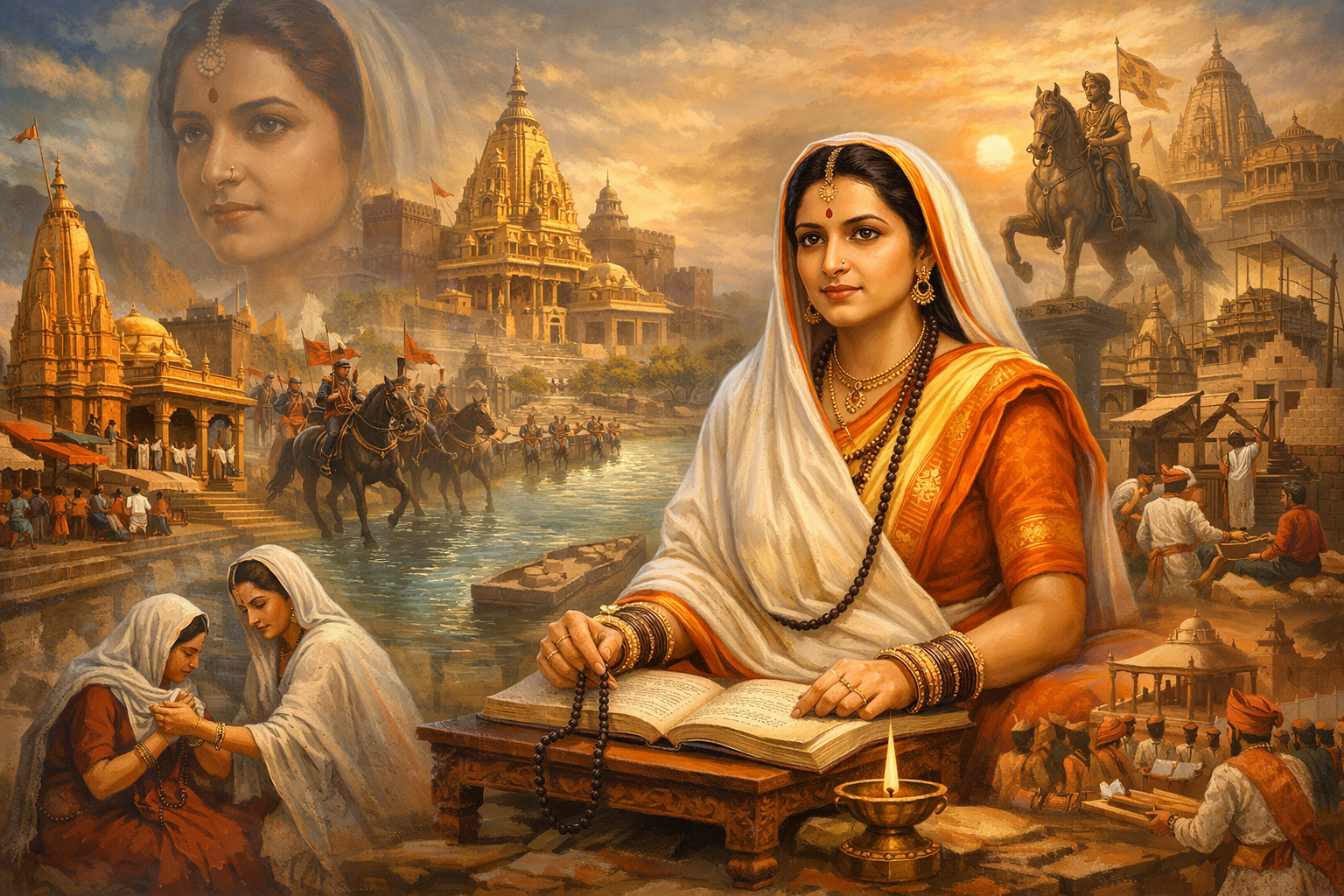
Thank you for reading this post, don’t forget to subscribe!In the long and complex history of India, few rulers combined moral authority, administrative excellence, social reform, and spiritual devotion as seamlessly as Rani Ahilyabai Holkar (1725–1795). Often described as a “Rajrishi in a woman’s body”, Ahilyabai was not merely a queen but a civilizational caretaker, who ruled with empathy, rebuilt sacred geography, empowered society, and upheld justice without tyranny.
At a time when monarchy was synonymous with conquest and opulence, Ahilyabai’s reign stood apart—defined by restraint, welfare, reconstruction, and reform. Her legacy continues to resonate in India’s temples, ghats, trade routes, and administrative ideals.
Early Life and Background
Ahilyabai was born on 31 May 1725 in Chaundi village, present-day Maharashtra, to Mankoji Shinde, a humble village patil. Unlike royal children, Ahilyabai grew up in a rural environment where she imbibed simplicity, devotion, and moral discipline.
Her life changed dramatically when Malhar Rao Holkar, the powerful Maratha noble and commander under the Peshwas, noticed her intelligence and piety at a temple. Impressed, he chose her as the bride for his son Khanderao Holkar—a rare instance where merit overshadowed lineage.
Marriage and Early Struggles
Ahilyabai married Khanderao Holkar in 1733 and entered the turbulent world of Maratha politics. However, her personal happiness was short-lived. In 1754, Khanderao was killed in battle during the siege of Kumher.
Widowed at a young age, Ahilyabai faced immense social pressure, including the expectation of sati, which she firmly resisted—marking her first act of quiet reform. Supported by her father-in-law Malhar Rao, she immersed herself in statecraft, administration, and governance.
Her resilience deepened when she later lost:
- Malhar Rao Holkar (1766)
- Her only son Male Rao Holkar (1767)
These successive tragedies would have broken most rulers. Instead, Ahilyabai emerged as a stoic, ethical, and visionary leader.
Accession to the Throne
In 1767, after Male Rao’s death, Ahilyabai took over the reins of the Holkar State of Malwa, ruling from Maheshwar on the banks of the Narmada.
Despite resistance from courtiers and patriarchal norms, she earned legitimacy through:
- Administrative competence
- Moral authority
- Support of the army
- Endorsement by Maratha leadership
Her reign lasted nearly 28 years (1767–1795)—a golden period of stability amid widespread political chaos in India.
Administrative Excellence and Governance
Ahilyabai’s governance model was people-centric and justice-oriented. She personally heard public grievances and ensured swift redressal.
Key Governance Features
- Transparent revenue system with relief during droughts
- Merit-based appointments
- Strict action against corruption
- Judicial fairness, even against state officials
- Protection of farmers, traders, and artisans
Her administration balanced state authority with compassion, a rare feat in feudal India.
Social Reforms and Ethical Rule
Though deeply religious, Ahilyabai was tolerant, inclusive, and reformist.
Major Social Contributions
- Protection of widows and women’s dignity
- Opposition to social exploitation
- Support for education and moral learning
- Patronage to scholars, poets, and philosophers
- Respect for all sects—Shaiva, Vaishnava, Jain, and others
She believed governance must align with Dharma, not coercion.
Reconstruction of India’s Sacred Geography
Ahilyabai Holkar is often remembered as India’s greatest temple-builder, but her work went far beyond architecture—it was civilizational reconstruction after centuries of invasions and neglect.
Major Reconstruction Works
She rebuilt or renovated:
- Kashi Vishwanath Temple, Varanasi
- Somnath Temple, Gujarat
- Mahakaleshwar Temple, Ujjain
- Trimbakeshwar, Nashik
- Rameswaram
- Gaya Vishnupad Temple
- Dwarka
- Ayodhya
- Mathura
- Haridwar Ghats
She also constructed:
- Dharmashalas
- Ghats
- Wells
- Roads and rest houses
These projects strengthened pilgrimage networks, local economies, and cultural unity across India.
Economic and Trade Reforms
Ahilyabai encouraged:
- Safe trade routes
- Market regulation
- Artisan welfare
- Agricultural sustainability
Maheshwar became a centre of textile excellence, giving rise to the world-famous Maheshwari sarees, still renowned today.
Military Policy: Peace with Preparedness
Unlike aggressive rulers, Ahilyabai avoided unnecessary wars but maintained a strong defence under commanders like Tukoji Rao Holkar.
Her military doctrine emphasized:
- Territorial protection
- Minimal civilian harm
- Strategic alliances
- Avoidance of expansionist violence
Spiritual Philosophy and Personal Life
Despite being a monarch, Ahilyabai lived like an ascetic:
- Simple clothing
- Minimal luxury
- Daily worship and meditation
- Deep engagement with saints and scholars
She saw herself as a trustee of public welfare, not an absolute ruler.
Death and Legacy
Rani Ahilyabai Holkar passed away on 13 August 1795.
Her legacy is extraordinary:
- Revered as a saint-queen
- Admired by British administrators for her governance
- Celebrated by historians as an ideal ruler
- Remembered by the masses through living institutions
Jawaharlal Nehru called her:
“One of the most remarkable women in history.”
Why Rani Ahilyabai Holkar Matters Today
In an age of governance crises, Ahilyabai’s life offers timeless lessons:
- Ethical leadership
- Women’s empowerment through merit
- Welfare-oriented governance
- Cultural preservation without fanaticism
- Power tempered by humility
She represents the highest moral imagination of Indian statecraft.
Conclusion
Rani Ahilyabai Holkar was not just a ruler of Malwa—she was a custodian of India’s soul. Through reform, reconstruction, compassion, and courage, she transformed personal tragedy into public service and left behind a legacy that still shapes India’s cultural and moral landscape.
Her life reminds us that true power lies not in conquest, but in service.
Leave a Reply