Introduction
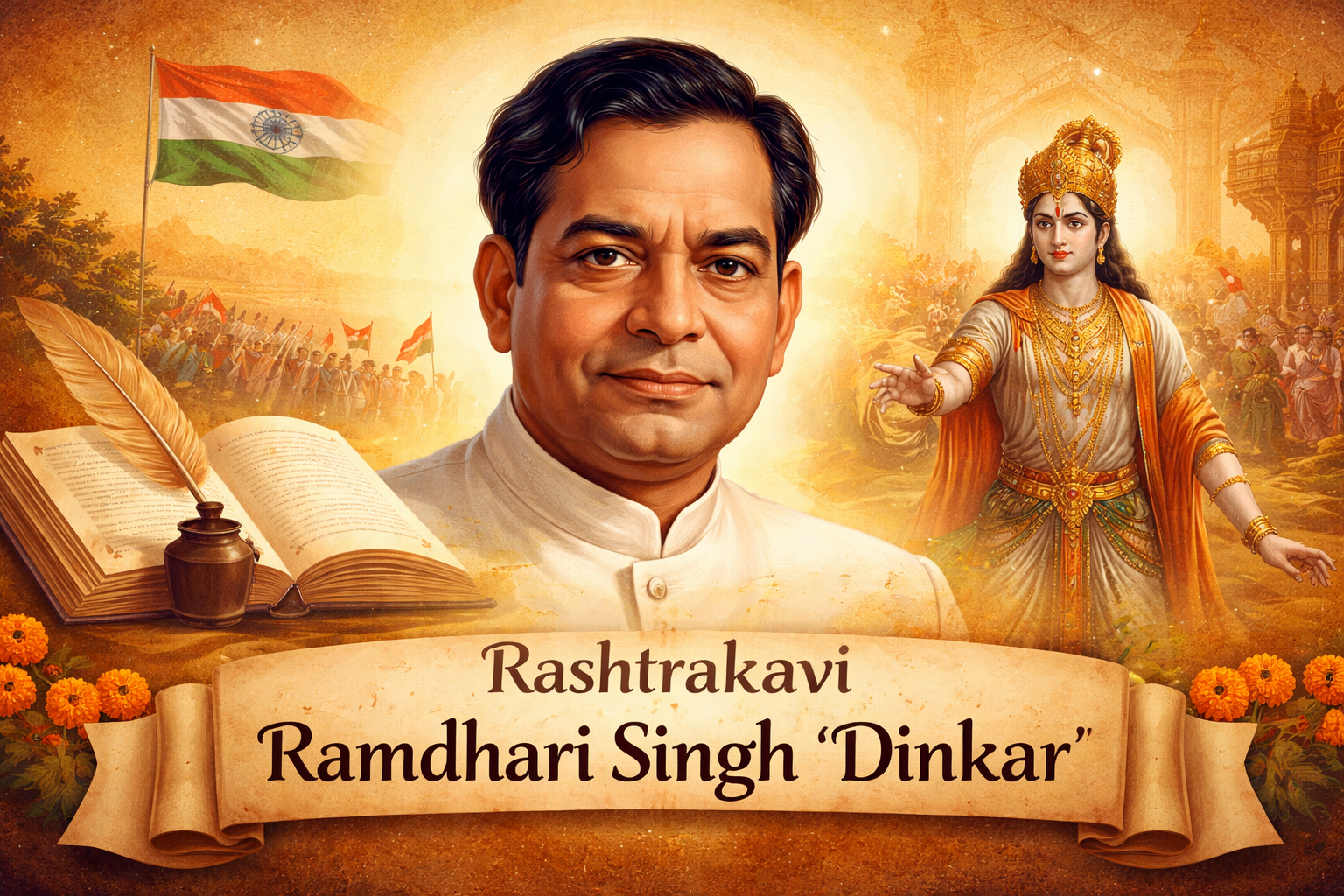
Thank you for reading this post, don’t forget to subscribe!Ramdhari Singh ‘Dinkar’ stands among the tallest pillars of modern Hindi literature. Revered as “Rashtrakavi” (National Poet), Dinkar was not merely a poet of words, but a poet of national awakening, resistance, cultural pride, and moral courage. His poetry ignited the spirit of freedom during colonial rule and later shaped India’s ethical and civilizational discourse in the post-independence era.
Dinkar’s verses blended Veer Rasa (heroism) with philosophy, social justice, nationalism, and humanism, making him the poetic conscience of modern India.
Early Life and Biography
- Full Name: Ramdhari Singh
- Pen Name: Dinkar
- Born: 23 September 1908
- Birthplace: Simaria village, Begusarai district, Bihar
- Died: 24 April 1974
Born into a modest Bhumihar Brahmin family, Dinkar lost his father at an early age. Poverty and struggle marked his childhood, but these hardships shaped his deep sensitivity toward injustice, exploitation, and national humiliation under British rule.
He completed his education at Patna University, where he studied history, philosophy, and literature—disciplines that later deeply influenced his poetic vision.
Struggle and Formative Influences
Dinkar grew up during:
- British colonial oppression
- The rise of the Indian freedom movement
- Gandhian mass movements and revolutionary nationalism
Although inspired by Mahatma Gandhi, Dinkar’s temperament was closer to Tilak, Aurobindo, and Subhas Chandra Bose—assertive, fearless, and uncompromising when it came to national dignity.
His poetry became a weapon of resistance, awakening self-respect and courage among Indians.
Why Ramdhari Singh Dinkar is Called “Rashtrakavi”
Dinkar earned the title Rashtrakavi not by official decree, but by public acceptance because:
- His poetry voiced India’s collective aspirations
- He revived Indian epics, symbols, and heroes for modern consciousness
- His works inspired freedom fighters, students, soldiers, and common citizens
- He consistently upheld national unity, integrity, and cultural pride
- His poetry addressed dharma, justice, sacrifice, and resistance
Like Rabindranath Tagore in Bengali, Dinkar became the national voice of Hindi poetry.
Major Literary Works of Ramdhari Singh Dinkar
Poetry Collections
- Rashmirathi
- Kurukshetra
- Urvashi
- Parshuram ki Pratiksha
- Hunkar
- Renuka
- Samdheni
Prose and Essays
- Sanskriti ke Chaar Adhyay
- Rashtriya Sanskriti
- Ardh-Nari Ishwar
‘Rashmirathi’ and the Iconic Poem: “Krishna Ki Chetavani”
Among all his works, “Rashmirathi” stands as Dinkar’s magnum opus. It reinterprets the Mahabharata through the character of Karna, presenting him as a symbol of human tragedy, dignity, and resistance.
One of its most powerful sections is “Krishna Ki Chetavani” (Krishna’s Warning).
Background: Krishna’s Mission to Hastinapur
Before the Mahabharata war, Lord Krishna travels to Hastinapur as a messenger of peace. His demand is simple—not the kingdom, not power, but justice.
The Pandavas ask only for five villages to avoid bloodshed.
This moment symbolizes:
- Moral compromise vs. ego
- Dharma vs. arrogance
- Peace vs. war
The Famous Stanza: Call for Justice and Peace
Dinkar immortalized this episode with thunderous clarity:
“दे दो हमें पाँच ग्राम,
रखो अपनी धरती तमाम।
हम वहीं खुशी से खाएँगे,
परिजन पर असि न उठाएँगे।”
Meaning:
Give us just five villages; keep the rest of your land.
We shall live contentedly there and shall not raise weapons against our kin.
But when peace is denied, Krishna’s tone transforms from conciliatory to resolute—a warning that war becomes inevitable when justice is rejected.
From Peace to Resistance: Moral Philosophy in Dinkar’s Poetry
Dinkar makes it clear:
- Peace is noble
- Compromise is virtuous
- But surrender to injustice is a sin
Krishna’s warning becomes a metaphor for:
- Colonial arrogance during British rule
- Authoritarianism and moral decay in any age
This poem inspired generations to understand that national unity and peace must stand on justice, not fear.
Role of Dinkar’s Poetry in National Unity and Awareness
Dinkar’s poetry played a decisive role in:
1. Freedom Movement
His early poems like Hunkar ignited revolutionary zeal among youth.
2. Cultural Nationalism
By reinterpreting the Mahabharata, Ramayana, and Vedic ideals, he rooted nationalism in Indian civilization, not borrowed ideologies.
3. Social Justice
He wrote against:
- Caste arrogance
- Gender inequality
- Economic exploitation
4. Post-Independence Moral Guidance
Works like Kurukshetra questioned:
- Violence
- Power politics
- Ethical responsibility of the state
Achievements and Honors
- Padma Bhushan (1959)
- Sahitya Akademi Award for Sanskriti ke Chaar Adhyay
- Jnanpith Award (1972) for Urvashi
- Member of Rajya Sabha (1952–1964)
Legacy and Relevance Today
Even today, Dinkar remains profoundly relevant:
- In debates on nationalism vs. morality
- In discussions on peace, power, and justice
- In awakening cultural self-confidence among Indians
His poetry reminds us:
A nation survives not by silence, but by conscience.
Conclusion
Ramdhari Singh ‘Dinkar’ was not just a poet—he was a national teacher, a cultural guardian, and a moral sentinel of India. His words continue to echo wherever justice is denied, dignity is threatened, or the nation’s soul is tested.
To read Dinkar is to understand India’s past, its struggle, and its eternal quest for dharma.
Leave a Reply