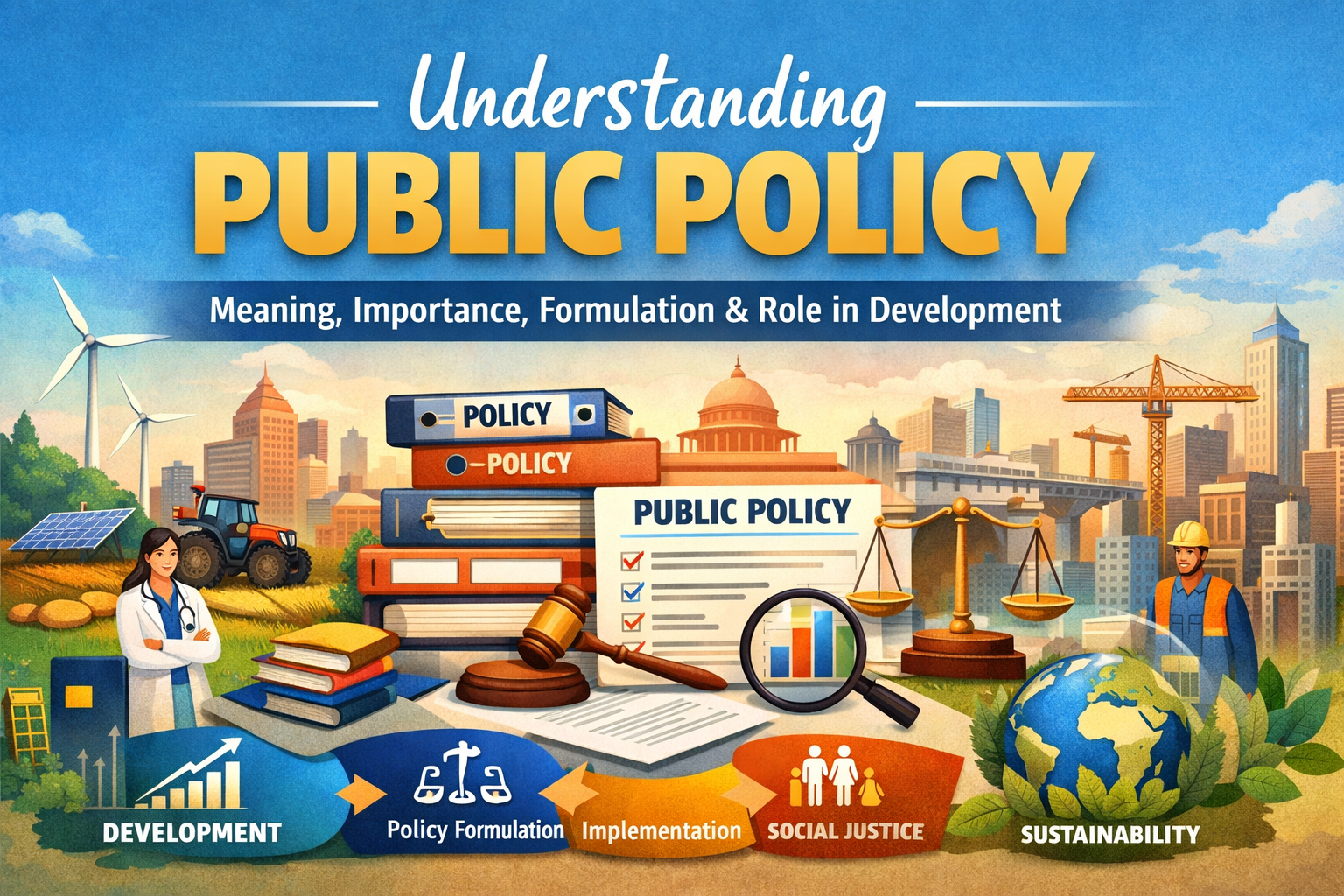
Introduction
Thank you for reading this post, don’t forget to subscribe!Every visible outcome of governance—education systems, healthcare services, infrastructure, climate action, poverty alleviation, or digital transformation—is shaped by public policy. While the term “policy” is frequently used, its depth, scope, and transformative power are often underestimated. Public policy is not merely a government decision; it is a structured response to public problems, anchored in constitutional values, socio-economic realities, and development priorities.
This blog explores what policy and public policy mean, why public policy is critical, how it is formulated, the criteria for sound policy-making, its role in development, key policy domains, and its indispensable role in monitoring and evaluation (M&E).
What is Policy?
A policy is a deliberate course of action or inaction adopted by an authority to address a specific issue or achieve defined objectives. It provides:
- Direction and intent
- A framework for decision-making
- Consistency in action
Policies can exist at multiple levels—organizational, sectoral, national, or international—and may be formal (written) or informal (conventions and practices).
What is Public Policy?
Public policy refers to decisions, actions, and strategies adopted by governments and public authorities to address collective societal issues. According to Thomas Dye, public policy is “whatever governments choose to do or not to do.”
Public policy includes:
- Laws and legislation
- Government programmes and schemes
- Regulations and guidelines
- Budgetary allocations
- Institutional reforms
In India, public policy is guided by:
- The Constitution of India
- Directive Principles of State Policy (DPSPs)
- Democratic accountability and public interest
Why is Public Policy Important?
Public policy is the backbone of governance and development. Its importance lies in the following:
1. Problem-Solving Mechanism
Public policy addresses market failures, social inequalities, environmental degradation, and governance gaps.
2. Instrument of Social Justice
Policies promote equity through affirmative action, welfare schemes, and inclusive growth strategies.
3. Resource Allocation
Public policy determines who gets what, when, and how, especially in limited-resource contexts.
4. Stability and Predictability
Well-designed policies ensure continuity, reduce arbitrariness, and build public trust.
5. Economic and Human Development
Policies shape growth trajectories, human capital formation, and innovation ecosystems.
How is Public Policy Formulated? (Policy Cycle)
Public policy formulation is not a one-time act but a dynamic and iterative process, often described as a policy cycle:
1. Problem Identification
Recognition of public issues through data, public demand, media, judiciary, or civil society.
2. Agenda Setting
Prioritization of issues by political leadership and institutions (e.g., Parliament, Cabinet, NITI Aayog).
3. Policy Formulation
Designing policy alternatives through:
- Evidence and research
- Expert committees and think tanks
- Stakeholder consultations
- Inter-ministerial coordination
4. Policy Adoption
Formal approval through legislation, executive orders, or cabinet decisions.
5. Policy Implementation
Execution by ministries, state governments, district administrations, and implementing agencies.
6. Monitoring and Evaluation (M&E)
Assessment of performance, outcomes, and impact, leading to policy revision or termination.
Criteria for Formulating Sound Public Policy
A robust public policy should meet the following criteria:
1. Relevance
Aligned with real societal needs and development priorities.
2. Equity and Inclusiveness
Benefits should reach marginalized and vulnerable groups.
3. Efficiency
Optimal use of public resources with minimal waste.
4. Effectiveness
Clear linkage between policy objectives, outputs, and outcomes.
5. Feasibility
Administrative, financial, political, and technological viability.
6. Transparency and Accountability
Clear roles, responsibilities, and grievance redressal mechanisms.
7. Sustainability
Long-term economic, social, and environmental sustainability.
8. Evidence-Based
Grounded in data, impact assessments, and global best practices.
How Public Policy Supports Development
Public policy is a central driver of development, acting through:
1. Economic Development
Industrial policy, fiscal policy, trade policy, and MSME support stimulate growth and employment.
2. Human Development
Education, health, nutrition, and skill policies enhance human capital.
3. Social Development
Policies address poverty, gender equality, social protection, and housing.
4. Environmental Sustainability
Climate action, biodiversity conservation, renewable energy, and disaster management policies safeguard the future.
5. Institutional Development
Governance reforms, digital governance, and administrative capacity-building strengthen the state.
Key Domains Where Public Policy is Required
Public policy is required across almost all sectors, including:
- Economic and Fiscal Policy
- Education and Skill Development
- Health and Nutrition
- Agriculture and Rural Development
- Urban Development and Housing
- Environment and Climate Change
- Energy and Infrastructure
- Science, Technology, and Innovation
- Digital Governance and Data Policy
- Social Welfare and Inclusion
- Internal Security and Justice
- Foreign Policy and International Cooperation
Role of Public Policy in Monitoring and Evaluation (M&E)
Yes, public policy plays a critical role in M&E.
How Policy Enables M&E:
- Defines objectives, indicators, and targets
- Establishes institutional mechanisms
- Mandates data collection and reporting
- Enables social audits and third-party evaluations
- Facilitates course correction and policy learning
Modern governance emphasizes:
- Outcome-based budgeting
- Result frameworks
- Real-time dashboards
- Evidence-led decision-making
Thus, M&E is not separate from policy—it is an integral component of the policy ecosystem.
Conclusion
Public policy is the bridge between governance intent and development outcomes. In a complex and rapidly changing world, effective public policy must be adaptive, inclusive, evidence-driven, and accountable. Whether addressing climate change, demographic transitions, or digital transformation, the quality of public policy determines the quality of life of citizens.
In essence, development is not accidental—it is a product of deliberate, well-crafted public policy.
Leave a Reply