What is World Quantum Day?
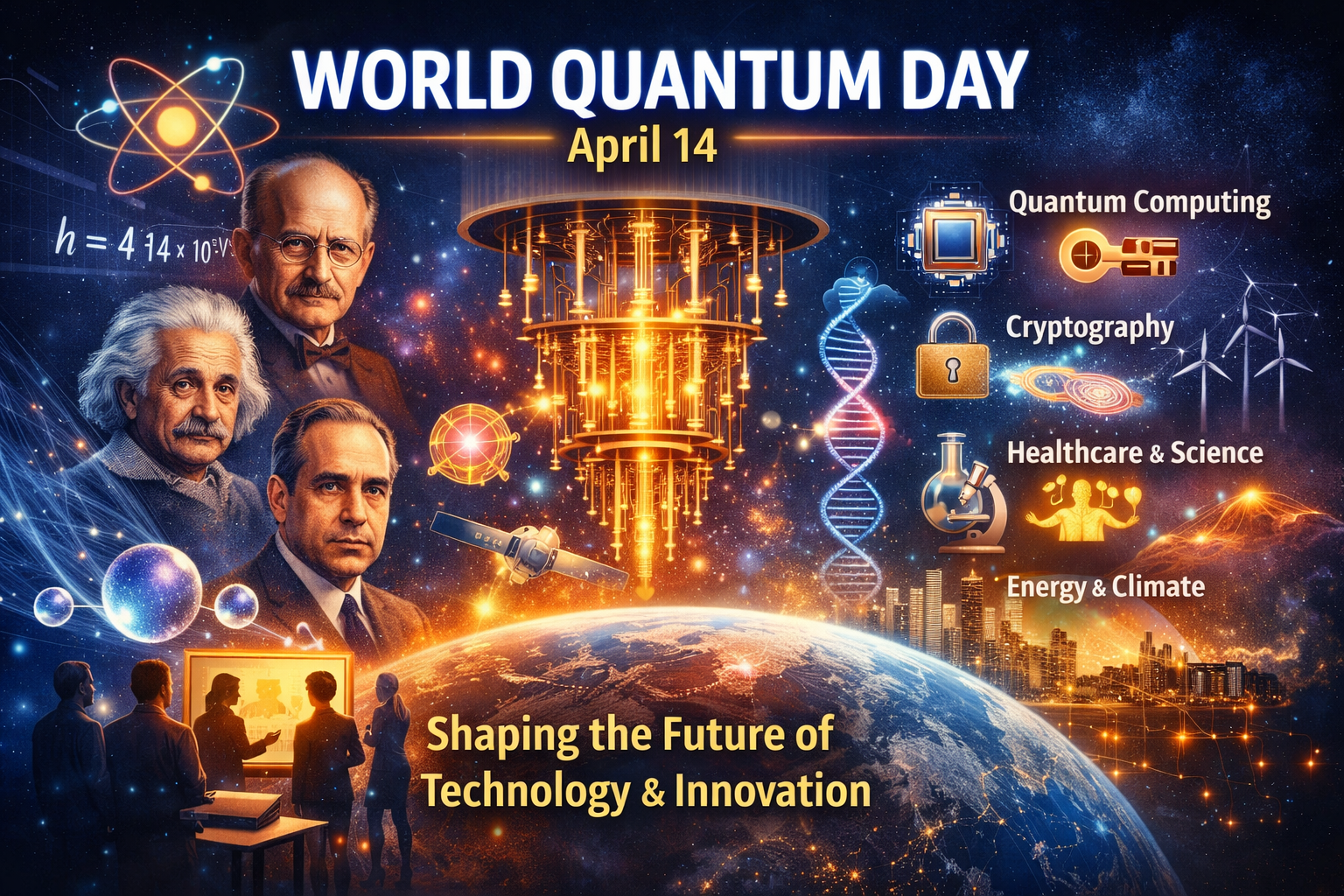
Thank you for reading this post, don’t forget to subscribe!World Quantum Day is celebrated every year on April 14 (4/14) across the globe. The date symbolically represents the first three digits of Planck’s constant (4.14 × 10⁻¹⁵ eV·s)—a fundamental constant in quantum physics discovered by Max Planck.
It is a global initiative aimed at promoting public awareness and understanding of quantum science and technology.
Why is World Quantum Day Important?
World Quantum Day is important because it highlights the role of quantum mechanics, one of the most fundamental branches of Physics, in shaping modern science and technology.
Quantum science underpins many everyday technologies, including:
- Smartphones and semiconductors
- Lasers and MRI machines
- GPS systems
- Emerging quantum technologies like quantum computing and cryptography
Without quantum mechanics, much of today’s technological world would not exist.
Why is it Celebrated?
The day is celebrated to:
- Promote scientific literacy among the general public
- Encourage students and researchers to explore quantum science
- Showcase advances in quantum technology
- Foster global collaboration among scientists and institutions
Events include lectures, workshops, public talks, online campaigns, and educational outreach programs.
Historical Background (Historicity)
Unlike many commemorative days rooted in ancient traditions or major historical events, World Quantum Day is a modern, community-driven initiative.
- It was first observed in 2021
- Initiated by an international group of scientists, educators, and quantum researchers
- Supported by scientific organizations, universities, and institutions worldwide
- Inspired by over a century of developments since the birth of quantum theory in the early 20th century
The foundations of quantum theory were laid by pioneers such as:
- Max Planck (1900: quantum hypothesis)
- Albert Einstein (1905)
- Niels Bohr (1913)
Key Concept Behind the Day: Quantum Mechanics
At the heart of World Quantum Day is the concept of Quantum Mechanics, which studies matter and energy at the smallest scales—atoms and subatomic particles.
Some fundamental ideas include:
- Wave-particle duality
- Quantum superposition
- Quantum entanglement
- Uncertainty principle (introduced by Werner Heisenberg)
These concepts challenge classical intuition and redefine our understanding of reality.
Relevance in Modern Times
World Quantum Day is highly relevant today due to the rapid rise of quantum technologies, which are expected to revolutionize multiple sectors:
1. Quantum Computing
Companies like IBM, Google, and Microsoft are investing heavily in quantum computers that could solve problems beyond the reach of classical computers.
2. Cybersecurity & Cryptography
Quantum encryption promises ultra-secure communication systems, potentially transforming global data security.
3. Healthcare & Drug Discovery
Quantum simulations can accelerate drug discovery and molecular modelling, improving healthcare outcomes.
4. Climate & Energy Solutions
Quantum technologies can optimize energy systems, materials science, and climate modelling.
Global Significance
World Quantum Day also aligns with broader global efforts such as:
- Promoting STEM education
- Strengthening scientific diplomacy
- Encouraging innovation-driven economies
Countries like the United States, China, and India are investing significantly in national quantum missions.
For example, India has launched the National Quantum Mission (NQM) to position itself as a leader in quantum technologies.
Challenges and Concerns
Despite its promise, quantum technology raises several challenges:
- High cost and technical complexity
- Shortage of skilled professionals
- Ethical concerns in quantum computing and encryption
- Potential disruption of current cybersecurity systems
Way Forward
To fully harness the benefits of quantum science:
- Invest in education and research
- Strengthen public-private partnerships
- Promote international collaboration
- Develop ethical and regulatory frameworks
Conclusion
World Quantum Day is not just a celebration of science—it is a recognition of how deeply quantum mechanics shapes our present and future. From powering modern devices to unlocking next-generation technologies, quantum science stands at the frontier of human knowledge.
By celebrating this day, the world acknowledges the importance of scientific curiosity, innovation, and collaboration in addressing global challenges and shaping a technologically advanced future.
Leave a Reply