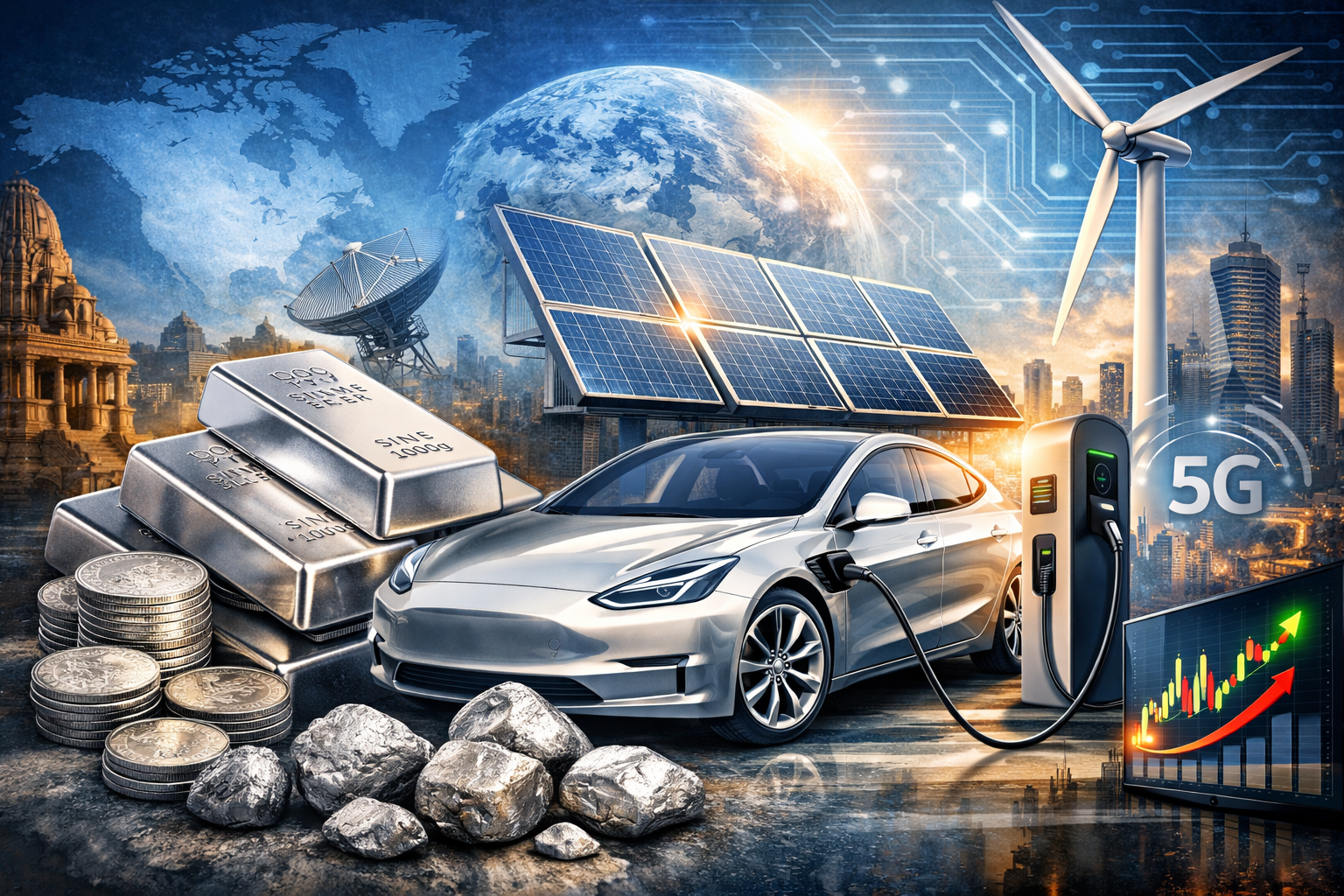
Introduction: Why Silver Still Matters
Thank you for reading this post, don’t forget to subscribe!Silver has occupied a unique position in human history—simultaneously a symbol of wealth, a medium of exchange, and today, a critical industrial metal. While often overshadowed by gold, silver is far more embedded in modern life. From solar panels and electric vehicles to global trade and monetary hedging, silver is no longer just precious—it is strategic.
What Is Silver? Why Is It Considered Precious?
Silver is a naturally occurring metallic element belonging to the transition metals group. Known since antiquity, it has been used in coins, jewellery, ritual objects, and trade across ancient India, Mesopotamia, Greece, Rome, and China.
Silver is considered precious because:
- It is relatively scarce in nature
- It does not corrode easily
- It retains intrinsic value across cultures and centuries
- It has historically functioned as money and store of value
Unlike gold, silver bridges the worlds of luxury and industry, making its demand broader and structurally stronger.
Chemical Identity and Nature of Silver
- Chemical Symbol: Ag (from Latin Argentum)
- Atomic Number: 47
- Atomic Weight: 107.87
- Group: 11 (Transition Metals)
Silver is a pure element, so it does not have a chemical “formula” in elemental form. However, it forms important compounds such as silver nitrate (AgNO₃) and silver chloride (AgCl), widely used in industry and laboratories.
Physical Properties of Silver
Silver is renowned for having the best electrical conductivity of all metals, a property that underpins its modern industrial importance.
| Property | Description |
| Colour | Bright, lustrous white |
| Density | ~10.49 g/cm³ |
| Melting Point | ~961.8°C |
| Electrical Conductivity | Highest among all metals |
| Thermal Conductivity | Extremely high |
| Malleability | Highly malleable and ductile |
These properties make silver indispensable in high-precision and high-efficiency technologies.
Chemical Properties of Silver
Silver is chemically stable but not inert.
- It does not oxidise easily in air
- It tarnishes when exposed to sulphur compounds, forming silver sulphide
- It reacts with nitric acid and some oxidising agents
- It typically shows a +1 oxidation state
This balance of stability and reactivity makes silver durable yet chemically useful.
How Has the Value of Silver Changed Over Time?
Silver prices have shown long-term appreciation with periodic volatility.
Long-Term Trends
- In the early 2000s, silver was relatively undervalued
- The 2010s saw increased investment and industrial demand
- Post-2020, silver prices surged due to inflation fears, energy transition, and supply constraints
- By 2025, silver reached historic highs in India, crossing ₹2.3 lakh per kg at peak levels
India vs Global Market
- Indian prices reflect global rates plus import duties and rupee-dollar movements
- Globally, silver is priced in USD per ounce and is sensitive to US interest rates and commodity cycles
Silver Price Growth Over Time
1. Silver Price in India (₹ per kg)
| Year | Silver Price (₹ / kg) |
| 2000 | 7,900 |
| 2005 | 10,675 |
| 2010 | 27,255 |
| 2015 | 37,825 |
| 2020 | 63,435 |
| 2021 | 62,572 |
| 2022 | 55,100 |
| 2023 | 78,600 |
| 2024 | 95,700 |
| 2025 (Sep) | 1,30,000 |
| 2025 (Dec) | ~2,09,000 |
Source: Forbes India
Over 25 years, silver in India went from ₹7,900/kg in 2000 to over ₹2,09,000/kg by late 2025—a more than 26× increase.
In 2025, global silver prices spiked to levels above $75 per ounce, roughly 3× the early decade price and far above early 2000s levels.
Why Is Silver a “Hot Cake” in Recent Years?
Silver’s renewed popularity is driven by structural, not speculative, factors:
1. Clean Energy Transition
Solar panels require silver paste for electrical conduction. With renewable energy expansion worldwide, demand has surged.
2. Electric Vehicles (EVs)
EVs use significantly more silver than conventional vehicles due to:
- Power electronics
- Battery management systems
- Charging infrastructure
3. Inflation and Monetary Uncertainty
Silver acts as a hedge against inflation and currency depreciation, especially for retail investors.
4. Limited Supply Flexibility
Most silver is mined as a by-product of copper, zinc, or gold—meaning supply cannot quickly respond to rising demand.
Role of Silver in EVs, Industry, and Business
Electric Vehicles
Each electric vehicle uses 25–50 grams or more of silver, depending on design and electronics.
Renewable Energy
Silver is irreplaceable in photovoltaic cells due to its unmatched conductivity.
Electronics and Digital Economy
Used in:
- Circuit boards
- High-frequency switches
- Data centres
- 5G infrastructure
- Medical devices
Silver is not just valuable—it is technologically indispensable.
Silver in Global Trade and Economy
Silver is traded globally as:
- Physical bullion
- Industrial input
- Financial asset (ETFs, futures, derivatives)
Major producers include:
- Mexico
- China
- Peru
- Poland
- Bolivia
India is a major consumer and importer, driven by jewellery, industry, and investment demand.
Global Silver Reserves: Who Holds the Most?
Top silver reserve-holding countries include:
- Peru
- Australia
- Russia
- China
- Poland
These reserves give countries strategic leverage in future clean-energy and electronics supply chains.
Geopolitical Importance of Silver
Silver is increasingly viewed as a strategic mineral because:
- It supports national clean-energy goals
- It underpins advanced manufacturing
- It reduces dependence on fragile supply chains
- It contributes to economic and technological sovereignty
As nations compete for control over energy transition materials, silver’s geopolitical relevance is rising steadily.
Conclusion: The Future of Silver
Silver’s journey—from ancient coins to electric vehicles—reflects humanity’s technological evolution. It is no longer merely a precious metal locked in vaults or ornaments. Silver is now a critical bridge between finance, technology, and sustainability.
In the decades ahead, silver’s importance is set to grow—not just in value, but in strategic relevance to the global economy.
Leave a Reply